Indigenous Wisdom of the Hopi Mysteries

In Honor of Native American Heritage Day, November 28, 2025

Wars are often caused by fear. Even when conquest is the intent, there is still an element of fear behind it.  In may be deeply buried in the subconscious, but it is there. It’s part of history that the white man has done everything possible to eliminate Indigenous people. This was clearly the intent of the Manifest Destiny era of western expansion of the United States when Native tribes were in the way. Had the tribes united against this invasion, they may have been able to prevail. But infighting among them made unification, even for their survival, impossible.

While given lip service as “sovereign nations” and even recognizing the strength of treaties in the constitution, nonetheless all the original occupants of what is now the United States retained was roughly 56.2 million acres (Bureau of Indian Affairs) which equals 87,800 square miles out of a total of  3.794 million square miles, or about 2.3%.

NationalAtlas.gov map of federa lands and Indian reservations

Those that weren’t killed or forcibly anglicized through brutal boarding schools were driven to these reservations. The definition of a “reservation” in Carl Waldman’s “Encyclopedia of Native American Tribes” states: A tract of land set aside historically by the federal government or state government for Indians. Reservations originally served as a kind of prison for Indians, who were not permitted to leave them. Nowadays, reservations are tribally held lands, protected by the government, where Indians are free to come and go as they choose.

So back to the original premise, before I went off on one of my usual tangents: What were they afraid of?  

I believe they were afraid of their inherent wisdom and connection with the Earth. Rather than belabor the sorry history of this country’s relationship with Indigenous people, let’s skip to the present time and the renewed attention to Hopi Prophesies concerning the end of the 4th world.

In her book, “Star Ancestors: Extraterrestrial Contact in the Native American Tradition,” Nancy Redstar states: Spiritual wisdom keepers around the world have recognized signs that were predicted by the ancient prophecies. These signs have signified the Time Keepers that they must now speak their closely held sacred knowledge concerning our origin from the stars; the influence of visitation on the formation of culture, tradition, and ceremony; and the imminent return of our Star Guardians.

The following video explains much of what the Hopi prophesy contains and definitely worth listening for 23 minutes.

Whether or not December 2025 is the turning point as implied by the video is a moot point. Timing in prophesy is difficult, but knowing what to look for is helpful– “Signs in the heavens,” if you will.

 Speaking of which, it’s interest to note that astrologically there are numerous changes occurring amongst the planets that likewise bode toward major change. The outer planets move slowly and they are all in the process of changing their zodiacal sign. It has been said that such a condition in the heavens has not been seen for 10,000 years.

Being a bit longer than western civilization has endured leaves us woefully ignorant of what happened back then.

Cover of Nancy Redstar's book "Star Ancestors: Extraterrestrial Contact in the Native American Tradition

This statement from Chief Dan Katchongva of the Sun Clan Hopi Sovereign Nation, (also found in Redstar’s book) explains why we might want to pay attention to the Hopi: The Hopi were survivors of another world that was destroyed. Therefore, Hopi were here first and made four migrations–North, South, East, and West–claiming all the land for the Great Spirit, as commanded by Massau, and for the True White Brother who will bring on Purification Day.

Others are not as confident as the video’s narrator that this transition will proceed peacefully. Thomas Benyaca states in Redstar’s book: Then you people must understand that the only way we can slow the cleansing and its terrible disasters is for the uniting of the Indian people to occur first.

This statement makes me smile as the author with Pete Risingsun of the Curse of Dead Horse Canyon Trilogy. The final volume of the saga depicts that very thing, unification of Native people, as they arrive on the cusp of prophesy. If you’re curious about a fictitious rendition of various Native American prophesies you would probably enjoy the story. While you may be tempted to skip to the third book, and if you’re really impatient, to the last chapter or so, reading the entire saga starting with the first book is highly recommended. Context is important regarding what precipitated the end result, which will also enhance your reading enjoyment. Let’s just say that a corrupt government gets what it deserves.

Troy Lang, another Native American quoted by Redstar, wisely states: The White race can choose two paths–the Black Road of Destruction or the Red Road of Spirit. The sacred circle cannot be complete as long as one of the race colors thinks it is the boss of all the colors.

Interesting times are on the way. The epilogue of “The Revenge of Dead Horse Canyon: Sweet Medicine Spirits” occurs on Native American Heritage Day. Maybe one in the future will see similar circumstances.

To quote the conclusion of the video, “Some truths open only when we’re ready to see them.”

I believe there are many people out there of all colors who are ready.
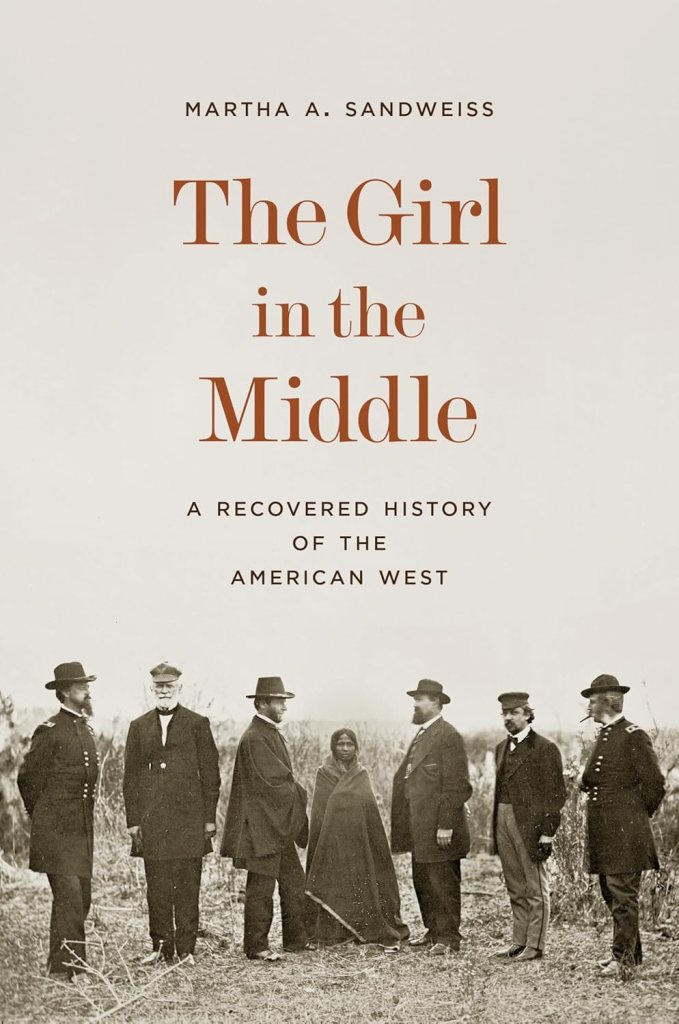
Exploring the Untold Stories of the 19th Century Peace Commission

Review of “The Girl in the Middle: A Recovered History of the American West” by Martha Sandweiss

A magnificent must-read for aficionados of the West’s colorful history

When I saw this book’s haunting cover, I knew I had to find out what was inside. I’m astounded by the wealth of research done by the author and what she uncovered, revealing who and what those six men were as well why they were gathered at that place and time. Sandweiss includes the photographer and even succeeds in identifying the lone Native American girl, whose name was not included in the photo’s caption.

Be aware that every incident included in the text is documented in fifty-seven pages of “Notes.”

Wow.

What an incredible quest! One accomplished through scrutinizing government records of official actions, census records, newspaper articles, wills, land records, and personal interviews with the progeny of those involved.

The men in the photo are General William S. Harney; Senator John B. Henderson; John B. Sanborn; Samuel F. Tappan;  Nathaniel G. Taylor; Alfred Howe Terry. The photographer is Alexander Gardner, famous for his documentation of the Civil War as well as portraits of President Abraham Lincoln, General William T. Sherman, and other dignitaries. The girl is Sophie Mousseau.

Looking at it journalistically, let’s use the standard who, what, when, where, and why.

Who: The men are members of the federal Peace Commission.

What: Meet with a multitude of Native American tribes.

When: It’s 1868, the nation still recovering from the Civil War.

Where: Fort Laramie, Wyoming Territory

Why:  To work out treaties and agreements with the Native Americans

Not a simple task, to be sure.

Within the pages of this amazing tome lie details not found anywhere else about who each of those men were besides soldiers, politicians and activists. Not their public persona: their angels and demons, opinions, political sway, family, and in some cases, criminal records.

Their negotiations with the various tribes is detailed as well.

This is not some dry, impersonal chronology that makes your eyes glaze over like you encountered in high school. It’s an intimate look at not only these men and the circumstances that brought them there, but a glimpse of the true condition the United States (which was still in the process of forming) and the challenges faced by the government.

Besides the challenge of integrating the slaves freed following the Civil War into society, they had troubles galore related to the settlement of the West and working out agreements with the Native Americans. Don’t forget that the nation was also loaded with immigrants, with everyone trying to find their place in the adolescent nation.

You may have heard of the Sand Creek Massacre and Wounded Knee, but what about Blue Water Creek? If you believe like I do that this land was deliberately stolen from its original inhabitants, (who were not considered citizens until 1924 because they were not born in the United States), you will learn even more of the sordid details.

At least some of the Peace Commissioners (obviously not the military members) were actually pretty objective and fair, acknowledging the many gripes the Native Americans had as legitimate. The report even pointed out conflicting values by stating, “If the lands of the white man are taken, civilization justifies him in resisting the invader. Civilization does more than this: it brands him as a coward and slave if he submits to the wrong.” Conversely, “If the savage resists, civilization, with the ten commandments in one hand and the sword in the other, demands his immediate extermination.” While the commissioners didn’t want Indians to disrupt the settlement of the West, they doubted “the purity and genuineness of that civilization which reaches its ends by falsehood and violence, and dispenses blessings that spring from violated rights.” (p. 159)

I was aware that the Black Hills were very much stolen.  The Fort Laramie Treaty of 1868, which promised the area to the Lakotas in perpetuity, was nullified by the so-called Agreement of 1877 and redrew the boundaries of the Great Sioux Reservation to exclude the Black Hills.

Why? To open it up to white settlement and the pursuit of gold while also ending the military defense of Lakota treaty rights.

Originally, that reservation was around sixty million acres. But the 1877 agreement (signed by only about 10% of Lakota men versus the required 75% according to an 1868 treaty), returned most of the Black Hills to the United States. The new reservation was now slightly less than twenty-two million acres, a 63% reduction.

In 1892 the Lakota began demanding  compensation. Petitions and protests persisted for roughly 60 years until 1980, when the Supreme Court ruled in their favor, stating that the 1877 federal seizure of the land was done in bad faith without the proper consent from the adult men of the tribe. It awarded the tribe $17.1 million in damages, plus interest from 1877, for a total of roughly $106 million.

That may sound as if the issue is resolved. It’s not. The tribe refuses to take the money, which with accruing interest, would now be around $1.5 billion. Why? Some leaders say it would represent relinquishing their claim to the land–a price too high.

Since then the Seven Council Fires of the Great Sioux Nation has resorted to purchasing parcels of land from private ranchers. The Interior Department now hold that land in trust to be governed by the same laws that govern other trust land in Indian Country.” (p. 273)

Did you know the U.S. Government had a program that accepted “Indian Depredation Claims” from people who had suffered property damage from Indian raids and other incidents? Some of those claims took decades to settle, typical of government programs to this day. Some things never change.

So what about the girl, Sophie Mousseau?

It turns out that Sophie was “in the middle” in another respect as well. Her mother was Yellow Woman, a Oglala Lakota. Her father was Magloire Alexis Mousseau, a French Canadian.

Indeed, Sophie went on to marry and have children with two different white husbands. In censuses and other records it was common for individuals to show up as white in one document and native in another.

This was another situation that arose with its own set of complications, the matter of mixed breed individuals who were often not accepted by either culture. Furthermore, there were Indians who behaved like whites, and whites who behaved like Indians. Some of this came about when reservations were broken up via allotment programs, where many stepped in to grab land, which further reduced the size of reservations.

We think the times we live in now are complicated, but this books demonstrates that the 19th Century was loaded with challenges, some of which we still face today.

If you’re a history buff interested in the growing pains of the American West, many of which still remain as various aches and pains, I cannot recommend this book highly enough. Maybe the detail will be too much for some, but getting to know the people in this iconic photo brings it to life like never before. It was heartening to find out that the Peace Commission did recognize many of the injustices perpetrated against Native People. However, Congress didn’t agree and thus ignored its recommendations as they pleased.

As stated before, Pete Risingsun and I did a lot of research writing the Dead Horse Canyon Saga, but it was nothing compared to what was done to create this amazing book. You can find it on Amazon here.

Co-Author Matchmaking

Have you ever wondered how Pete Risingsun, a Northern Cheyenne elder living on the tribe’s reservation in southeastern Montana, and Marcha Fox, a science fiction author living in Texas, became coauthors? If so, you’ll want to read the article published by the staff of Soaring Eagle, the charitable organization that supports the Heritage Living Center for Northern Cheyenne elders where Pete resides. You can find it in the Spring edition on their website here. That organization was key to facilitating this incredible partnership that has produced three award-winning novels over the past five years.

Pete and Marcha have never met face-to-face and he does not even have a computer! Phone calls, texting, and snail mail were the vehicles used to communicate, collaborate, and produce over 1400 pages of an incredible three-volume story.

The response to the article was great, as shown by a significant increase in book sales. Of particular interest was a letter, which you can see below, that was sent to Soaring Eagle by a woman who read the newsletter and as a result purchased and read the three books.

The biggest challenge for most authors, especially those that are self-published, is finding their audience. The Dead Horse Canyon Saga is unique, making this even more difficult since it doesn’t fit a single genre. However, with multiple story themes including a government conspiracy, murder, a detailed glimpse at Cheyenne history and ceremony, deep bonds of family and friendship, to say nothing of Charlie Littlewolf’s transformational journey back to his roots, there is something for everyone.

So far the three volumes have captured a total of 13 awards. This includes 5-stars and glowing reviews from Readers’ Favorite for each book, along with prestigious Book Excellence Awards.

Fans of the Longmire series (Craig Johnson’s books as well as the TV series) or the Leaphorn and Chee stories by Tony Hillerman and continued by his daughter, Anne, (novels and the Dark Winds TV series) are likely to enjoy these books. Dead Horse Canyon takes an even deeper dive into native culture and history with characters the reviewer from The Book Commentary described as “lovable,” while an Amazon reviewer of the third book described them as “Characters you will fall in love with. Characters you will fantasize horrible death wishes for with fingers crossed. And sleepless nights as you read it.

It’s been said, “Do not to judge a book by its cover.” Just in case this is an issue, new covers are coming the end of June! Stay tuned!

You can find the books on Amazon here.

Did I Channel this Trilogy?

Okay, folks. Here’s the deal.

Pete Risingsun, my coauthor, and I did a vast amount of research when we wrote “The Curse of Dead Horse Canyon” trilogy. The depiction of the Cheyenne culture is accurate. The history referred to in the stories really happened, save that which was clearly made-up, though even that was feasible. Abandoned mines definitely are a pollution issue. The astrology is actual for the time and place and characters involved, which is weird and another blog in itself.

But if there was one thing that was made up it was the source of the conspiracy, i.e., the Pearson Underground Residence Facility (PURF).

Or was it?

My jaw dropped when a friend sent me this article about just that, such a facility on an even grander scale than I have in our novel! Check it out here.

The article in The New York Post linked above opens with the following paragraph, “The federal government has secretly spent trillions building an elaborate network of subterranean ‘cities’ where the rich and powerful can shelter during a ‘near-extinction event,’ a former Bush White House official sensationally claimed.”

Much of its source and, if you’ll excuse the expression “from the horse’s mouth,” can be found in this short video (12 minutes) where Elizabeth Austin Fitts, who served as the assistant secretary of Housing and Urban Development for Housing between 1989 and 1990, talks about it on Tucker Carson’s podcast.

While I knew there were plenty of underground bases (because the History Channel says so, right?) which made PURF credible, I had no idea it was even worse than I imagined!

So if anyone out there thinks that part of the story is a stretch, bear in mind that they have actually spent even more, by several orders of magnitude, than I have noted in the books. We’re talking TRILLIONS whereas in the story it was BILLIONS.

The money probably came from those “magic money machines” the DOGE team found, right? The actual corruption coming out these days makes my fictitious situation pale by comparison.

While Pete and I were writing these books I was amazed by how many actual situations–historical and otherwise–fit perfectly. Particularly, as we researched Cheyenne ceremonies, much came out that drove and further defined the storyline. I didn’t know anything about the Massaum as the Earth Giving Ceremony, the meeting of Indigenous leaders at Walker Lake, Nevada, or any number of other things when I conceived this story. I knew how it would end but I had no idea how.

As I look back, I can’t help but wonder where this story came from? Mine and Pete’s imagination? I may have mentioned this before, but I’m what they call a “pantser,” not a “plotter.” In other words, I write “by the seat of my pants.”

I start with a very general idea/theme in mind. I populate it with characters and turn them loose. I’m more of a scribe than an author making the story up. I simply watch what they do and write it down. My characters repeatedly get themselves into scrapes where I have absolutely no idea how they’ll get out.

But they do. Usually in some way I never dreamed of.

Did I channel these books rather than make them up?

I think most of us can agree there are other dimensions out there. Psychic phenomena are very real and no doubt operate in some other reality beyond what we can currently detect. Did these stories actually take place in one of them?

I had much the same experience while writing the Star Trails Tetralogy, especially in “The Terra Debacle: Prisoners at Area 51″ in developing the science behind a telepathic walking plant.

One of the reasons I love research is all the amazing, serendipitous factoids I uncover that fit and often drive the plot and action. It’s as if the story is already out there, just waiting for some writer’s muse to whisper it in their ear.

I must say, not knowing what will happen makes writing as much fun as reading. I like to think that if it has me in suspense that such will be conveyed to my readers as well.

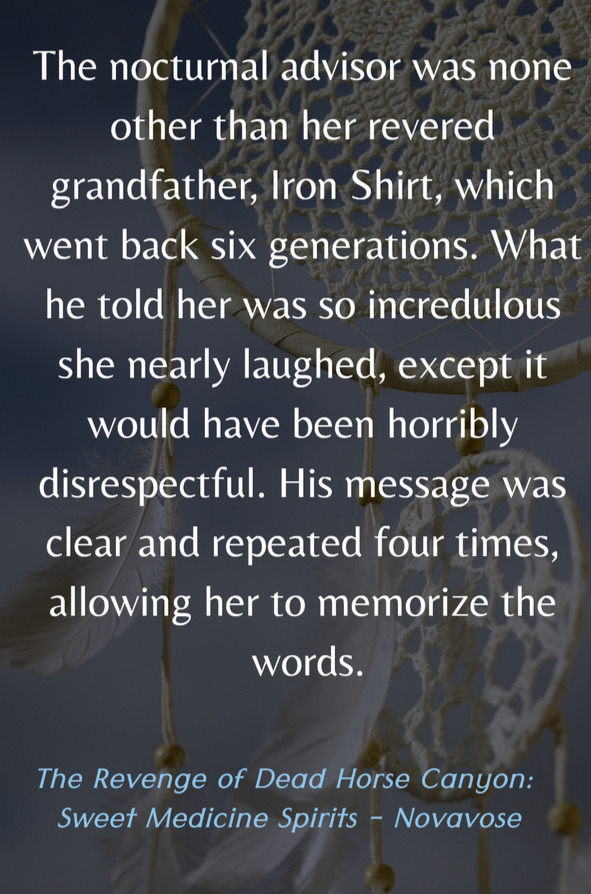
Here’s one teaser from “Revenge of Dead Horse Canyon: Sweet Medicine Spirits – Novavose” where I had absolutely no idea what would happen. The character in question popped up quite late in the book, but she fit perfectly.

If you’d like to get the entire trilogy in a single mega-ebook that also includes some bonus material about that Earth Giving Ceremony, you can pick one up on Amazon here.

Let me know in the comments what you think regarding where stories come from as well as whether you find my stories predictable. Like I say, I know how they’ll end, but rarely if ever know how it comes about.

The Power of Words

The purpose of words is to convey meaning. How they’re spelled, how they sound differs tremendously. Sometimes they convey the same meaning, such as for a cat or dog. Others are unique and can’t be translated into another language, especially if they’re based on cultural context.

When immigrants come to a country, they assimilate better if they learn the host language. This is not simply a matter of getting along better in society. It integrates them into the culture. America became a “melting pot” as immigrants came from a multitude of foreign nations, then were united in a common language, i.e. English, even if they maintained their ethnic traditions.

When Europeans came to the American continent they encountered indigenous peoples whose languages were entirely foreign. While there’s a similarity in etymology and syntax among Latin-based languages (English, Spanish, French, Portuguese, Italian, etc.), those spoken by Native Americans (which were several) had no similarities to European languages. Their culture and society were so different, many words common to Europeans didn’t even exist in theirs and vice versa.

Most of our thoughts comprise words. A person’s vocabulary determines their ability to think and comprehend the world around them. Without applicable words, unfamiliar concepts cannot exist. Emotions, however, exist beyond words. If you see someone laughing or crying, you know they’re feeling something.

Europeans took possession of this country in a less than friendly manner. Eventually, indigenous people became the “Indian Problem.” They refused to cooperate by giving up the land gifted to them by the Creator, a.k.a. Great Spirit. After numerous wars, massacres, and ugly confrontations, those that remained were herded off to reservations. As if that wasn’t bad enough, their children were taken and sent to government boarding schools where they were “reprogrammed.” This comprised cutting their hair, dressing them in “civilized” clothing, and forbidding them from speaking their native tongue. Being caught doing so resulted in their mouth being washing out with soap.

This was not a benevolent gesture to help Native Americans assimilate into European/American society. The intent was to annihilate their culture, identity, and beliefs, an insidious form of virtual genocide. A slight improvement, I suppose, over edicts from the Vatican that gave early explorers and colonists permission to kill them or make them their slaves.

Imagine forcing new immigrants to give up their language and customs. As “guests” in this country, it could almost be justified, a condition of habitation that promotes unity. Instead, just about any document they may need to read is available in their own language at taxpayer expense. Yet, quite the opposite was done to indigenous peoples who were here first.

If you have a difficult time relating to this, consider hoards of Chinese soldiers swarming our borders and forcing us to abandon our way of life, including our language, and adapt to theirs or die.

As intended, indigenous languages began to disappear. Fortunately, some survived. Ironically, helping the current younger generations to learn their native tongue is now a function of the very schools who originally forbade them from speaking it.

Why should they care? Because that is who they are. Culture, ceremonies, and their collective philosophy of life is embedded in their language. They have words with no English analog. Even in English, certain things have different meaning. For example, “All my relations” to a Native American includes all living things as well as the Earth herself. “Turtle Island” is not only this continent, but embodies their creation story.

Why should we care if their culture is lost? Because it’s in the world’s best interest for it to be revitalized. Assimilating it may be the only thing that can save us from ourselves in this war-torn, polluted, technology-dependent world.

This short video (less that 3 minutes) contains the 10 Commandments of Native Americans. As you listen, consider they initially welcomed Europeans to their land. They only became aggressive when the Founding Fathers and those who followed didn’t want to share this country with its original inhabitants.

They wanted them out of their way.

History Books Are Written by the Victors

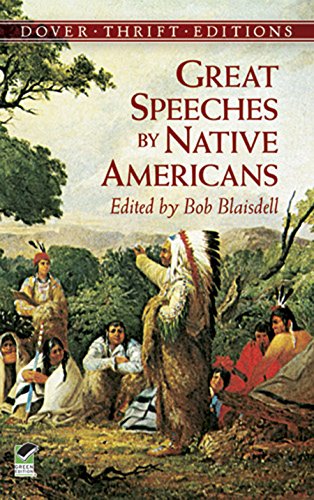
This is the first book I read as research when I started the Dead Horse Canyon series. That was three years ago in January and I have learned so much since then. It opened my eyes to the fact that history books truly are written by the victors, often to justify horrific deeds, vilify the conquered, or pretend they never happened. Every American History book in print should have this one as an appendix, albeit “the rest of the story.” What follows is the review I wrote in January 2019. –MF

Great Speeches by Native Americans

Edited by Bob Blaisdell

Anyone who thinks they know American history needs to read this book. Those who don’t understand why the white men are hated also need to read it. In a nutshell, it’s a testimonial of exploitation, lies, and aggression, which has been the norm on the part of supposed “civilized” nations for millennia. Seeing indigenous people as inferior, savages, and uncivilized based on their lifestyle and thus treating them no better than animals has a sordid and long history.

This book chronicles the treatment of the Indigenous Americans from the first contact by the Pilgrims in the 1600s through the 20th century. The lies and aggression are nothing short of shameful and an embarrassment to any honest person. Those of us who grew up playing “cowboys and Indians” and watching similar TV shows were not seeing things as they really are.

In most cases, the Indigenous Americans only wanted peace. Some had the foresight to see the problems that were coming. They saw the land as sacred, given to them by The Great Spirit, and they treated Mother Earth with respect and gratitude. They may not have had the white man’s technology, but their societal norms were often far more advanced than “civilized” nations. The wholesale slaughter and exploitation of these people in the name of Christianity is a national disgrace.

Besides the actual slaughters, their children were often taken away, essentially kidnapped, and sent to boarding schools where their native culture was derided while they were indoctrinated with supposedly white civilization’s values. Their women were often sterilized without their knowledge. There is no doubt the intent was genocide.

If you think things have changed today, think again. Power and control by those with selfish and evil intent still prevails. Corporate power subdues the rights of individuals. Nothing has changed.

I cried more reading this book than any novel. It’s a very sad commentary on the foundation of the United States. These Native Americans were highly intelligent, moral individuals. In the vast majority of cases, they were only aggressive when they’d had enough of being lied to and could see the intent was their annihilation.

Read it. More people need their eyes opened to the truth that is our history and how it relates to what’s going on today.

You can pick up a copy on Amazon here.

A Quizzical Glimpse of Native American History

Most people are familiar with the saying “To the victor go the spoils,” which includes writing (or rewriting) history books to justify defeating the enemy.

With that in mind, see how many of the following questions you can answer correctly.


1. True/False King Ferdinand was given permission to kill indigenous people or make them their slaves by the pope.


2. How many tribal nations have a formal nation-to-nation relationship with the U.S. Government?

a. 14

b. 567

c. 173


3. How many federal and state-recognized American Indian reservations are there?

a. 492

b. 39

c. 334


4. How many states have a recognized American Indian reservation?

a. 35

b. 9

c. 17


5. True/False The Founding Fathers were sympathetic toward Native Americans and recognized their rights under the Declaration of Independence.


6. True/False The Declaration of Independence’s statement that “all men are created equal” included Native Americans.


7. What was the reason for the majority of U.S. Government – Indian wars?

a. White settlers occupying Indian land in violation of treaties

b. U.S. Government ignoring existing treaties due to westward expansion.

c. Loss of livelihood and hunting grounds to encroachment by white settlers.

d. All of the above


8. Indian people are categorized by culture and geography. Which of the following are NOT considered culture areas?

a. Arctic, subarctic, Northwest Coast, Plateau

b. Great Basin, California, Southwest, Mesoamerica

c. Great Plains, Northeast, Southeast, Caribbean

d. None of the above


9. In the early 19th Century, Sequoyah, a Cherokee polymath from the Little Tennessee Valley created:

a. A list of treaty violations to present to the U.S. Congress

b. The allotment system to assign land to individuals

c. A syllabary of 86 ornate characters


10. Which of the following places are based on Native American names?

a. Allegheny, Alaska, Adirondack

b. Biloxi, Caddo, Chattanooga

c. Hatteras, Erie, Huron

d. Wyoming, Winnebago, Wichita

e. All of the above


ANSWERS

1. True. The first papal bull issued for King Ferdinand in Spain after Columbus returned from the Caribbean stated: “All people of North America are no better than feral animals and may be slaughtered at will.” 

And that bull was followed by another that accompanied the North American land grants: “All land grants will be governed by the same rules as the land grants in Spain, to which you have been accustomed. Thus, as usual, any people populating your land defined by the land grant here issued are your slaves.”

2. b. 567 tribal nations

3. c. 334 reservations

4. a. 35 states with reservations

5. False. George Washington was known as Town Destroyer in the Seneca language based on the decimated cornfields and razed villages he promoted. Thomas Jefferson as Governor of Virginia, ordered a war of extermination against the Shawnee.

6. Following that “created equal” statement it states “except the inhabitants of our frontiers, the merciless Indian Savages, whose known rule of warfare, is an undistinguished destruction of all ages, sexes, and conditions.

Yes, it really says that. The Natives were accused of being savages for defending their homeland while as one example, at Sand Creek the U.S. Army slaughtered innocent Native Americans who were literally flying the U.S. Flag with a white banner of surrender.

Custer did, indeed, have it coming.

I find it ironic that following WWII the U.S. was more than generous helping to rebuild war zones of former enemies in Germany and Japan, yet few promises made to this country’s original residents have been kept.

7. d. All of the above are reasons for the U.S. – Indian Wars.

The “Manifest Destiny” attitude of America’s early European explorers and subsequent settlers toward the country’s native population was overtly hostile. Land that was virtually stolen, deceptive treaties of which the Indigenous signers were not advised of their true content, and treaties to which both signatories agreed but Congress never ratified are but a part of the sordid tale.

Too many members of the Native population live in substandard conditions with many reservations comparable to a Third World Country and comprise some of the poorest counties in the United States. Yet now the government proposes giving hundreds of thousands of dollars to illegal aliens for being “inconvenienced.”

What’s wrong with this picture?

8. d. None of the above. All represent designated cultural areas.

9. c. A syllabary of 86 characters based on the sound of syllables in the Cherokee language

10. e. All of the above. Hundreds, more likely thousands, of places in the U.S. and Canada retain their Native American names.


SCORES BASED ON NUMBER CORRECT

9 – 10 Cheated or has a college degree in Native American History.

7 – 8 Assumed this was an open-book quiz.

5 – 6 Fan of Longmire series on Netflix.

3 – 4 A few lucky guesses.

0 – 2 Don’t waste your money on lotto tickets.


Swallow your pride and leave your scores below.

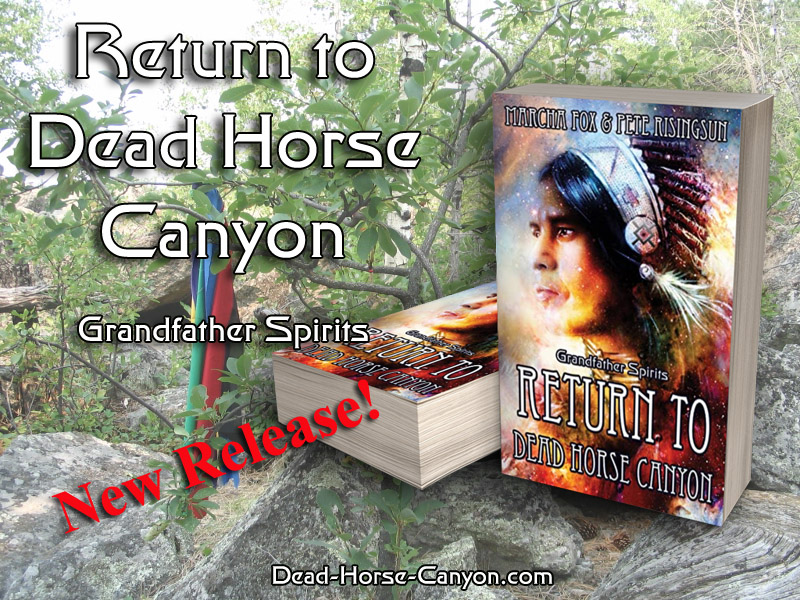
“Return to Dead Horse Canyon: Grandfather Spirits” Now Available!

The suspense-laden sequel to triple award winning “The Curse of Dead Horse Canyon: Cheyenne Spirits” is now available!

In honor of Native American Heritage Month both this new release as well as its predecessor, “The Curse of Dead Horse Canyon: Cheyenne Spirits,” are on sale in ebook format for only $0.99 through November 30, 2021.

If you’ve read the first book, no doubt you’ve been wondering what happens now that Charlie and Sara have discovered what her husband, Bryan, discovered that cost him his life.

While Charlie swore to avenge his white brother’s death, the path to do so remains unclear.

His job with Lone Star Operations allows him to use his college education and earn a generous income. However, it conflicts with everything he knows to be right. Is violating the Earth wrong or not? Little does he realize that his work will ultimately return him to the Northern Cheyenne reservation where his true destiny will manifest in ways he never imagined.

Sara is determined to fulfill Bryan’s last request to expose the government corruption coupled with the lethal forces that stole his life. Releasing the scandalous Top Secret data via WikiLeaks infuriates those with much to lose, which places her in the cross-hairs of a hired killer.

While miles apart, each struggles with life-threatening situations as a result of their dedication to Bryan’s legacy. Their lives remain entangled through a series of fateful decisions and circumstances that define a future fraught with unknowns for them both.

The books are available through the following links with more vendors to follow in the coming days. Remember that reviews are pure gold to authors and help other readers decide on whether a book is right for them.

Book 1:

Amazon Affiliate Link

Barnes and Noble

Google Play

Other eBook Vendors

Book 2

Amazon Affiliate Link

Barnes and Noble

Google Play

Smashwords

When Every Day was Earth Day

Karl Bodmer: Indians hunting the bison. Tableau 31. In: Maximilian zu Wied-Neuwied: Maximilian Prince of Wied’s Travels in the Interior of North America, during the years 1832–1834; published London 1843–1844.

Today is Earth Day, reminding us to honor and appreciate our planet as well as treat her kindly. The concept of doing so only once a year is incomprehensible to Indigenous cultures. Native American reverence for all living things extends to the Earth herself. Taking what you need with respect and gratitude is expected; exploiting her resources for the sake of greed is abhorrent.

Every day was “Earth Day.”

For example, bison (erroneously called buffalo) were revered and respected. They killed only what was needed for food, then used the hide, horns, bones, and sinew for such things as clothing, tipis, and tools. Nothing was wasted. Killing for sport or simply for the animal’s hide (much less its tongue), was unheard of.

Then the white man came.

At the beginning of the 19th century 30 to 40 million bison were present on the Plains. By 1895 their numbers had been reduced to roughly 1,000. Upon completion of the Intercontinental Railroad, they were often shot from moving trains. Hide Hunters moved into Native hunting grounds and slaughtered bison, leaving their rotting carcasses behind.

1892: bison skulls await industrial processing at Michigan Carbon Works in Rogueville (a suburb of Detroit). Bones were processed to be used for glue, fertilizer, dye/tint/ink, or were burned to create “bone char” which was an important component for sugar refining.

In 1873, Army Lt. Col. Richard Irving Dodge stated, “Where there were myriads of buffalo the year before, there were now myriads of carcasses. The air was foul with a sickening stench, and the vast plain which only a short twelve months before teemed with animal life, was a dead, solitary putrid desert.”

Historian, Pekka Hämäläinen, noted the effect this had on Native Americans when she noted, “The buffalo was the foundation of their economy and the centerpiece of their cosmology, and the wholesale slaughter shook their existence at its core.”

Rath & Wright’s buffalo hide yard in 1878, showing 40,000 buffalo hides, Dodge City, Kansas.”

Where might our country be today if it weren’t for such wanton destruction? But the real question is have we learned anything since?

THE STORY OF BRIGHT EYES IS COMING TO THE BIG SCREEN

Many indigenous people from various tribes have fought for their rights, whether on horseback or in the halls of Congress. Among them was a young woman named Bright Eyes, about whom plans are in work to make a feature-length movie.

To quote the producer’s website:

It’s the true story of a shy, young woman of the Omaha Tribe whose love for her people and other Native Americans helped her overcome her fear. So, she spoke out against injustice and helped bring about the landmark court case of Chief Standing Bear vs. General George Crook where a Native American was first regarded as a “person” with legal rights!

Can you believe that it took until 1880 for Native Americans to be considered a “person?”

What’s wrong with this picture? Let’s take a look at the founding documents of the United States penned in 1776. How many times have you heard the following words from The Declaration of Independence ?

“We hold these truths to be self-evident, that all men are created equal, that they are endowed by their Creator with certain unalienable Rights, that among these are Life, Liberty and the pursuit of Happiness.”

“All men?” Really? Obviously that didn’t apply to First Nation peoples.

Did you know that in the early 19th Century slaves were counted as three-fifths of a person for census purposes while indigenous people were not counted at all?

Then there’s the Fourteenth Amendment, ratified July 9, 1868, following the Civil War:

“All persons born or naturalized in the United States, and subject to the jurisdiction thereof, are citizens of the United States and of the State wherein they reside. No State shall make or enforce any law which shall abridge the privileges or immunities of citizens of the United States; or shall any State deprive any person of life, liberty, or property, without due process of law; nor deny to any person within its jurisdiction the equal protection of the laws.”

Did this apply to indigenous people? Obviously not.

Instead they were considered savages for fighting for their rights to land on which they were the original occupants. A country that shoved them out of the way, yet states in the Second Amendment to its Constitution, “A well regulated Militia, being necessary to the security of a free State, the right of the people to keep and bear Arms, shall not be infringed.”

And why the Second Amendment? To defend our country from a tyrannical government or foreign invaders!

Sound familiar?

Seems to me that’s what Native Americans were trying to do when all other negotiations with the U.S. Government failed.

If more people understood the true history of how indigenous people were treated it could make a huge difference. As I’ve discovered the truth through research I’ve done writing The Curse of Dead Horse Canyon: Cheyenne Spirits and working with my Northern Cheyenne co-author, Pete Risingsun, I’ve been outraged by the hypocrisy and double standard.

The United States would be a wonderful country if only it followed its own declarations rather than the whims of greedy, powerful individuals who either warp or by-pass the law to their own benefit. And if you think things are improving currently, clearly you don’t understand what’s going on. Why are illegal aliens treated better than our nation’s first people? Everyone who belongs here is losing their rights at an unprecedented rate.

Perhaps it’s a case of “What goes around, comes around.”

I didn’t intend for this blog to turn into a rant, but it’s something I’ve come to feel very strongly about.

Back to Bright Eyes, this wonderful true story about an heroic Native American woman is being made into a feature film. I encourage you to watch the trailer here.

The producers are looking for crowd funding to make it happen. You can help bring this inspiring story to the big screen! Find out more on their website.