THE WORLD OF THE MAIYUN

My method of writing is generally referred to as a “pantser,” i.e., I write by the seat of my pants. The other prevalent writing style that of a “plotter,” where the author determines the entire story, scene by scene, in an outline. I tried plotting, but my characters persistently got out of hand. They’d refuse to follow my plan and do their own thing. It didn’t take long to discover they had a better grip on the story than I did. Thus, I became a “pantser.” I populate my story idea with characters, then sit back to watch what they do as would a dutiful scribe.

I began work on this saga before connecting with my co-author, Pete Risingsun. I had a handle on the story’s government conspiracy angle, but lacked cultural knowledge of my main character, Cheyenne Charlie Littlewolf. I wrote what he told me to, but didn’t know whether it was feasible.

As a science fiction author, I wondered.

Was my imagination getting carried away?

I tend to obsess over accuracy and can get carried away with research. I started reading books on Native American cultures, but I needed to find a Cheyenne elder who could let me know if what I had written from Charlie’s point of view was accurate or too off-the-wall.

When Pete got involved he assured me that the various incidents I’d included were indeed realistic in the Cheyenne world. I smiled, relieved to learn Charlie was not leading me astray.
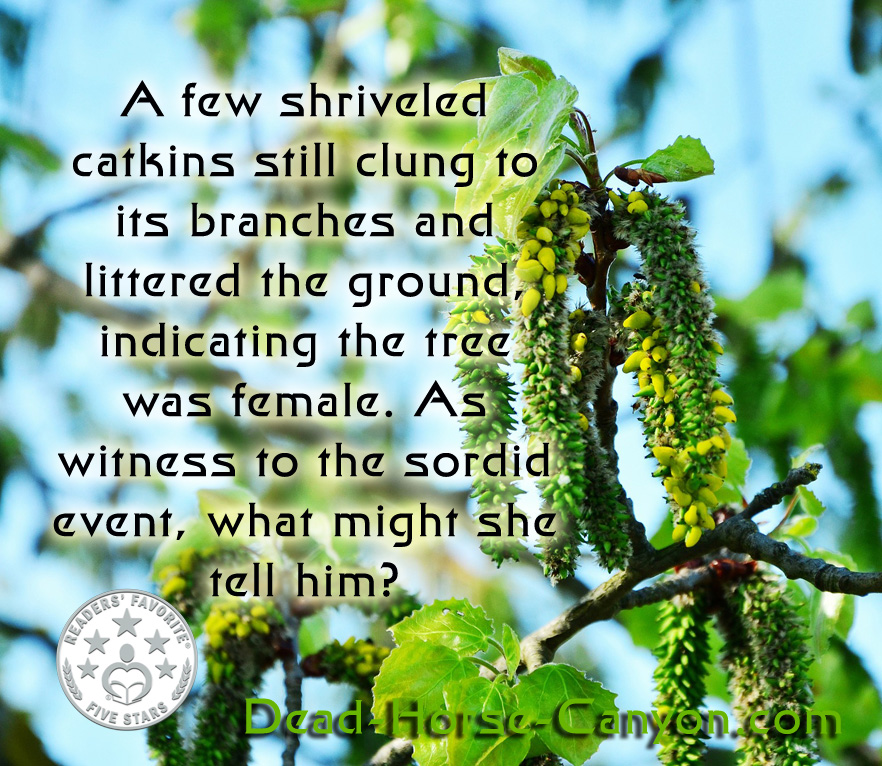
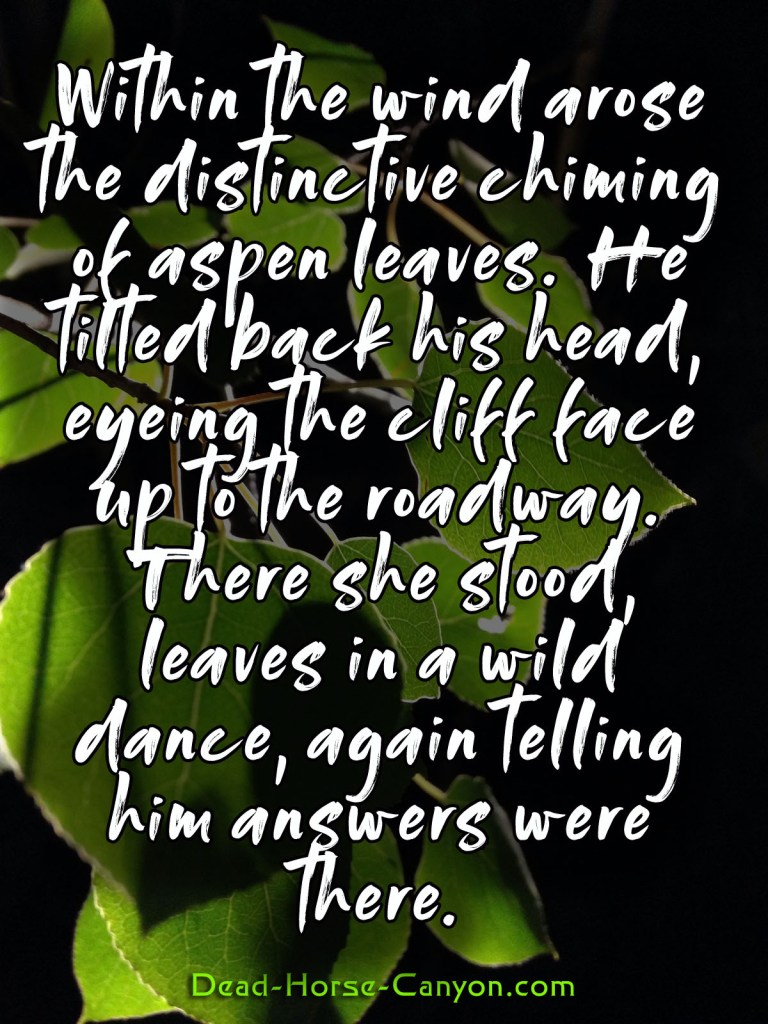
One incident that I wondered about is depicted in chapter six, “The Aspen,” of the first book, “The Curse of Dead Horse Canyon: Cheyenne Spirits.” It’s there that Charlie receives a message from the aspen tree that witnessed the wreck that killed his best friend. Besides numerous others, another one of my favorites is in the second book, “Return to Dead Horse Canyon: Grandfather Spirits,” where in chapter thirty-nine, “Trail Ride,” Charlie finds an ancient arrowhead that tells him and his brother, Winter Hawk, (cousin in western culture), that their prayer regarding the fate of the murderer had been heard.

As work on the saga continued, more and more research came into play. The works of George Bird Grinnell as well as Peter John Powell were excellent sources, but had limitations. I find it ironic that some of the most detailed information on ancient Cheyenne (Tsistsistas) beliefs and ceremonies is conveyed by German anthropologist, Karl H. Schlesier. His book “The Wolves of Heaven” was priceless while writing this trilogy, especially his detailed description of the Massaum, the Earth Giving Ceremony, that plays a key role in the final volume. In a typical episode of serendipity, I found Schlesier’s book on Amazon, attracted by its subtitle, “Cheyenne Shamanism, Ceremonies, and Prehistoric Origins.”

Or was it a maiyun who brought it to my attention?

What is a maiyun?

Schlesier tells us they are powerful spirits that associate with human beings. There are also the hematasoomaeo, which he describes as “the immortal spiritual forms of plants, animals, and human beings. . . .The maiyun most responsible for physical life on earth belong either to the deep earth or to the sky places. In Tsistsistas ceremonies they are celebrated especially and represented through plant and animal forms.”

The lodge of the maiyun is the Sacred Mountain, i.e., Novavose. (You’ll meet plenty of them in “Revenge of Dead Horse Canyon: Sweet Medicine Spirits – Novavose.”)

Why have western religions denied the existence of such things? Claim that animals do not have souls, a belief with which any pet owner, farmer, or rancher will disagree? Slowly the world is awakening to the reality of other dimensions; recognizing the thin veil between life and death and the elusive nature of time.

Things ancient peoples took for granted.

Speaking of animals, a few months ago, my precious 18 year old feline fur baby, Ophelia, crossed over. I hoped that when she did, that she was reunited with her half-brother, Hamlet, who’d left this life four years before. Thus, I was drawn to the “Pets and the Afterlife” book series by Rob Gutro. He’s a medium who specializes in connecting with pets in the spirit world. These books contain dozens of stories of such experiences. The truth of what he envisions is validated by multitudes of grieving pet owners when he provides details of the encounter that he couldn’t possibly have known.

As I read Gutro’s books I couldn’t help but think of the maiyun–spirit helpers that indigenous people have relied on for millennia. What are “civilized” people missing by tuning out these messages and connections?

I am beyond grateful for my introduction to this marvelous world while writing these three tomes with Pete. My heart and mind lived there from July 2018 when this story was conceived until the final book was published in January 2025. My life is enriched beyond measure for the experience.

Two of my favorite quotes related to this lost wisdom were spoken by Tȟašúŋke Witkó (Crazy Horse), the Oglala Lakota Leader who said:

The red nation shall rise again and it shall be a blessing for a sick world; a world filled with broken promises, selfishness and separations; a world longing for light again. I see a time of seven generations when all the colors of mankind will gather under the sacred tree of life and the whole earth will become one circle again. . . In that day, there will be those among the Lakota who will carry knowledge and understanding of unity among all living things and the young white ones will come to those of my people and ask for this wisdom.

The Curse of Dead Horse Canyon Trilogy is a lengthy saga that is more than a juxtaposition of a corrupt government’s clash with Cheyenne spirituality. It’s an introduction to a world too many don’t yet see.

But as Crazy Horse declared, they will.
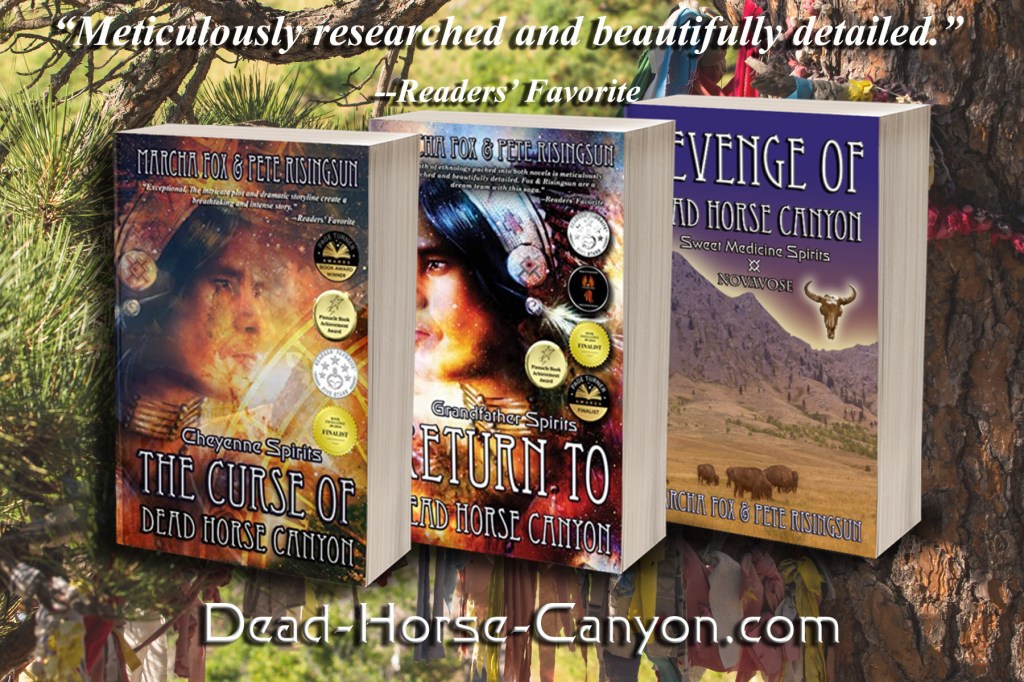
You can find the trilogy on Amazon and other online vendors.

Are you Listening?

If there’s one thing most of us need it’s an occasional sign that we’re heading in the right direction. One thing indigenous people have that most others don’t is a deep connection with nature, which talks to them on a regular basis.

Yes, I’m talking about spirit animals and receiving messages from them.

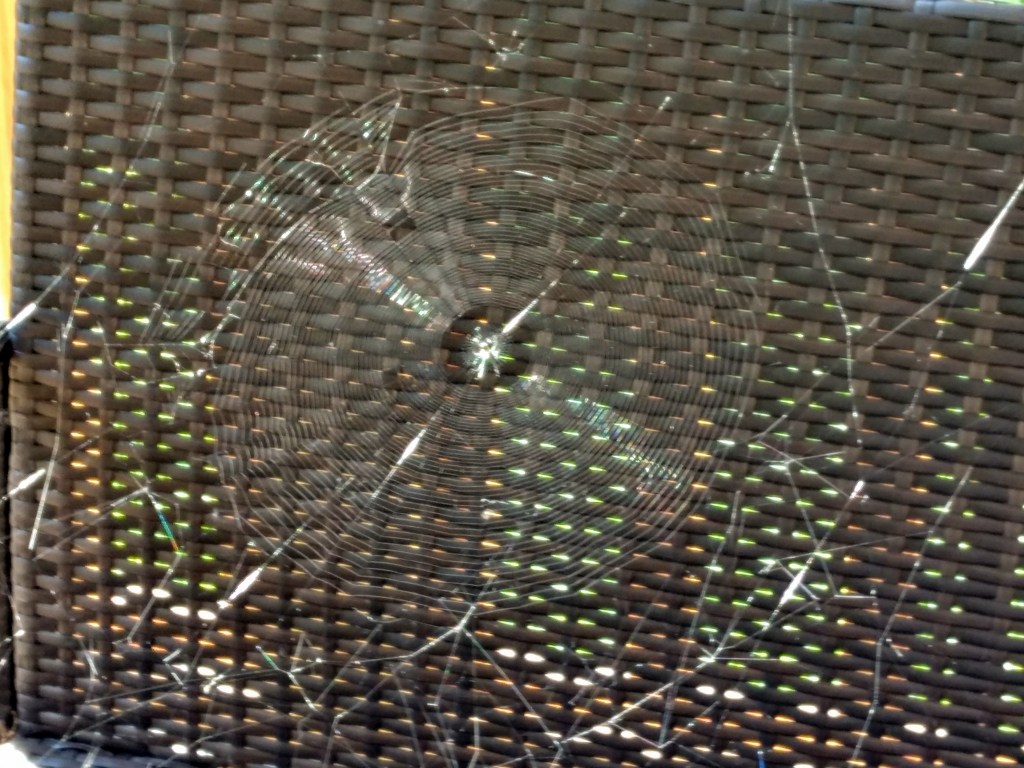
This morning when I went outside to feed my feral cats this beautiful spider web caught my eye. The fact it was on my deck furniture was slightly less than enchanting, but the perfection of the spider’s handiwork got my attention, especially the way it glistened in the rising sun.

In many cases, if you’re paying attention, you can figure out such a message yourself by considering the animal and its characteristics. At other times, it might be more subtle. In that case, you need a reference of some description to help you figure out what the natural world is trying to tell you.

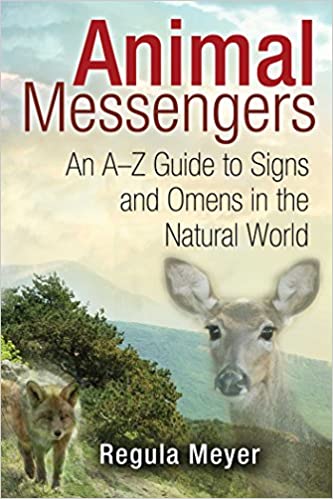
Fortunately, I have such a reference, the book “Animal Messengers: An A – Z Guide to Signs and Omens in the Natural World.”

Here’s a excerpt from what it says about spiders: “The spider symbolizes infinite possibilities. With its eight legs it is anchored in every direction, and it weaves together the powers of the elements and their expression into a unified whole. The spider weaves webs of fate, in which we can get caught, and it encourages us to keep searching for new possibilities and explore the endless steps of our journey of learning. If your attention is drawn to a spider it wants to remind you that you are constantly building new webs with your own thoughts, feelings, actions, and visions that contain tasks you must solve and subjects you must deal with.”

As is always the case with such an encounter, this had a very personal meaning to me.

If you’re not listening to what nature is telling you, you’re missing out. If you need a little help discerning what an animal is trying to say, I highly recommend this book by Regula Meyer. Note that it does not contain exotic animals you might see in a zoo, but concentrates on those you’re likely to see in the wild including mammals, birds, invertebrates, and insects, for a total of 145 different animals. It was originally written in German, so some birds common to the United States such as cardinals are not included, either, but overall it’s very insightful. It’s available at Amazon via this affiliate link.

Panpsychism in Indigenous Cultures

What is he trying to say? (Photo credit Robert C, Pixabay)

Panpsychism.

That’s a big word, isn’t it? I’d bet dollars to donuts most of you have never heard of it before, much less know what it means.

Okay, here’s a hint:

Indigenous people consider panpsychism to be intuitively obvious.

This is something that’s inherent to their culture. It’s a form of spirituality and reverence for life too many in today’s modern world lack.

If you’re still lost, here’s another hint.

If you’re a pet owner, you might know more about this than you realize. Do you believe your fur baby, or even fish or turtle, has a personality? Does that mean it has a soul? Okay, skip the dualism, do you believe it’s conscious? A sentient being?

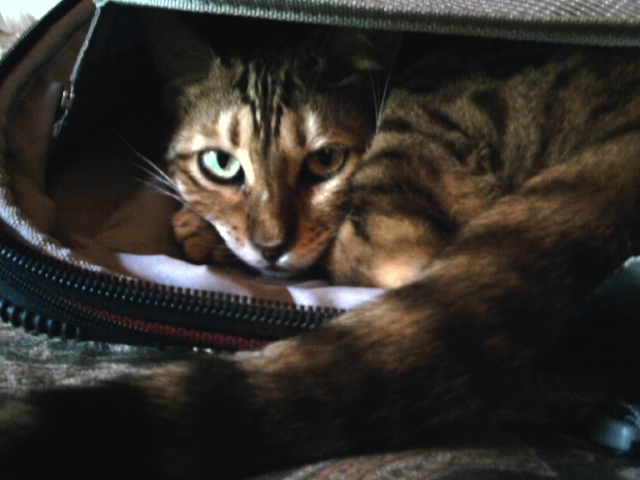
My little suitcase stowaway is no doubt saying, “I want to go with you.”

What about your houseplants and garden, the trees that shade your home? Do you ever talk to them? Provided they’re not made of plastic, there’s no doubt they’re alive. But are they conscious? Some research in recent years suggests they are, even if they’re a bit snobbish about it and only talk to their own kind.

Anyone who’s had their car, computer, cell phone, or some other electronic device go wonky right when they need it most has seen this. Maybe it’s only Google spying on you, in which case you can hope they hear the unpleasant things you’re expressing in your frustration.

If you haven’t figured it out by now, panpsychism is the belief that all things, animate and otherwise, have consciousness. Here’s a quote from an article by Berit Brogaard, D.M.Sci., Ph.D. and graduate student, Kristian Marlow, published in Psychology Today a few years back:

“According to the traditional version of panpsychism, everything around you is conscious: the chair your are sitting on, the rock you use as a doorstopper at home and the thick hurricane-safe windows in your office. Panpsychism literally means that particular kinds of psychological states are embedded in everything…. Consciousness may be a force akin to electromagnetism or gravity that exists in some form on the fundamental level of reality.” (Read the entire article here. )

Indigenous people have known this to be true for thousands of years.

By now Native American readers are rolling on the floor at the stupidity of the white man. No wonder he makes so many bad decisions, he’s out of touch with his world in the most pathetic of ways. Now, at long last, the white man is starting to catch on. Spirit animals are becoming popular as well as sensitivities to other energies as well. The question is whether or not it’s too late.

One of my favorite stories is told by Russell Foureagles when he states, “This may sound crazy, but rocks–especially artifacts manufactured by our ancestors–have occasionally spoken to me and sent me pictures, sometimes even movies, when I picked them up. With the aid of a rock, I have not only seen the past but, in a sense, lived it.” (The Making of a Healer: Teachings of my Oneida Grandmother, p. 195) He goes on to tell a delightful story of a rock calling to him and telling him its amazing story of being part of a hide scraping tool thousands of years before.

Think what you want, but you cannot make this stuff up.

As a writer, I let my characters lead, and they often teach me many things I never could have imagined. I don’t believe as a writer I create their essence, then channel them. One of my favorite parts of “The Curse of Dead Horse Canyon: Cheyenne Spirits” is Chapter 6, “The Aspen,” where Charlie Littlewolf connects with an quaking aspen tree that helps him solve his white brother’s murder. (You can read that excerpt here.) In my science fiction story, “The Terra Debacle: Prisoners at Area 51,” the main character is a telepathic walking plant. I’ve never seen plants quite the same way since.

Okay, you don’t have to be crazy to be an author but it helps.

My point is if we but learn to listen, there are messages all around us. What wisdom might a mighty oak convey? Meditate on a tree sometime and see what you learn. I’ve obtained amazing insights just watching my birdfeeder.

One of the problems of modern life is that we so rarely take time to listen.

What are you missing?

Spirit Animals: Key to Life’s Answers

Excerpt from “The Curse of Dead Horse Canyon: Cheyenne Spirits.”

“The Enlightenment” era did more to stop people from being enlightened than achieve it. True, when Galileo et al succeeded in disproving the solar system is geocentric, that was a good thing. Some things deserve scientific scrutiny. However, even to this day, hundreds of years later, there are phenomena many have experienced to be true while those blinded by science debunk them.

That attitude has done more to destroy faith and spirituality than Darwin’s Theory of Evolution. It took decades before technology advanced enough to prove Einstein’s Theory of Relativity. Just because it can’t be proven in a lab doesn’t mean it’s not true. Having an open mind is the most scientific thing you can do. My ongoing criticism of skeptics is that they don’t have to prove anything. I think they should have the same standards imposed on them as they expect of others.

Don’t believe astrology works? Prove it.

Don’t believe in telepathy? Prove it.

Don’t believe in past lives? Prove it.

Space Shuttle Columbia Recovery Team, Hemphill, Texas, Spring 2003

Indigenous people as a rule believe in animism, i.e. that everything has an innate soul. We are all  brothers and sisters. Everything and everyone is connected. We all came from the Earth, are part of her, and will return there. Having such beliefs, they’re in tune with their surroundings. Situational awareness at its best. Like the Navajo shown in the picture on the left. We grid-searched the fields outside of Hemphill, Texas together, picking up debris from the space shuttle, Columbia. Men and women who could spot a copperhead sunning on a rock from fifty yards.

Do you have a question? Pay attention. “Ask and ye shall receive” or perhaps, “The truth is out there” are valid principles.

One way Indigenous people find answers is through Spirit Animals. This goes beyond identifying with one particular animal, such as a wolf, lion, bear, mountain lion, etc. Admiring and assimilating the qualities of any animal you encounter can teach you something about

Available at Amazon

yourself or your situation.

How do you know what they are teaching you? Often it’s intuitive, because you’re already looking for an answer. Charlie Littlewolf, the main character in “The Curse of Dead Horse Canyon: Cheyenne Spirits” knows this. Coupled with prayer, fasting, and traditional rituals his grandfather taught him, he’ll find answers.

If you prefer more specific help, an excellent book on the subject is “Spirits of the Earth: A Guide to Native American Nature Symbols, Stories, and Ceremonies.”

The stories in particular are delightfully reminiscent of Aesop’s Fables and most are suitable to read to young children. They explain the traditional meaning of various animals, indigenous archetypes, if you will.

But first you have to pay attention.

Excerpt from “The Curse of Dead Horse Canyon: Cheyenne Spirits.”

Since expanding my awareness to this hidden realm I have encountered numerous valuable insights, from birds in particular. A small flock of sparrows and a single male cardinal at my feeder. Two bald eagles soaring directly above my house. A raven squawking from the top of a phone pole. Hundreds of white pelicans circling above my house as they arrive at their winter home.

What are the odds? Those birds are not out there whenever I happen to look up. We have buzzards galore, but that is not what I have seen when I was pondering an issue. Buzzards, too, have a message, but when they’re out there most the time, there’s far less meaning unless they do something unusual that catches your attention.

How do these animals know when to appear? Pure coincidence? Or, as part of this web of life, are they drawn to us by our asking to provide an answer only they can deliver?

Many would declare such beliefs in the realm of superstition. Have you ever noticed that superstition has the same root as supernatural? The world of the unseen?

There is so much that fails to meet the untrained eye.

Excerpt from “The Curse of Dead Horse Canyon: Cheyenne Spirits.”