Missing and murdered indigenous women and girls (MMIWG) is but another critical issue that never makes it to the news. This is even more likely if you don’t live in one of the states most highly affected such as Arizona, New Mexico, Oklahoma, Montana, and various others. Major highways known for drug and human trafficking often cross remote areas of Indian reservations, conditions that make the victims easy prey.
The following is a direct excerpt from the Native Hope website that sums up much of the issue:
What People Get Wrong
Stereotypes of Native Americans Perpetuate Injustice
Due to the lack of tribal jurisdiction beyond reservation borders, Urban Indians receive less than adequate assistance when a loved one goes missing. America has written a stereotypical narrative for its First People:
They are lazy, drug addicts, and alcoholics who rely on the government to survive.”
Moreover, this modern stereotype was created through acts of colonization and cultural assimilation. Pre-colonization, Native societies traditionally revered and honored the sacredness of women. Women held positions of authority and did a large portion of labor within their camps, but the European colonists with patriarchal views took the women as slaves to the men. Soon, Native women had been victims of rape, violence, and submission. This mistreatment can be traced throughout America’s history. Natives were viewed as “savages.”
In Andrea Smith’s paper “Not an Indian Tradition: The Sexual Colonization of Native Peoples,” she explores the connection between sexual violence and colonialism in the lives of Native people in the United States. Smith reveals that Natives were viewed as “dirty” for their lack of clothing which in the minds of the colonists made them “polluted with sexual sin.” They were seen as less-than-human—therefore, “rapable.”
Now, when a Native woman is reported missing, these negative stereotypes hinder the search process. Law enforcement tends to turn a blind eye, fail to take the report seriously, and do little to assist. The media rarely picks up on the story and if they do, there is normally a negative spin on the story making the victim seem at fault.
The following video further explains this tragic situation. It points out that too many agencies can be responsible due to blurry lines between jurisdictions, creating cracks for cases to fall through. Lack of resources coupled with the absence of accurate data is also a major problem. Sadly, most deaths are attributed to “exposure.”
Tomorrow, May 5, is MMIWG Awareness Day. You can support the effort by spreading the word and wearing red.
Waste, fraud, and abuse of federal funds is being exposed like never before. However, if you’ll forgive the cliche, they need to stop throwing the baby out with the bath water.
I worked as a NASA contractor for twenty-one years. I saw a lot of sketchy activities that showed that agency was not immune to corruption. One example I encountered personally was the scheme where someone would come up with an idea, such as a space experiment, satellite, space vehicle, or whatever. The first step in such an endeavor is a concept study. If that passes, then there’s the feasibility study, design study, etc, etc.
I worked on a few of these, which I believed were good ideas. However, just before it would get to the phase where it would actually get built, it would be cancelled. All groundwork was essentially wasted, except, perhaps, if it turned out not to be a good idea after all and thus applied to a future project. What shocked me, however, was to find out in many cases the intent was never to build it.
Rather, it was to line the pockets of people who’d retired (or in some cases, been fired) from NASA (i.e., their fishing buddies) who’d become highly paid consultants. The “Good ol’ boy” system at its best. It was demoralizing enough to work hard on such a study, be enthusiastic for its potential, then have it cancelled. It was even more painful to find out it was never intended to come to fruition, but no more than a high tech boondoggle.
I witnessed too many civil servants whose only work-related activity comprised thinking up busy work for contractors. They loved what they called “metrics,” i.e., an attempt to measure our productivity. Of course we could have done more real, meaningful work, if we weren’t figuring out ways to measure it and report it in a way they could understand it. Most had no clue what we did, so how could they possibly manage it? There were numerous times when we kept the Space Shuttle program running just fine when the civil servants were gone because of one of those budget situation government shutdowns.
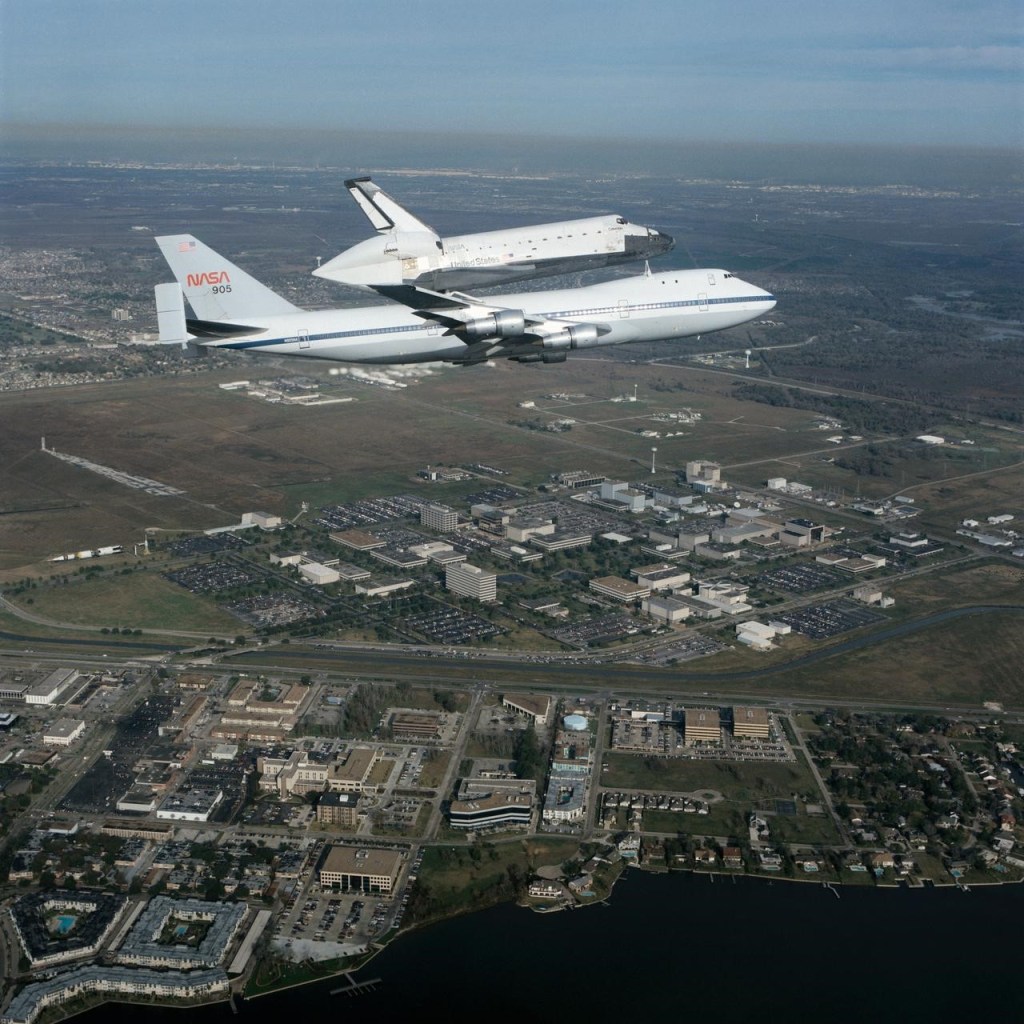
Air-to-air view of Columbia, OV-102, atop SCA NASA 905 flying over JSC site NASA ID: S90-55294 S90-55294 (19 Dec. 1990) — Johnson Space Center employees and neighbors on the ground didn’t get quite this closeup of a view of the Dec. 19 1990 flyover of the Space Shuttle Columbia mounted piggyback atop NASA’s Shuttle Carrier Aircraft (SCA–NASA 905). However, hundreds were able to spot it as it passed nearby en route to Florida from California following the successful STS-35 mission. Almost the entire 1625-acre site of the Johnson Space Center is visible in the background, along with a number of businesses and residences in the nearby municipality of Nassau Bay. The air-to-air photograph was taken by Pete Stanley of JSC’s Image Services Division who was a passenger in a T-38 jet aircraft.
Another thing I observed was referred to as “Empire Building.” Civil Servants got promotions based on how many people reported to them. They would claim to need more people than there was work for, just to inflate their numbers. As a contractor manager, I’d be told to hire more engineers when the ones I had barely stayed busy.
Yes, that’s the way it was, in an agency highly admired, especially our youth, even aspired to work for–I know, because I was one of them. I got a physics degree at the age of 39 so I could work there. Sadly, I came away disappointed in many things I saw as an insider, especially the safety area where we knew all the dirty little secrets of why missions failed, inevitable when engineers were ignored by upper management.
Did NASA do some amazing things? Unquestionably! Did I have some wonderful experiences while I was there? Absolutely!
That picture above? I saw that from the ground and it was awesome. But this does not mean that there isn’t a lot of waste that needs to be eliminated. Since I retired in 2009, much has happened already with the retirement of the Space Shuttle Program and availability of commercial rockets.
I could go on and on with examples, but that is not the purpose of this blog. I simply wanted to make a point that what the Department of Government Efficiency (DOGE) is doing is needed and in many respects a very good thing. I recently heard indirectly from someone who works at the Federal Reserve that only about 6% of Federal employees report to an office daily.
What? Really?
More fallout, I suppose, from the COVID-19 debacle, which allowed people to work from home. As a former NASA contractor manager I was well aware that only a small handful of my personnel could be trusted to be productive working from home.
You Don’t Prune a Rosebush with a Chainsaw
However, that said, I believe DOGE may be figuratively pruning a rose bush with a chainsaw. Some of these agencies may be totally worthless, saving the taxpayers from paying for frivolous and even criminal activities, which is desperately needed. But we must remember, for the most part, the majority of agencies had something beneficial for at least some segment of the populace at their core when they were created.
Rebuilding the U.S. economy, creating jobs, and being self-sufficient as a country, especially when it comes to energy, make sense. But I don’t agree with decimating our forests, public lands or environment. Agencies should be pruned carefully with lopping shears at worst, trimmers at best.
For example, laying off Forest Rangers and those who watch over our National Parks, both the wildlife and visitors from around the world, is ill-thought-out. These individuals serve the citizenry! These are not the slackers! C’mon!
It’s my opinion that we need to keep a close eye on what’s being eliminated and speak up when they’re ill-advised for the damage they’ll do. As a senior citizen I have a perspective that those making such decisions may not have. Audit them all, definitely, and cut back as warranted. But let’s bring some finesse into the process before causing irreparable damage.
For example, a petition landed in my email inbox recently about the Environmental Protection Act being totally ignored. You can find it here.
I love nature and wildlife. That’s why I live in the boonies where I can look out my office window and see everything from rabbits, squirrels, and chipmunks to wild turkeys, deer, foxes, and even fisher cats, which I never heard of before moving to Western New York State. True, some are a threat to our livestock, but that’s another story. Trees, diverse vegetation, and wildlife feed my soul.
While the land immediately around me is privately owned, I shudder to think if it were Federal land and some logging company came in and stripped the mountainsides bare. That not only impacts the aesthetics, but the wildlife that calls that forest home.
Same goes for oil exploration. Having lived in Texas for 35 years, I know enough about that industry to recognize how dirty and dangerous it is. Essential, yes. But it could be done in a safer, more discriminatory manner so as to cause less damage. Fracking threatens water supplies with toxic chemicals and has been proven to cause earthquakes. Do we really want our National Parks subjected to that?
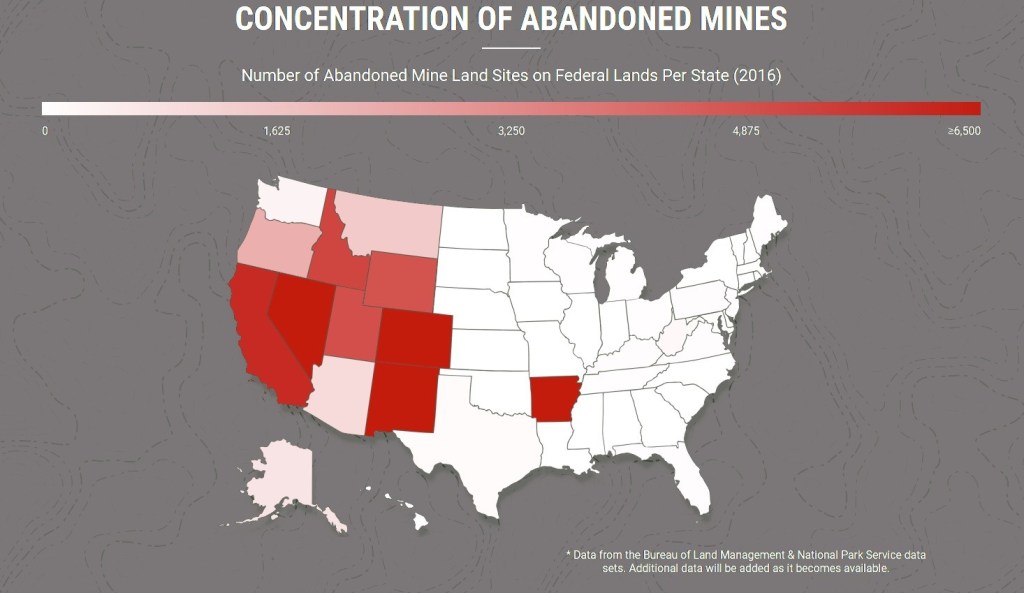
In the 19th Century mining activity in the Rocky Mountains caused considerable damage. These corporations do not care about the mess they leave behind, only profits. Some regulations are essential, which should be enforced with integrity, not bribes, and involve fines that are painful enough to motivate compliance. When I was writing The Curse of Dead Horse Canyon Trilogy my research made me aware of how bad that century-old situation was as well as oil exploration, both situations making it into the plot of the story.
I highly recommend Robin Wall Kimmerer’s “Braiding Sweetgrass” for more perspectives on that issue. You can see my review of this beautifully written book here.
Harming Vulnerable First Americans
Eliminating the Department of Education is another issue. While some research indicates the USA is not “dead last” but 8th out of 41 countries, in 2022, the U.S. ranked 16th in science, ninth in reading, and 34th in math. Not particularly stellar, to say the least.
Having had six children go through public schools, I’m well aware of the flaws in that system, too, e.g. using our children as test subjects (no pun intended) without our consent. Lunacy such as “New Math” and various other indulgences, like not teaching phonetics, and other “experiments” which deprive our youth of a decent education. This has gone on for decades, even predates the Department of Education, much less the “No child left behind” edict, which had its pros and cons as well.
The system, with or without the Department of Education, is deeply flawed. Indeed, they shot themselves in the foot when they started demanding all school districts incorporate the reigning political party’s “woke” agenda and various other idiotologies [not a typo] to which a vast majority of the population objected as proven by the 2024 election results.
Again, rather than throwing the Department of Education away like last year’s test scores, why not fix it? Our “throwaway” mentality should not relate to matters that affect human lives. Granted, sometimes fixing something, whether it’s your car or washing machine, is less cost-effective than buying a new one. But unless an agency is thoroughly corrupt to the core, you don’t delete it without closer examination regarding whether any part of it is worth salvaging.
One useful function of the Department of Education relates strongly to financial aid to poor districts. Its loss will be particularly hard on Native Americans. To quote from a recent email sent out by Native American College Fund president, Cheryl Crazy Bull:
We must raise our voice and let our representatives know that this bill cannot pass.
What you may not realize is that the Department of Education’s main role is financial. Dismantling it would disrupt programs that disburse federal student aid, negatively impacting all students that receive student loans and Pell grants. To qualify for a Pell grant, you must show need and the majority of College Fund and Tribal scholars demonstrate that financial need.
The Department of Education also provides federal funding for public schools and the ability to enforce civil rights protections for all students in education, including characteristics like disability, religion, and sex.
Native students are at the center of this attack and will experience tremendous hardships.”
If you don’t know how to contact your representatives, you can find that information here.
This very useful tool also includes your state officials, who often need prodding as well.
Getting rid of corruption is important. Saving taxpayers from enriching crooked politicians is essential. But the government is expected to provide some services. We just need to make our voices heard demanding that it be done in a wiser, more selective and sensitive manner.
In closing, as citizens, what we allow will continue. Whether its waste, fraud, and abuse or cutting things back so brutally and thoughtlessly that we never recover what good there was.






 The Curse of Dead Horse Canyon