Living in a Gift Economy with Reciprocity and Gratitude

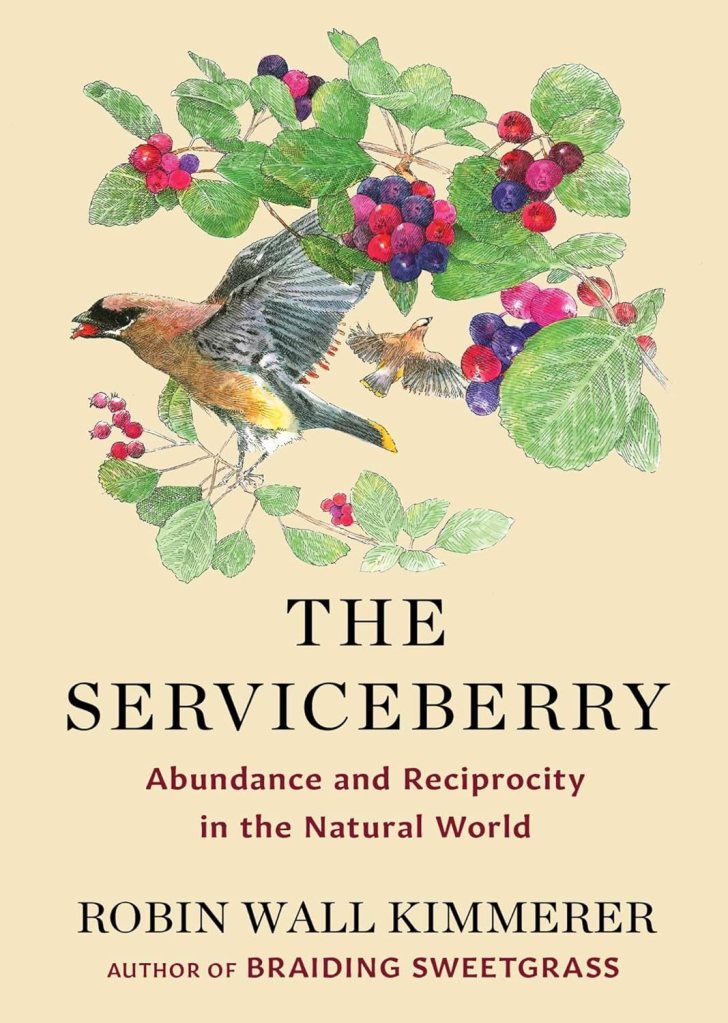
Book Cover of "The Serviceberry"

Review of “The Serviceberry: Abundance and Reciprocity in the Natural World” by Robin Wall Kimmerer

This beautiful little book gives you plenty to think about. The illustrations complement the text perfectly and help convey it’s sweet message. I expected it to be a bit longer, but it’s the expansion of an essay/article done previously.

I love the author’s insights based on her Native American heritage. There is so much wisdom there. The core message of the analogy to the serviceberry is reflected in the subtitle, “Abundance and Reciprocity in the Natural World.” Everything we have and need comes from the Earth as a gift. We should take only what we need. Greed and hoarding are not how nature operates. When do we attain the feeling of “enoughness?”

It’s message is also nicely expressed in Chief Seattle’s quote, “Take only memories, leave only footprints” from a speech he gave on honoring the environment.

Sharing builds friends and community. Giving back benefits both the donor and the recipient. She states, “Gratitude and reciprocity are the currency of a gift economy, and they  have the remarkable property of multiplying with every exchange, their energy concentrating as the pass form hand to hand, a truly renewable resource.”

She tells the story of a little wooden “Free Farm Stand” that was placed by the road where excess produce was left for people to take. The irony was that when winter approached and the stand was shut down, someone took the sign literally and actually took the stand itself! Fortunately, a young man in the area was working on his Eagle Scout Award and planned to build a new one as his project.

Many years ago I lived in a community that dated back to the 1800s where everyone knew each other. Probably more than half of them were related, progeny of the town’s founders. Our children played together, we shared our talents and our harvests. We bartered, eggs for fresh milk and various other exchanges.

This is fairly easy to do in a small community.  She mentions potlatches, which I was not familiar with, so I looked it up. The American Heritage Dictionary defines it as “A ceremonial feast among Indian tribes on the northwest Pacific coast to which the host distributes gifts requiring reciprocation.”

I have seen that on a smaller scale, where you would take a treat or dinner to someone and tell them to pay it forward to someone else as opposed to paying it back to the giver. To think this was a inherent part of Indigenous culture is thought provoking at the least.

These practices are more easily accomplished in small neighborhoods where everyone knows each other. It brings to mind something I read in Nancy Red Star’s book, “Star Ancestors,” about a great migration that occurred thousands of years ago. The people were advised not to stop and build cities, but of course some of them did.

If you look at cities today you can see the wisdom of that advice. In cities people lose touch with one another. Jean-Jacques Rousseau, clear back in the 18th Century, argued that humans were happier and more virtuous in a “state of nature.” Cities, civilization, and fancy social structures just made people fake, greedy, and miserable. He saw city life as the root of inequality and moral decay. He believed living close to nature, simple living, and smaller, self-sufficient communities — not the crowded, artificial world of cities, was the way to live. Centuries later, Henry David Thoreau echoed the same sentiment in Walden Pond.

Going deeper into that subject opens Pandora’s Box, so I’ll leave that for another day.

Indigenous cultures had a beautiful concept of community and taking care of one other. Small communities often operate in a similar manner. Each of us could start with our families by instilling the concept of giving, reciprocity, and gratitude, then expanding it to friends, neighbors, and relatives.

After all, it’s the family where such beliefs should begin.

You can get your copy on Amazon here.

Co-Author Matchmaking

Have you ever wondered how Pete Risingsun, a Northern Cheyenne elder living on the tribe’s reservation in southeastern Montana, and Marcha Fox, a science fiction author living in Texas, became coauthors? If so, you’ll want to read the article published by the staff of Soaring Eagle, the charitable organization that supports the Heritage Living Center for Northern Cheyenne elders where Pete resides. You can find it in the Spring edition on their website here. That organization was key to facilitating this incredible partnership that has produced three award-winning novels over the past five years.

Pete and Marcha have never met face-to-face and he does not even have a computer! Phone calls, texting, and snail mail were the vehicles used to communicate, collaborate, and produce over 1400 pages of an incredible three-volume story.

The response to the article was great, as shown by a significant increase in book sales. Of particular interest was a letter, which you can see below, that was sent to Soaring Eagle by a woman who read the newsletter and as a result purchased and read the three books.

The biggest challenge for most authors, especially those that are self-published, is finding their audience. The Dead Horse Canyon Saga is unique, making this even more difficult since it doesn’t fit a single genre. However, with multiple story themes including a government conspiracy, murder, a detailed glimpse at Cheyenne history and ceremony, deep bonds of family and friendship, to say nothing of Charlie Littlewolf’s transformational journey back to his roots, there is something for everyone.

So far the three volumes have captured a total of 13 awards. This includes 5-stars and glowing reviews from Readers’ Favorite for each book, along with prestigious Book Excellence Awards.

Fans of the Longmire series (Craig Johnson’s books as well as the TV series) or the Leaphorn and Chee stories by Tony Hillerman and continued by his daughter, Anne, (novels and the Dark Winds TV series) are likely to enjoy these books. Dead Horse Canyon takes an even deeper dive into native culture and history with characters the reviewer from The Book Commentary described as “lovable,” while an Amazon reviewer of the third book described them as “Characters you will fall in love with. Characters you will fantasize horrible death wishes for with fingers crossed. And sleepless nights as you read it.

It’s been said, “Do not to judge a book by its cover.” Just in case this is an issue, new covers are coming the end of June! Stay tuned!

You can find the books on Amazon here.

Lakota Healing Song

This morning a beautiful Lakota healing song showed up in my YouTube feed. I didn’t understand a word, but it brought tears to my eyes. If there was ever a time when many of us–the entire planet, actually– needs it, it is now.

It also had special meaning because it fits perfectly with a scene in book 2, “Return to Dead Horse Canyon: Grandfather Spirits.”

 In Chapter 19, Leaping Elk, an Oglala Lakota medicine man, performs a healing ceremony for Charlie. You will meet Leaping Elk again in book 3. Here’s the excerpt:


BELTON MEDICAL CENTER

July 15, Sunday

1:50 p.m.

Charlie sensed a presence. Opening his eyes failed. The soul-crushing weight remained, confirming he was alive, like amasani told him. Surely it didn’t hurt this much to be dead. Every breath filled his lungs with pain soaked in suffocating fire.

The realization someone was speaking in a grandfather voice stirred within his soul. The reverent, beseeching tone indicated prayer, but he couldn’t understand the words. Not Diné or Tsetsehestaestse, and certainly not English or Spanish.

Who was it?

Why was he there?

Mysteries and ceremonies came to men like Sweet Medicine from within the earth. Was that where he was?

Why else were some sounds muffled, others not? Though distinct, the man’s speech came as if from a great distance.

Perhaps he was within the earth. Swallowed by an angry Earth Mother.

The prayer ended and the man began to sing, accompanied by the rhythmic swish of a rattle. Even without understanding the language he recognized it as an honor song. Its healing effects settled upon him with an unexpected sense of peace.

The singing faded.

Again all was deathly still.


Here’s the song. Close your eyes and feel the words, even if you can’t understand them.

Some of the comments on YouTube explain the song is asking the Creator to have pity on us, that we understand our suffering is a vehicle to teach us something, and to please heal us.

There is so much to be learned from this beautiful culture. Teachings that we need today, more than ever before.


Image by Aline Berry from Pixabay