Medicine Men: Then and Now (Part 1)

AI Generated image of a traditional medicine man shaking hands with a modern woman doctor

Healing is something we all seek at one time or another. In these modern times, many turn to their physician, who then sends a prescription to their chosen pharmacy. If you can afford it, you take it as directed. Sometimes it works, sometimes it doesn’t.

Yet the human race survived for thousands of years without pharmaceutical companies. Probably the most questionable thing about them is how they did all in their power to suppress natural cures.

Why?

A natural substance cannot be patented and thus assure income.

Of course it’s becoming more apparent day by day that the pharmaceutical/healthcare industry isn’t about helping people get well–it’s about profits. While this subject is ripe for discussing any number of conspiracy theories, that is not the point I want to make.

Rather, I’d like to illustrate similarities between methods used for thousands of years by indigenous healers (i.e., medicine men or, in some cultures, shamans) versus “new” alternative medicine approaches that eschew drugs for other means for optimizing health, both physical and emotional, which are more connected than most people realize.

Cover of Louise Hay's book "You Can Heal Your Life"

That is one of the most fascinating “breakthroughs” in relatively recent times. Much of this began with Louise Hay’s book, You Can Heal Your Life. A similar book that was my first introduction to the possibility is Feelings Buried Alive Never Die by Karol Kuhn Truman.

In his book, A New Earth, Eckhart Tolle states, “Suffering or negativity is often misperceived by the ego as pleasure because up to a point the ego strengthens itself through it. For example, anger or resentment strengthen the ego enormously. . . If you were able to observe the physiological changes that take place inside your body when possessed by such negative states, how they adversely affect the functioning of the heart, the digestive and immune systems, and countless other bodily functions, it would become abundantly clear that such states are indeed pathological, are forms of suffering and not pleasure…”
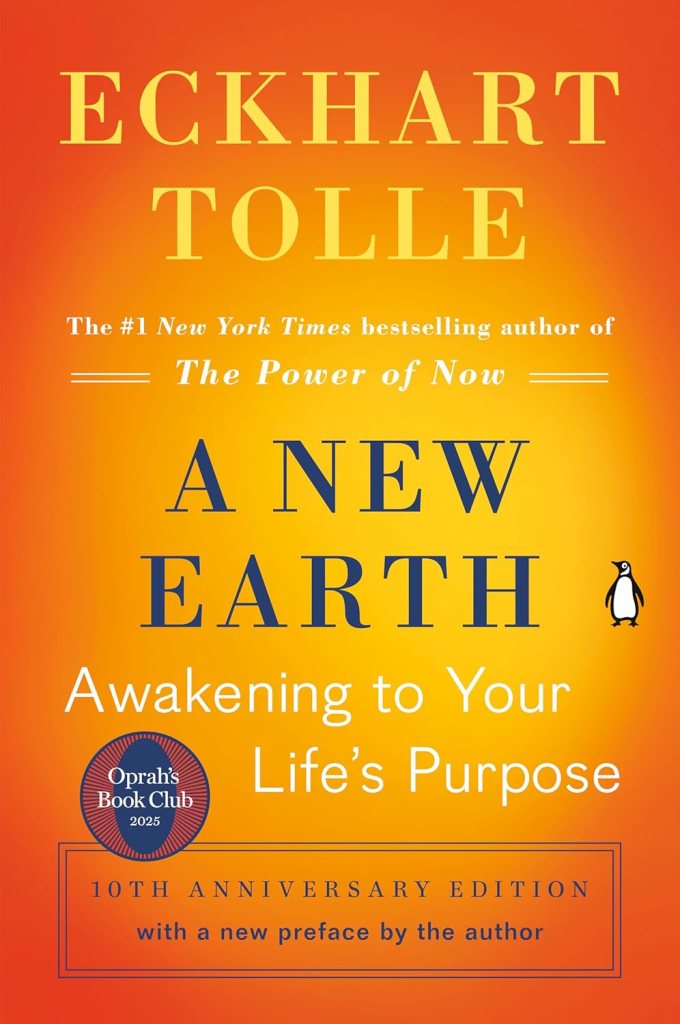
Cover of Eckhart Tolle's book "A New Earth"

He goes on to say, ” The remnants of pain left behind by every strong negative emotion that is not fully faced, accepted, and then let go of join together to form an energy field that lives in the very cells of your body…The pain-body is a semi-autonomous energy-form that lives within more human beings, an entity made up of emotion. It has its own primitive intelligence, not unlike a cunning animal, and its intelligence is directed primarily at survival…That’s why it thrives on negative thinking as well as drama in relationships. The pain-body is an addiction to unhappiness.

Cover of "The Making of a Healer" by Russell FourEagles

Here is what Russell FourEagles, a modern-day Native American healer, has to say about such emotions:

“We humans tend to hang on to too much baggage such as anger, guilt, and pain. We tend to keep inside the hurts and sorrows from losses of family and friends. We also hang onto other life losses such as money and material things. That little place the Creator gave us to store our hurts was meant to be used for just a short while, until we were ready to let them go. But instead, we stuff our heart boxes with more and more hurts and traumas until we learn from our life’s lessons or die. We may often carry this baggage for many lifetimes if we don’t learn to let it go…

“The addition of the new trauma has caused the heart box to swell, so that it presses uncomfortably against the heart and lungs. But then, in an unconscious ability the Creator gave us, we have stolen energy from our own cells to build a wall around our heart box… One way to unload our heart boxes is through the Oneida Fire Ceremony. The ceremony’s main function is for us to give all our painful memories and traumas to the Creator. We do this through writing things down and offering them up in prayer. This ritual helps us to heal and get stronger. In the process, we uncover ever and ever deeper old hurts.” (The Making of a Healer: Teachings of my Oneida Grandmother)

Cover of Dr. Bradley Nelson's book "The Emotion Code"

As far as the Heart Box is concerned, modern researcher and chiropractor, Bradley Nelson, states: “Trapped emotions can create a wall around your heart that can block you from living life to the fullest…Your subconscious mind–which knows no limitations–will sometimes use the energy of these trapped emotions to create a barrier or shield around your heart. Literally, it creates a wall of energy around your heart, to protect it…

“When you have a Heart Wall, you are not able to give love as well as you might, because that love energy that is in your heart cannot get out as well. (The Emotion Code: How to Release Your Trapped Emotions for Abundant Health, Love and Happiness)

Cover of Karol Kuhn Truman's book "Feelings Buried Alive Never Die."

The heart is not the only place that emotions can be trapped. As Louise Hay, Karol Kuhn Truman, and Dr. Bradley Nelson each explained, different feelings get stored in different organs. If you have specific health problems, its origin could lie in some past emotional trauma.

I invite you to check out one or all of these books for details.

Watch for more on this fascinating subject of how ancient beliefs about everything from healing to the true meaning of consciousness are coming full-circle with modern science.

The Fascinating World We Cannot See

If you’ve read any books in the Dead Horse Canyon trilogy you’ve encountered numerous instances where Charlie received a message from something other than another human being. In the Cheyenne culture these messengers are known as the maiyun, or spirit helpers. When I was writing these stories and Charlie would come across one, I always wondered if it was a stretch, my imagination getting out of hand. However, my coauthor, Pete Risinsun, always assured me they were quite typical in his culture.

If we focused on tuning into nature, considering we’re all part of the same greater, spiritual whole, we could hear them, too. You could start with noticing spirit animals, which is when you spot anything from a spider, bird, squirrel, or other wild animal that gets your attention. What is he or she trying to tell you? Often it will relate to one or more of its characteristics that you would do well to replicate. You can find a previous blog on spirit animals here.

If relating to an indigenous culture is too much of a stretch, try reading about the experiences of someone from a more familiar western way of life; someone whose work provides a bridge of sorts between the two belief systems. One I’ve learned from is medium, Rob Gutro, who has first-hand experience with the world of spirits.

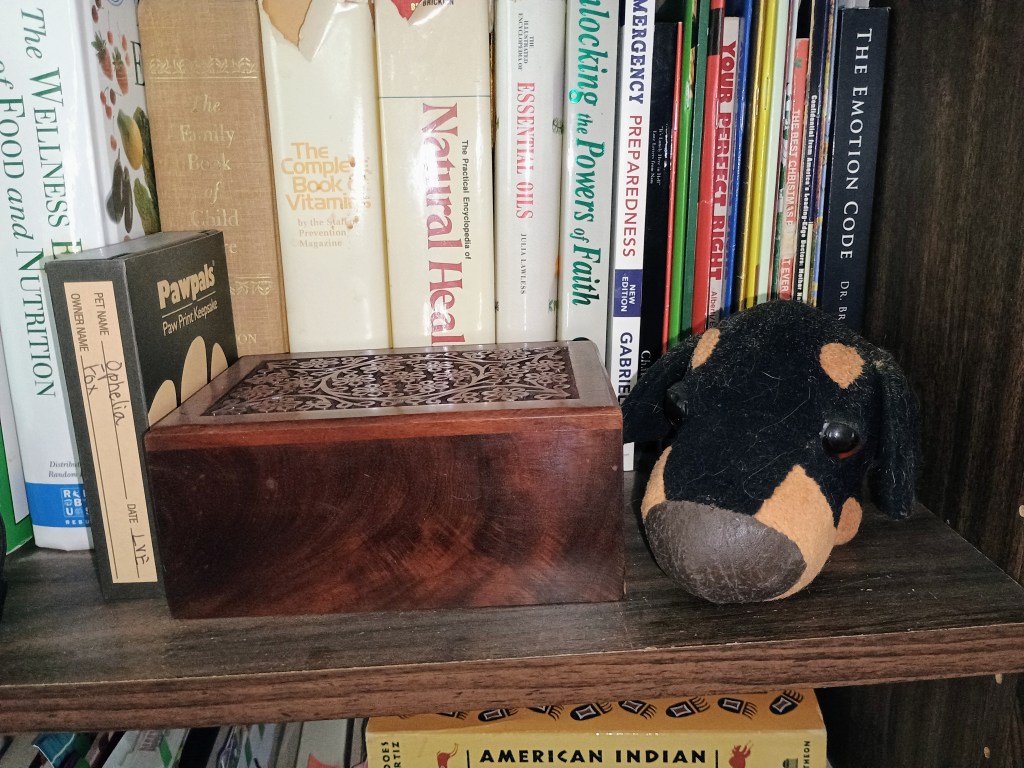
I first discovered his books when I stumbled upon his “Pets and the Afterlife” series after losing one of my fur babies, an 18 year old Bengal named Ophelia. He not only channels humans, but pets as well, providing information he couldn’t possible know or understand, yet has meaning to grieving pet parents. I found considerable comfort in the stories, which include information on signs to watch for that your pet is paying you a visit from beyond the Rainbow Bridge.

Indeed, shortly after reading the first book in that series, Ophelia did, indeed, come to visit one night. I have her cremated remains on a bookshelf in a little wooden box. Next to it is her favorite toy that she used to carry around. When she did, she would meow as Bengals do which, with the toy in her mouth, came out as a distorted blood-curdling yowl.

She loved her “baby” and often slept with it. And one morning, when I got up, her “baby” was on the floor. There was no other way it could have gotten there since it was out of reach of my other two cats. Furthermore, there was a chair stacked with pillows in front of it, so it should have fallen on top. If one of the cats had jumped on it, the pillows would have fallen. However, the toy was not only on the floor, but underneath the chair.


I’m sure she’s come by other times as well, most likely with her much larger brother, who passed in 2020, which I suspect is what’s going on when my other two cats are staring with wide eyes at something I cannot see.

If you have ever lost a beloved pet, I highly recommend this series. I had the first two books, both of which I’ve given away to friends and family when they were grieving a similar loss.

Thus, when I encountered another of Gutro’s book, “Kindred Spirits: When a Medium Befriends a Spirit” I was fascinated. The other books were very informative about the Spirit World, so I wondered what else I might learn. A few details came out that were new and directly related to the Cheyenne concept of maiyuns.

One very basic concept is that our deceased loved ones are not as far away as we may think. He explains how spirits are those who “go into the light” when they pass while ghosts remain in a fixed location for some reason known only to them. Sometimes they’re lost or confused and can be helped to cross over, which Gutro has done on occasion.

If you’ve read the Dead Horse Canyon books, you may recall White Wolf and Charlie talking about doing that in book 2 when they drove to Billings to get a new alternator for the Explorer and perceived spirits along the highway, which according to Gutro’s explanations, would have been ghosts.

Gutro noted that spirits can interact with anything living. There are various instances in the trilogy where Charlie encountered just that. What comes to mind is whether it was the spirit of the aspen tree (Book 1, Chapter 6), or the squirrel (Book 3, Chapter 43) that spoke to him, or was it a spirit of one of his ancestors prompting the interaction?

According to Gutro, visiting spirits often leave something for you to find, like a coin. In most cases its date will relate to the person in some way, such as their birth or death year, or other key time, for example when you met. Such an example in the books is the arrowhead Charlie came upon during a trail ride. (Book 2, Chapter 39). Later, in Book 3, White Wolf told him that a maiyun spooked the horse so that he would fall off and find it.

Gutro also mentioned how a person’s energy is retained in their cherished possessions. This is what “sentimental value” is all about. What do you have that is quite possibly just sitting around collecting dust, but you simply can’t get rid of it because it means something to you or did to someone you cared about and is now gone?

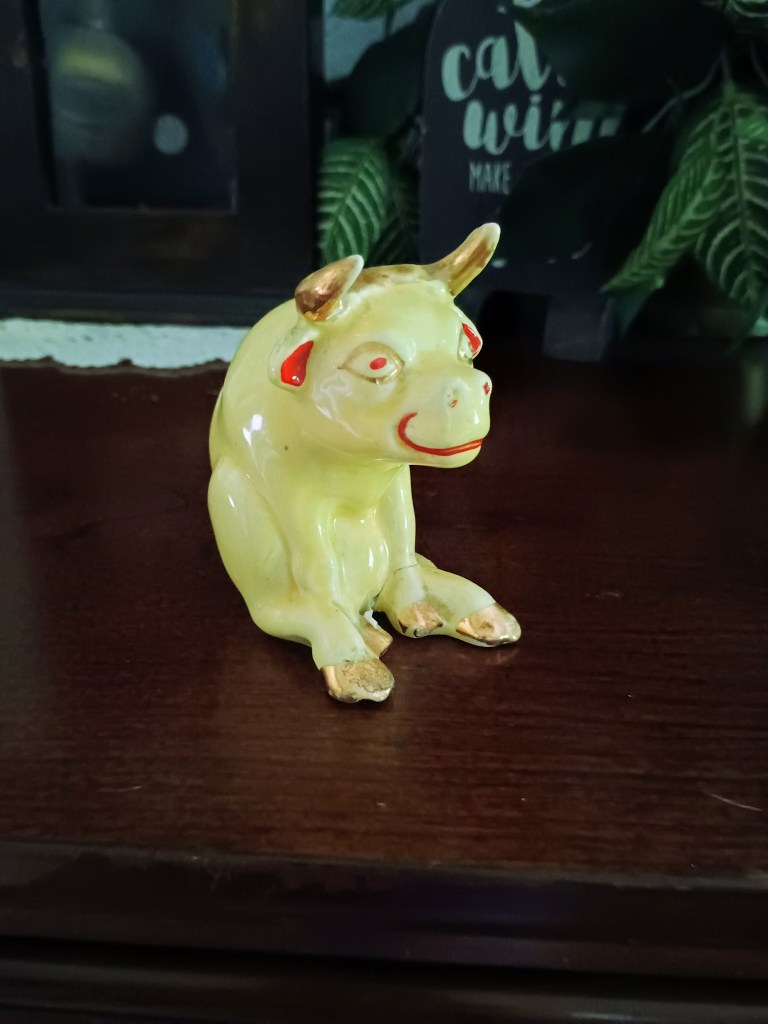
Here’s an example of such an object I have doing just that. That little knick knack,

which is older than I am and at one time cost $0.79, which is inked on the bottom, belonged to my mom. As long as I can remember it sat on the kitchen windowsill. I have no idea what it meant to her or why, but it was always there, and has been broken and repaired numerous times. For whatever weird reason, I think I would protect that little bull with my life! (Maybe not, but you get the idea.) Something about that little guy touches my heart.

Not long ago, a friend sent me something and when I received it I could feel the affection it contained. That made me rethink my usual practice of having presents drop-shipped to save money rather than reshipping them myself. Should I be infusing these gifts with affection, like Star did with the gifts for Sara and her family in Book 2? And what about Amasani’s blanket, (Book 1, Chapter 24) that conveyed her love and comfort to Charlie?

I can’t help wondering about trickster maiyuns, like the ones that always caused minor household problems whenever White Wolf and Charlie were away from home. If you’ve ever had a friend or relative who was prone to practical jokes, could that be their origin? Still up to no good in the afterlife?

Gutro’s knowledge of the Spirit World has vast similarities with what the Northern Cheyenne and other indigenous cultures not only know but take for granted. Spiritually enlightened people continue to remind us we are all connected and love is the strongest energy there is. We can always hope that daily living spirituality is making a comeback.

The real question is not only why but when was it lost to the white man, but not indigenous people?

History undoubtedly holds the answer.

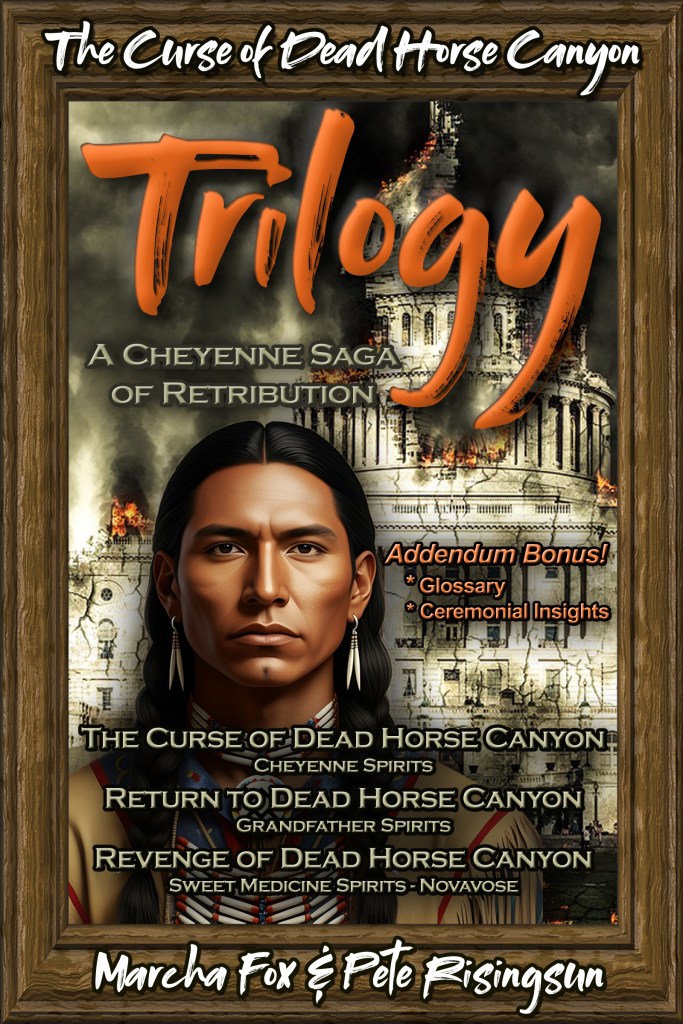
[Note:–The Dead Horse Canyon Trilogy mega-ebook that contains all three Dead Horse Canyon volumes is now on Kindle Unlimited! If you haven’t yet indulged in this series and don’t have Kindle Unlimited, you can get your copy for only $7.99, a 38% savings over buying the ebooks separately, plus a special addendum is included.]