Confessions of a Life-Long Bibliophile

The True Loves of My Life

As an only child, books were important. Fortunately, my mother read to me as a young child such that I could read by the time I went to school. I was reading chapter books by 3rd grade, maybe sooner. My early favorites were animal stories by authors like Paul Gallico, who wrote “The Abandoned,” my favorite book for many years, perhaps for all time. Robert Lawson, author of “The Tough Winter” was another favorite.

I remember going to the Peekskill New York Public Library in my home town and coming home with a huge stack of books, especially in the summer.

While still in elementary school I discovered Nancy Drew Mysteries. I would save my allowance to buy the latest release and had them all, which were usually read more than once. As a teen my favorite was “The Catcher in the Rye” by J.D. Salinger. I remember reading on a city bus and coming to a part that made me laugh out loud, earning odd looks from my fellow passengers.

As a working adult, I had to give up certain authors because they kept me up all night: Michael Crichton, Tom Clancy, John Grisham, to name a few.

Home at Last!

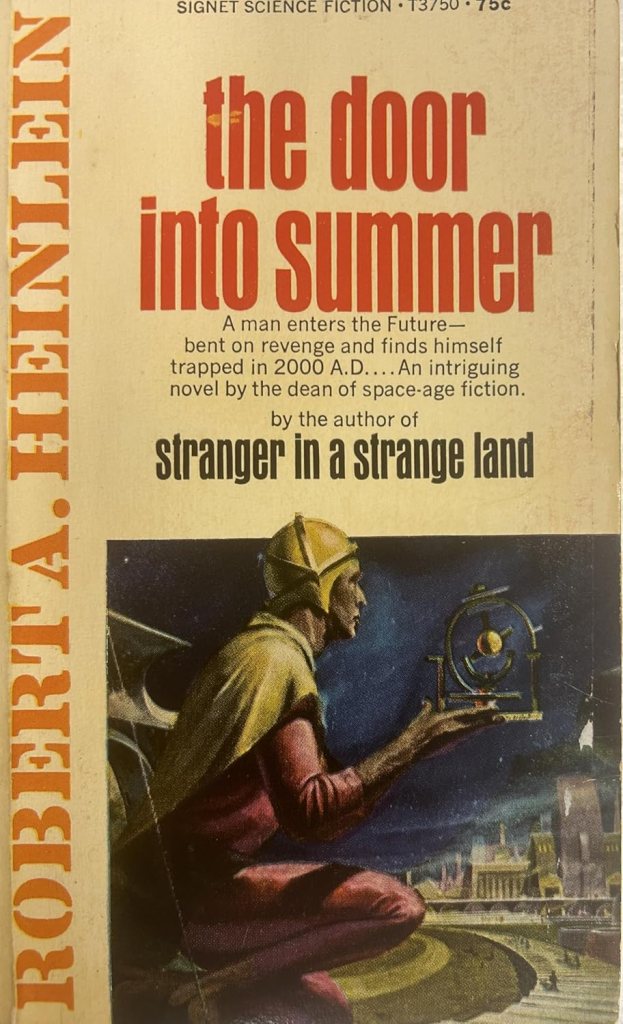
Somewhere along the line I discovered science fiction. The classics by Jules Verne such as “Journey to the Center of the Earth” and H.G. Wells’ “The Time Machine” were my first discovery, followed by Isaac Asimov and Robert A. Heinlein, the latter my all-time favorite, especially “The Door Into Summer” and “A Stranger in a Strange Land,” where the word “grok” originated, for those of you who didn’t know.
I scratched out my first science fiction story in 6th grade on yellow lined paper about the planet our teacher hailed from.  Not much of a plot, but my classmates found it entertaining. Not surprisingly, an avid reader like myself aspired to be an author when I grew up, more specifically a science fiction author.

One thing that always frustrated me was that science fiction books had very little actual science in them, probably why I favored Heinlein, who was an aeronautical engineer whose fiction started the “hard science fiction” sub-genre.

As a perfectionist, I wanted to learn more about science so that when I wrote my stories they would contain the scientific explanations I craved as a youth. Thus, at 35 I returned to school to earn a bachelor’s degree in physics from Utah State University, followed by a 21 year career at NASA’s Johnson Space Center in Houston, Texas.

We’re told to “Write what you know,” right?

My first science fiction novel, “The Capture of Phaethon,” about an asteroid collision with Earth was written while I was in college. It won me a scholarship as well as First Place Honor in a state competition. Maybe someday I’ll get it published. For now, the manuscript is in a box in the basement. Writing Phaethon was when I discovered the mysterious serendipity associated with creating fiction.

That’s all it is, right? Fiction? Something made up in your head?

My fictitious asteroid was named Phaethon, after the son of Apollo who crashed his father’s chariot into the Sun. Imagine my shock when doing research in the USU library’s NASA section that I found an asteroid by that name had recently been discovered! OMG! Later I discovered its usefulness in astrology, where it often indicates a “crash and burn” situation, figuratively or literally.

Heaven on Earth

The first time I set foot inside a library it felt like I was in Heaven. How it feels within the walls of a building lined with thousands upon thousands of books is as unique as it is indescribable. Every cell senses the knowledge and secrets that await, stirring my soul.

That could be why I often spend as much time researching a book as I do writing it, sometimes more. As much as I love my Kindle, for research it has to be a print book. I dog-ear pages, highlight, and leave sticky-notes galore.  When I encounter a used book like that, it tells me someone was really into its content, which is what any author hopes for.

When I wrote the Star Trails Tetralogy I incorporated science and technology problems into the plot. These were books I wanted to read as a youth but couldn’t find. I even created a Compendium with additional information for readers, teachers, and home-schoolers.

Star Trails books were popular in a charter school in Utah among young nerds like I was. I had the privilege of talking to those students a few years ago, which was so much fun. I know of at least one middle school science teacher in Florida who has my books in her classroom for extra credit reading. 

My favorite review for these books is the one where my writing was compared to Robert A. Heinlein. Imagine that! I have no idea how many children may have been inspired by them, but it’s good to know of at least a few.

Shifting Genres

The Curse of Dead Horse Canyon” saga started as a cozy mystery, but my propensity for research quickly led to a far deeper and darker story. My characters got out of hand, as usual, and suddenly I had a main character who was Cheyenne, a culture about which I knew nothing. My encounters with Native Americans was limited, and primarily with the Navajo. Research and serendipity delivered coauthor, Pete Risingsun, who kept the cultural elements on target, to say nothing of the story itself and additional research we did together.

The Reader’s Favorite review for the second book, “Return to Dead Horse Canyon: Grandfather Spirits” noted, to our delight, that “The depth of ethnology packed into both novels is meticulously researched and beautifully detailed. Fox and Risingsun are a dream team with this saga.”

Serendipity was alive and well writing that saga, especially how beautifully ancient ceremonies dove-tailed with the plot as if I’d known about them all along.

What will be lost?

Besides a book’s creative or intellectual content, to me it’s a physical thing. I love how they feel and smell, whether it’s fresh ink newly off the press or a musty antique over a hundred years old. Ebooks just didn’t feel that satisfying. I was grateful when self-publishing a paperback was an option, making it possible to hold my first print book, “Beyond the Hidden Sky,” in my hands and flip through the pages.

However, to me, a real book is a cloth-bound hardback with a dust jacket.

And this past June that dream was finally realized when all three books of the “Dead Horse Canyon” saga were released as hardbacks, laminated covers on Amazon, and real books with a cloth cover and dust jacket available through Ingram and found on Barnes and Noble, Books-A-Million (BAM), and numerous other booksellers’ websites.

Everything is being digitized, which is convenient, but I shudder to think that my generation of Baby Boomers may be the last to embrace physical, print books. The expense and storage involved versus the option of digitizing everything leaves no other choice.

Given that, how many will grow up without the joy of holding a brand new release from their favorite author in their hands, much less an autographed copy? Or never know the awe and expectation amid the imposed silence found within a massive library? While the words may be the same, there’s an essence found only from a tome in tangible form. When they’re my age will they miss their first smart phone the way I treasure the memory of those beloved books?

Or maybe that’s just me, an admitted bibliophile, who loves the print medium as much for its physical presence as what lies within. Digital formats that could disappear with a power surge or a few key strokes just aren’t the same. (Probably a thought my children will express loudly when I die and they have to deal with my many bookshelves full, only one of which you see at the top of the page.)

And how much easier might it be to pull the plug on books with content found offensive or declared “wrong” by someone in authority? Where would we be as a civilization without old tablets, scrolls, and other records?

To a bonafide bibliophile like myself digitizing books reeks of sacrilege. If you agree, be sure to buy a physical book once in awhile. Preferably a new one, so the author sees even a few dollars of benefit from it.

Epilogue
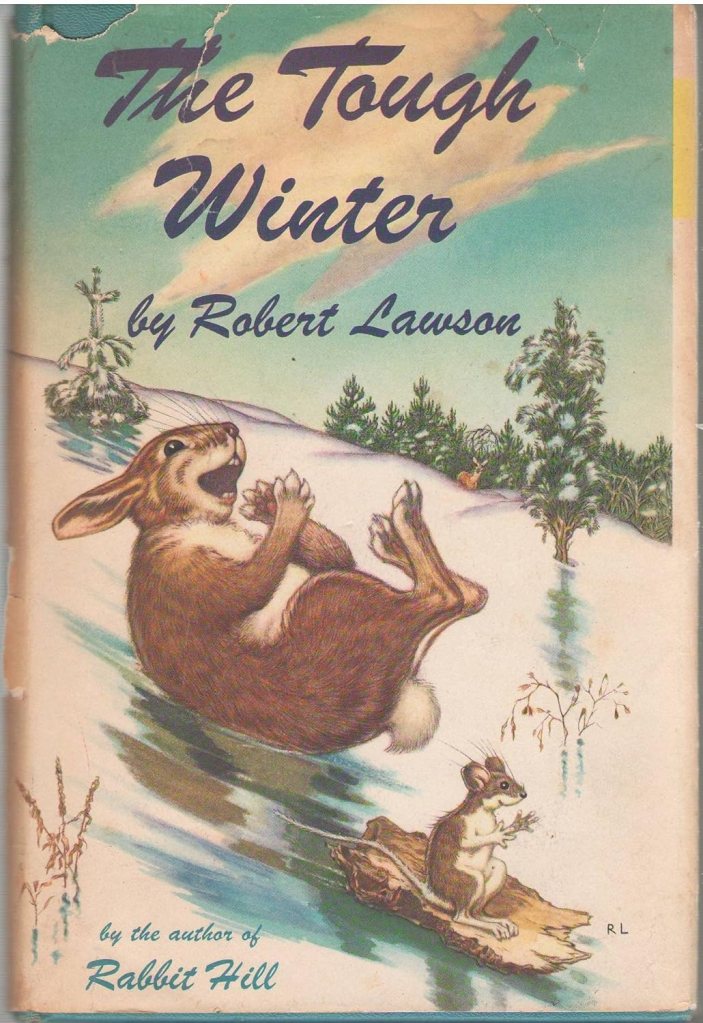
When I saw “The Abandoned” and “The Tough Winter” were still available on Amazon I literally cried. The book cover for “The Tough Winter” looks exactly like the book I had as a child. I ordered “The Abandoned,” planning to read it again, then leave it as my favorite book from my childhood to whomever wants such an anachronism when I die.  

This trip down memory lane led me to discover my reading list for the remainder of this year. Revisiting those favorites from the perspective of a septuagenarian should be interesting.

What books did you love from the time you could read? What made them special? Would you like to hold them again as you would hug a dear friend you hadn’t seen for years?

And that, no doubt, is why I simply had to order a physical copy of “The Abandoned.”
open book overlooking canyon

Essential Guide to The Curse of Dead Horse Canyon

If you’re a serious reader and want to really sink your teeth into this saga, now you can download our free Readers’ Guide for help along the way. Loaded with thought-provoking insights, discussion ideas, a few recipes, playlists, and a touch of trivia, it will enhance your enjoyment and understanding of the complexities of this award-winning story. Numerous readers have reported reading it at least twice, which bodes well for its quality and reader engagement.

If you belong to a book club, this will facilitate your dive into the series, with similar guides for the other two books coming soon.

Download your copy today!

Do You Hate Cliffhangers?

Are you a reader like my daughter who avoids serials* until all volumes have been released?

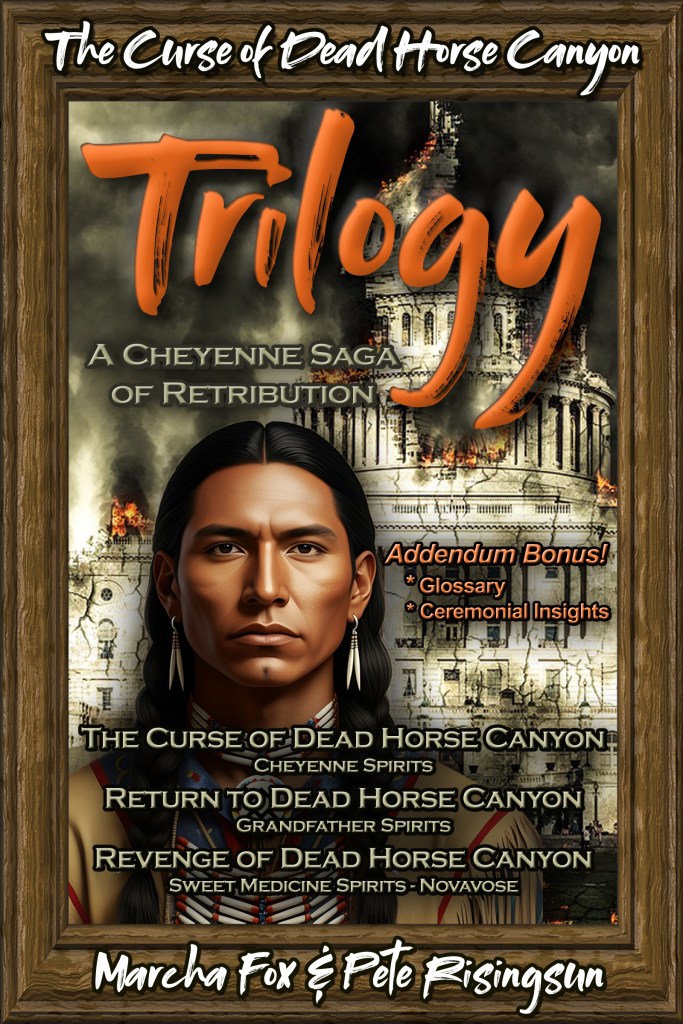
Like the Curse of Dead Horse Canyon trilogy?

Sorry about the wait, folks. Two factors slowed down the saga’s completion: Disruptions to both authors’ lives and research.

Especially research!

If you’ve been waiting, (even though book 3 came out awhile back), your patience is about to pay off.

All three novels will be released as a single mega boxset ebook on April 18!

Preorder now to reserve your copy at a bargain price of $9.99 with the ebook delivered electronically as soon as its released. All three books are complete and unabridged, 2266 pages worth plus an addendum not found anywhere else.

See? Good things come to those who wait.

Assuming you haven’t read book 3, “The Revenge of Dead Horse Canyon: Sweet Medicine Spirits – Novavose,” you’ll find it has a different pace than the others, especially once Charlie embarks on his ceremonial four-day fast.

Be prepared for a deep dive into Cheyenne history, culture, and ceremonies seldom represented in fiction! Those of you who relish immersion in anthropology through fictitious characters and situations imbued with historical truth will treasure these chapters.

Not so much if you’re looking for wham-bang suspense with no other substance.

I must warn you, however, if you’re tempted to skip the fasting sequence, be aware it’s the most consequential part, not only of the third book, but the entire saga. Consider that it drove the title as well as the picture of the Sacred Mountain on the original cover. The ending has far less meaning without that context, as one disgruntled reader expressed in a very nasty review.

Readers’ Favorite, however, gave it 5-stars and a glowing review that among other complimentary things states, “Stands out for its sharp writing and complete ability to immerse readers, especially in Charlie’s spiritual transformation. [His] heritage is painted from the sky to the smallest pebble and the fire burning in between. This finale succeeds with a perfect 10 landing. Very, very highly recommended.”

The cover for the ebook trilogy is a bit different than the others. Not only does it feature “AI Charlie,” whom you may have already met in the trailer video, but blatantly captures the saga’s overall theme. The trilogy’s description has a different spin when viewed from the ten-thousand foot level. Same novels, but the collective vibe is slightly different. Furthermore, upon request, a glossary of Native American words and phrases has been added along with a closer look at the Earth Giving Ceremony too detailed to include in the story.

 Its online description states:

The Curse of Dead Horse Trilogy ebook includes all three books of this multi-award winning saga! If you hate cliffhangers and waited until it was complete, this is what you’ve been waiting for. Furthermore, the addendum includes a glossary as well as additional information on Cheyenne practices with a comprehensive look at their Earth Giving Ceremony.

Order your copy now and prepare to be consumed by a story that brings a vast government conspiracy face-to-face with Cheyenne history, prophesy, and ceremony. After centuries of lies, oppression and broken treaties will justice be served at last?

You can preorder your copy here.

I hope you enjoy the completion of this saga. I must admit that I knew exactly how it was going to end from the first book, but didn’t know how it would transpire until Charlie’s fast. The research was worth its weight in gold showing how the ending was not so much of a stretch after all. Prophesy tends to be fulfilled, sooner or later.


*Per Google AI, “While both “serial” and “series” refer to a sequence of things, “series” generally describes a collection of related items or events, while “serial” specifically implies a story or narrative told in installments, often with an ongoing plot.”

Navajo Weaving

Navajo rugs are a rare art form that often sell for thousands of dollars.

Navajo (Diné) blankets and rugs are world-famous for their beauty and technique. Here are two videos that tell about them. The first one is a lovely montage with no narration, just restful Native American music in the background and the other is Wally Brown, a Diné elder, talking about his mother who was a weaver.  Following that is an excerpt from Chapter 24 of “The Curse of Dead Horse Canyon: Cheyenne Spirits” where the main character, Charlie Littlewolf, reminisces on when he helped his amasani  (Diné for grandmother) weave a very special blanket.

Enjoy.

CHARLIE’S CABIN

RURAL FALCON RIDGE

June 9, Saturday

9:32 p.m.

Charlie sat cross-legged in front of the fireplace, wool blanket draped around his shoulders. In two days he’d start work with Lone Star Operations.

Was there any other way he could make that kind of money?

No. Absolutely not.

The prospect, however, shadowed his mind like a storm front. In response a random thought tickled his psyche.

This is something you must do.

The justification, however, remained buried beneath any conscious awareness.

Besides the industry itself, what concerned him most was the thought of living with those people. Like when he left for college.

Harassment stories along with the racist views that characterized the industry constituted modern tales of cowboys and Indians. Working with them all day would be bad enough. But bunking with them as well? He didn’t want to think about the pranks he’d be subjected to.

He pulled the wrap closer, fingers entwined in its soft texture. June or not, nights were brisk at seven thousand feet. Its earthy scent, including a hint of lanolin, unfurled memories of three decades past, when he was living on the Diné reservation in New Mexico.

His very first job.

An assignment he resented.

He could still see Littlebear leaning against the horse corral, arms folded across his chest.

“No, son,” he’d said. “You have only six winters. You are too young for the javelina hunt. You must stay and help your mother and amasani.”

Charlie hung his head, thinking he’d sneak away somewhere for the remainder of the day.

“Look at me,” his father commanded. When he obeyed, his intent collided with the probing eyes of a knowing parent. “When I return you will tell me what you did and they will tell me if you did it well.”

He pouted, looking back at the ground. Not hunting with his father was disappointing enough. That edict made it even worse. The teasing he’d suffer from his cousins and friends for doing the work of squaws would be merciless.

Moccasins shuffling in the dirt, he trudged back home to find his mother. As soon as he stepped inside their hogan she took one look at his sour face and shooed him away.

Outside again, he stifled a smile, vindicated to pursue his original plan. Then he remembered. His work was subject to review. His grandmother, one of the tribe’s weavers, was his other option. He’d watched her work a few times, but progress was slow and tedious—far too boring to hold his interest for any length of time. With luck, she wouldn’t be busy and would tell him one of her wonderful stories. He especially liked those about mischievous coyote.

But when he got to her little house, she wasn’t there.

It sounded like a big commotion over by the training corral. Sheep bleating along with people talking and a variety of other unfamiliar sounds. Curiosity tickled, he headed that way.

The characteristic smell of sheep was strong with so many confined to a small area. That, along with all the dust, evoked a giant sneeze. He wiped his nose on his sleeve, then climbed up on the fence to watch the antics of one of the lambs. That held his attention until he spotted his grandmother a short distance away.

What was she doing, poking around what looked like dozens of flat, dead sheep?

Then it a registered: Shearing time.

He watched one of the men use clippers to peel away a year’s worth of wool from one of the ewes. It came off in what looked like a solid piece. His grandmother spotted him and waved him over.

Maybe this wouldn’t be so bad after all.

“I’m supposed to help you today, amasani,” he said.

Her weathered face, round like the moon and likewise bearing the grooves and craters of life, broke into a broad smile. “I’m so glad, grandson. What think you of all this wool?”

“I think it smells funny.”

“I like it,” she replied. “Sheep are almost as important now as buffalo were long ago. They give us meat and they give us wool. This is one of my favorite days, when I pick the fleeces I want before the rest go to market.”

“Aren’t they all the same?”

“No. Each is very different. Certain parts are better than others, too.” She took his little hand and led him over to those she’d set aside. “Let me show you.”

She pointed out the different parts of the animal from which the fleece was removed. Some areas were much cleaner and the fiber longer.

“I have a very special project I must do. I need you to separate the shoulder section from the ones I’ve chosen. Do you know why?”

He looked closer. “Because it is cleaner?”

“Yes. It is also the longest, which makes it easier to spin.”

That task finished, he thought he was done. Little did he realize his work had only begun. The raw wool needed to be prepared for spinning. She showed him how to tease each lock by pulling it apart.

His reverie paused as he rubbed his thumb and forefinger together, remembering how they squeaked when coated with lanolin. To his surprise back then, it also softened the callouses he’d earned practicing with his bow.

Next came combing the teased wool with a pair of carders that looked like giant-sized dog brushes. The resulting bats went into a reed basket, miniature clouds of fluff awaiting his grandmother’s skilled hand.

As the day wore on, his arms ached and he couldn’t card quickly enough to keep up with her spinning. She prodded him to work faster, her hand moving the spindle relentlessly as she twisted the prepared fiber into yarn.

As it turned out, the project lasted into summer. By then he earned her name for him, Naalnish. Once enough yarn was spun, the fun began. Now he could do some exploring while he gathered the dye materials needed to produce a variety of warm colors. Best of all, the collection process for some required a knife or ax, a worthy task for a young brave.

Cottonwood leaves, yarrow, and oak bark were some of the things she requested. Among the most challenging were cochineal beetles which, when dried and ground into powder, yielded shades of red. It took an entire day or more to collect enough from their cactus homes for a single batch. To both him and his amasani, however, it was time well-spent.

When shewas ready to start the dyeing process, he hauled water from either the iron-rich spring north of their village for reds, or the alum-rich one to the east for yellows. The resident minerals affected the final hue and were necessary for the fiber to retain its color—the ‘”why” of which planted the seed for his interest in chemistry.

When she had sufficient dyed yarn, he helped warp the loom constructed from tree trunks, tie the warp rods that helped create the pattern, then wind the different colors on smooth sticks that served as shuttles.

Then, at last, weaving began.

He marveled day by day as she lifted the warp rods and alternated shuttles, colorful geometric patterns emerging with each row, until their collective labors produced a finished blanket that was not only functional, but a work of art.

His heart swelled as he remembered the day it came off the loom. She folded it carefully, hugged it a moment, then handed it to him with a sparkle in her eyes.

“Where should I put it for you, amasani?”

“In your hogan, Naalnish. By where you sleep.”

 “Why?”

“Because it is yours.”

Only now, as a grown man, did he appreciate the love and wisdom of that experience. Especially when he discovered that most blankets, at least those offered for sale by members of the tribe, were not made the old way, but with commercial dye and machine-spun yarn.

This was one like none other, made expressly for him with his amasani’s love and his reluctant assistance.

It was far more than the work itself. It was what it taught him. Not only about the old ways, but of cycles. Of going full circle from the vegetation the sheep ate to grow wool to dyeing the yarn with some of those same plants. The process was tedious and long, yet the result was priceless.

From that first bat of carded wool to its liberation from the loom, it instructed him in the ways of life. It taught him patience, perseverance, and appreciation—for hard work and simple things.

The Diné believed part of their soul went into such creations and always hid a loop somewhere in the tight weave for their soul to escape. So far, it was so cleverly hidden he’d never found it. His fingers caressed the soft fiber, wondering if he ever would. It felt softer each year, improving with use, unlike so many things that didn’t last. Analogous to the earth itself and his connection to it.

All thanks to the wisdom of an old woman, who at the time was not much older than he was now. Whose kind heart would forever live in a cherished wrap that kept him warm for what would soon be thirty haigos, including many spent in the frigid Colorado Rockies.

How many white men had such a treasured possession?