THE WORLD OF THE MAIYUN

My method of writing is generally referred to as a “pantser,” i.e., I write by the seat of my pants. The other prevalent writing style that of a “plotter,” where the author determines the entire story, scene by scene, in an outline. I tried plotting, but my characters persistently got out of hand. They’d refuse to follow my plan and do their own thing. It didn’t take long to discover they had a better grip on the story than I did. Thus, I became a “pantser.” I populate my story idea with characters, then sit back to watch what they do as would a dutiful scribe.

I began work on this saga before connecting with my co-author, Pete Risingsun. I had a handle on the story’s government conspiracy angle, but lacked cultural knowledge of my main character, Cheyenne Charlie Littlewolf. I wrote what he told me to, but didn’t know whether it was feasible.

As a science fiction author, I wondered.

Was my imagination getting carried away?

I tend to obsess over accuracy and can get carried away with research. I started reading books on Native American cultures, but I needed to find a Cheyenne elder who could let me know if what I had written from Charlie’s point of view was accurate or too off-the-wall.

When Pete got involved he assured me that the various incidents I’d included were indeed realistic in the Cheyenne world. I smiled, relieved to learn Charlie was not leading me astray.
One incident that I wondered about is depicted in chapter six, “The Aspen,” of the first book, “The Curse of Dead Horse Canyon: Cheyenne Spirits.” It’s there that Charlie receives a message from the aspen tree that witnessed the wreck that killed his best friend. Besides numerous others, another one of my favorites is in the second book, “Return to Dead Horse Canyon: Grandfather Spirits,” where in chapter thirty-nine, “Trail Ride,” Charlie finds an ancient arrowhead that tells him and his brother, Winter Hawk, (cousin in western culture), that their prayer regarding the fate of the murderer had been heard.

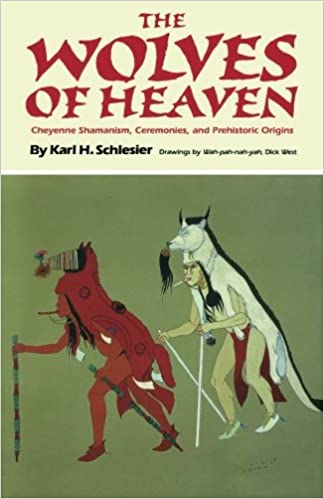
As work on the saga continued, more and more research came into play. The works of George Bird Grinnell as well as Peter John Powell were excellent sources, but had limitations. I find it ironic that some of the most detailed information on ancient Cheyenne (Tsistsistas) beliefs and ceremonies is conveyed by German anthropologist, Karl H. Schlesier. His book “The Wolves of Heaven” was priceless while writing this trilogy, especially his detailed description of the Massaum, the Earth Giving Ceremony, that plays a key role in the final volume. In a typical episode of serendipity, I found Schlesier’s book on Amazon, attracted by its subtitle, “Cheyenne Shamanism, Ceremonies, and Prehistoric Origins.”

Or was it a maiyun who brought it to my attention?

What is a maiyun?

Schlesier tells us they are powerful spirits that associate with human beings. There are also the hematasoomaeo, which he describes as “the immortal spiritual forms of plants, animals, and human beings. . . .The maiyun most responsible for physical life on earth belong either to the deep earth or to the sky places. In Tsistsistas ceremonies they are celebrated especially and represented through plant and animal forms.”

The lodge of the maiyun is the Sacred Mountain, i.e., Novavose. (You’ll meet plenty of them in “Revenge of Dead Horse Canyon: Sweet Medicine Spirits – Novavose.”)

Why have western religions denied the existence of such things? Claim that animals do not have souls, a belief with which any pet owner, farmer, or rancher will disagree? Slowly the world is awakening to the reality of other dimensions; recognizing the thin veil between life and death and the elusive nature of time.

Things ancient peoples took for granted.

Speaking of animals, a few months ago, my precious 18 year old feline fur baby, Ophelia, crossed over. I hoped that when she did, that she was reunited with her half-brother, Hamlet, who’d left this life four years before. Thus, I was drawn to the “Pets and the Afterlife” book series by Rob Gutro. He’s a medium who specializes in connecting with pets in the spirit world. These books contain dozens of stories of such experiences. The truth of what he envisions is validated by multitudes of grieving pet owners when he provides details of the encounter that he couldn’t possibly have known.

As I read Gutro’s books I couldn’t help but think of the maiyun–spirit helpers that indigenous people have relied on for millennia. What are “civilized” people missing by tuning out these messages and connections?

I am beyond grateful for my introduction to this marvelous world while writing these three tomes with Pete. My heart and mind lived there from July 2018 when this story was conceived until the final book was published in January 2025. My life is enriched beyond measure for the experience.

Two of my favorite quotes related to this lost wisdom were spoken by Tȟašúŋke Witkó (Crazy Horse), the Oglala Lakota Leader who said:

The red nation shall rise again and it shall be a blessing for a sick world; a world filled with broken promises, selfishness and separations; a world longing for light again. I see a time of seven generations when all the colors of mankind will gather under the sacred tree of life and the whole earth will become one circle again. . . In that day, there will be those among the Lakota who will carry knowledge and understanding of unity among all living things and the young white ones will come to those of my people and ask for this wisdom.

The Curse of Dead Horse Canyon Trilogy is a lengthy saga that is more than a juxtaposition of a corrupt government’s clash with Cheyenne spirituality. It’s an introduction to a world too many don’t yet see.

But as Crazy Horse declared, they will.
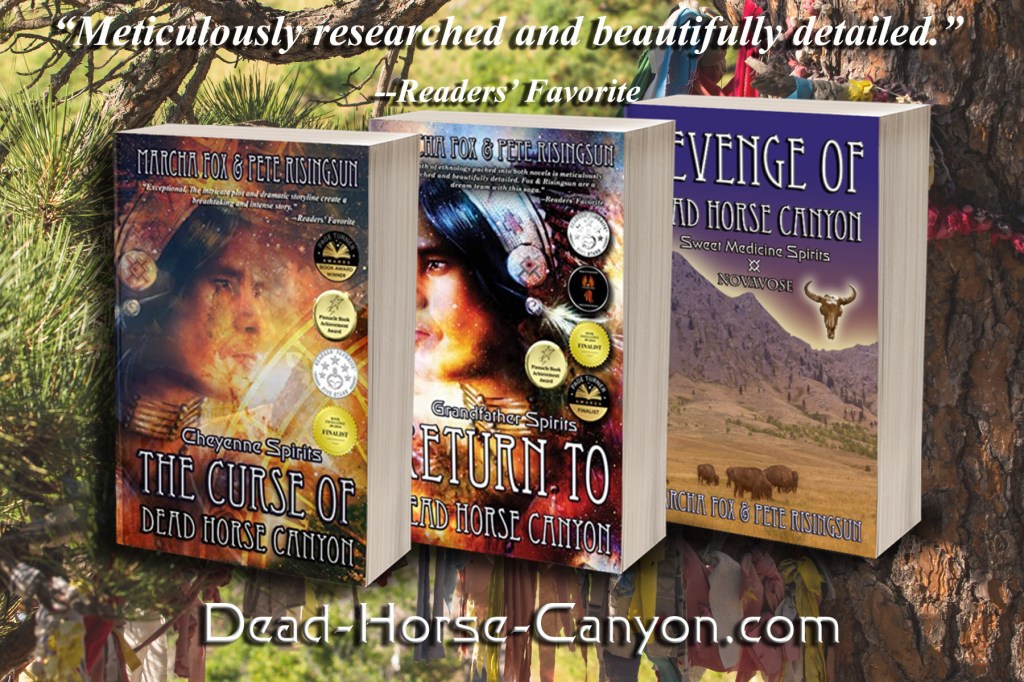
You can find the trilogy on Amazon and other online vendors.

“The Wolves of Heaven: Cheyenne Shamanism, Ceremonies, and Prehistoric Origins” by Karl H. Schlesier

If you’re just learning about the Cheyenne (Tsistsistas), this book is likely to be considerably over your head. I’m glad that I read Book One of Peter J. Powell’s “Sweet Medicine” first, which went into enough detail to make this one a good follow-up, though Powell’s Book Two, which I am currently reading, would have been helpful, too.

The author, Karl Schlesier, is a German anthropologist who did a tremendous job researching the existing body of knowledge on the subject, including that of George Grinnell and Powell, then synthesizing it with his own research to arrive at some interesting and well-founded conclusions.

One thing he establishes is that the Tsistsistas were in the northern Plains from about 500 B.C. to A.D. 800. Their language is in the Algonquian family, which the archaeological record indicates first manifested in North America around 8000 B.C.

So when the Cheyenne claim the land was given to their ancestors thousands of years ago, Schlesier has shown that be true.

The Sacred Mountain (Bear Butte State Park)

Think about that for a moment. He even attributes the huge medicine wheel in Wyoming to the Tsistsistas.

In her book “Braiding Sweetgrass,” Robin Kimmerer pointed out what it meant to be indigenous to an area. Those of us like myself who has lived in numerous locations have difficulty relating to this concept. Yet those who are living in the same town or region where their grandparents or other ancestors were born, lived, and are now buried, may comprehend what that means.

If your entire life, as well as that of generations of your family, has been spent in a specific area, there’s a sense of ownership, attachment, and love for the land and all it represents.

I’ve been a “move-in” various times and the “locals” always scope out newcomers with a jaundiced eye. To an outsider this feels somewhat clannish, projects a sense of seniority or even superiority. They may appear friendly, but you know you’ll always be suspect and never make it into the “inner circle.”

I lived in a small town in Northern Utah for 15 years and was always considered a move-in by those whose great-grandparents founded the town in the 19th century. Where I live now in Central Texas has similar vibe. I shudder to think what it would be if they realized that by birth I’m a Yankee! They think I’m from Houston, but even that doesn’t count.

City folk are suspect, too.

Put yourself in the local’s shoes for a moment. First of all, move-ins change things. For example, they may scoop up land for sale by a local farmer who’s decided to retire. None of his family members are interested in agriculture, so he sells for a good price and retires in town. Good news for the farmer. However, for his neighbors and community at large, what happens when the buyer is a developer who proceeds to put in a large tract of new homes complete with a few shopping centers?

Community development leaders in small towns, who are often likewise move-ins, are often guilty of the same thing. Their goal is to build up the economy and make money. They don’t care that they are forever changing the lifestyle of people whose roots go back a century or more. More than once I’ve purposely moved to a rural location only to have it build up over the years, heading toward the environment I purposely left. Currently, Austin, Texas is creeping closer and closer to my Hill Country retreat. I wasn’t born here, but I don’t like it, either.

Now think about the Cheyenne, who’d been given their land by their creator god, Maheo, thousands of years before. Furthermore, the concept of land ownership by indigenous people is entirely foreign. Then one day the white man comes along, tells them they have to leave, and proceeds to call them savages when they fight to keep it.

Thousands of years, folks. Thousands of years.

If some foreigner turned up on your land and told you to leave, what would you do?

So this book validated the fact that the Tsistsistas did indeed occupy the northern Plains, including parts of Montana, North Dakota, and Canada for millennia.

Literally.

The main focus of this book is to describe an ancient ceremony known as the Massaum. Its complexity and production requirements rival any pageant, to say nothing of its symbolism. It’s most basic tenet is that of an earth-giving ceremony, in remembrance of what they were taught by their Creator and how they were told to live. (For comparison, think of how many thousands of times the Christmas Story has been retold in pageants.)

The Tsistsistas summer ceremonial period was timed by the respective heliacal risings of the stars Aldebaran, Sirius, and Rigel. The fifth day of the Massaum began upon Rigel’s rising, a magnificent blue star. The author states, “In the Massaum, the blue star design . . . was painted on the buffalo skull placed on the deep earth on the west side of the wolf lodge and on the faces of [the participants.]

While he never states it explicitly, my conclusion is that this is the design found on the Cheyenne flag, in this case white on a field of blue, with blue the color associated with Maheo. I found this extremely fascinating because I’d wondered what the symbol’s origin was and this fit beautifully.

It also clearly incorporates the cardinal as well as the four sacred directions (southeast, southwest, northwest, and northeast) tended by the maheyuno, the four sacred guardians of the Universe.

How cool is that? Gives it a lot more depth of meaning, other than an unusual geometric design that’s a bit hard to describe.

The author definitely did his homework and painted a fascinating picture of the Tsistsistas as an ancient culture with rich traditions and ceremonies. From time to time he’d digress into the practices of other tribes, which didn’t necessarily add anything to the Cheyenne story other than the interesting fact that indigenous tribes in Siberia share numerous things in common, suggesting similar origins.

This book is not a light, leisurely read any more than Powell’s “Sweet Medicine” volumes unless you love the scholarly details behind Cheyenne culture. If you’re seriously interested, you won’t be disappointed. For me it’s research material for Dead Horse Canyon Book 3 along with a huge pile of other books. I’m one of those crazy authors who enjoys the research phase as much as weaving it throughout the story itself, with various factoids having a way of enriching the plot. If you’re so inclined, you can find it in paperback on Amazon.