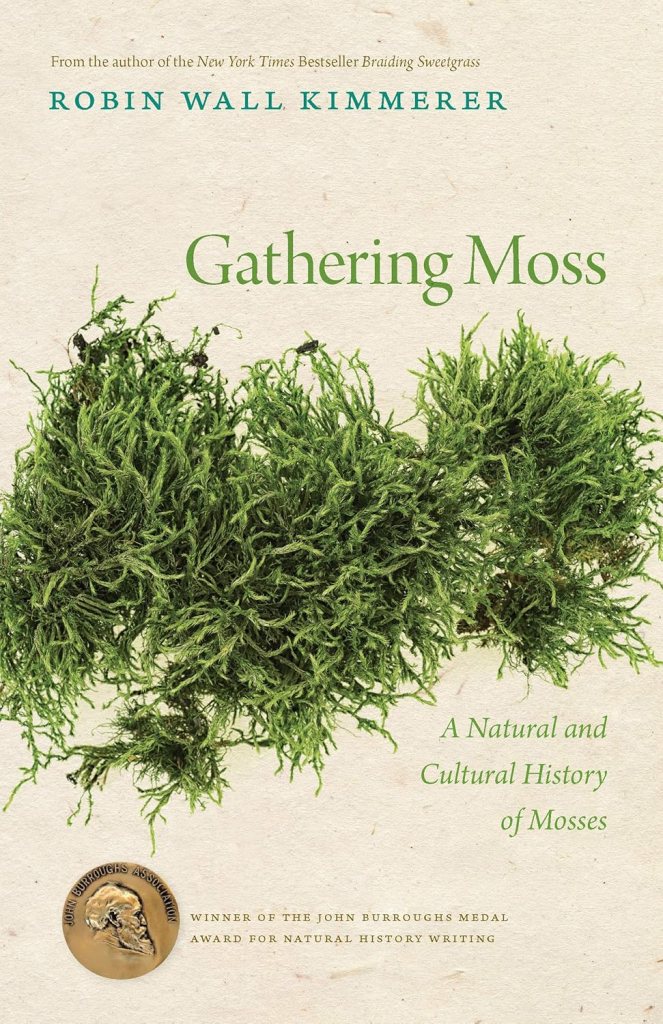
Review of Robin Wall Kimmerer’s “Gathering Moss: A Natural and Cultural History of Mosses”
This book has so many layers I hardly know where to start. First of all the prose is so beautifully poetic that aspiring writers of any genre should read it as a sterling example of that alone. Her use of analogies and metaphors add so much for the depth it reveals about this incredible author whose indigenous roots shine brightly in her books.
I never would have imagined that there could be that many varieties of mosses or that someone could devote their life and earn a PhD to their study. Our world is full of wonders, many of which are consistently overlooked. The beauty of mosses is clearly overlooked by the average person, myself included.
I love nature of all varieties, and was fascinated as well as astounded by the botanical side of this book. Who has ever expected more beauty from a moss beyond its soft, velvety touch on tree trunks or an old stone wall? That some mosses you may find are as old as the place they occupy? That they are true home-bodies and don’t respond well to being moved? That they can live for centuries, yet are so sensitive and particular about where they grow?
How many people realize that moss has amazing absorption qualities such that it can hold 60X its weight in liquid? Or that prior to the availability of cloth much less Huggies that ancient woman used it for diapers or sanitary products? If you need a trivia question no one is likely to guess there’s one for you!
Robin’s love for nature is impossible to miss. As a Native American she has a connection to Mother Earth that most white people lack. A couple times when she mentioned a species evolving I had to smile. I guess you can’t get to PhD level without being indoctrinated to the white scientific view of the world to some degree. But surely in her heart she knows that each of these beautiful plants was created as were all the animals and humans.
Her experiences during her research were fascinating. Canoeing through rivers embraced by steep canyon walls, a research center accessible only by boat where she would spend summers with her daughters, a consulting job at some anonymous wealthy owner’s estate who was trying to coerce nature to his will, thinking money alone was enough.
As an integrated whole, this book is like a guided meditation. It’s about so much more than the science of bryophytes. The title has as many layers as the book itself. Like the cliche, “A rolling stone gathers no moss,” it beckons you to slow down and look closer at the world around you.
This book is a masterpiece. Think of it as a walk through the woods on a spring day, not to be rushed, expectations open, or you’ll miss its magic. It’s encouraging to see how popular her books are, that people are seeking a world that those obsessed with power and greed have tried so hard to hide.
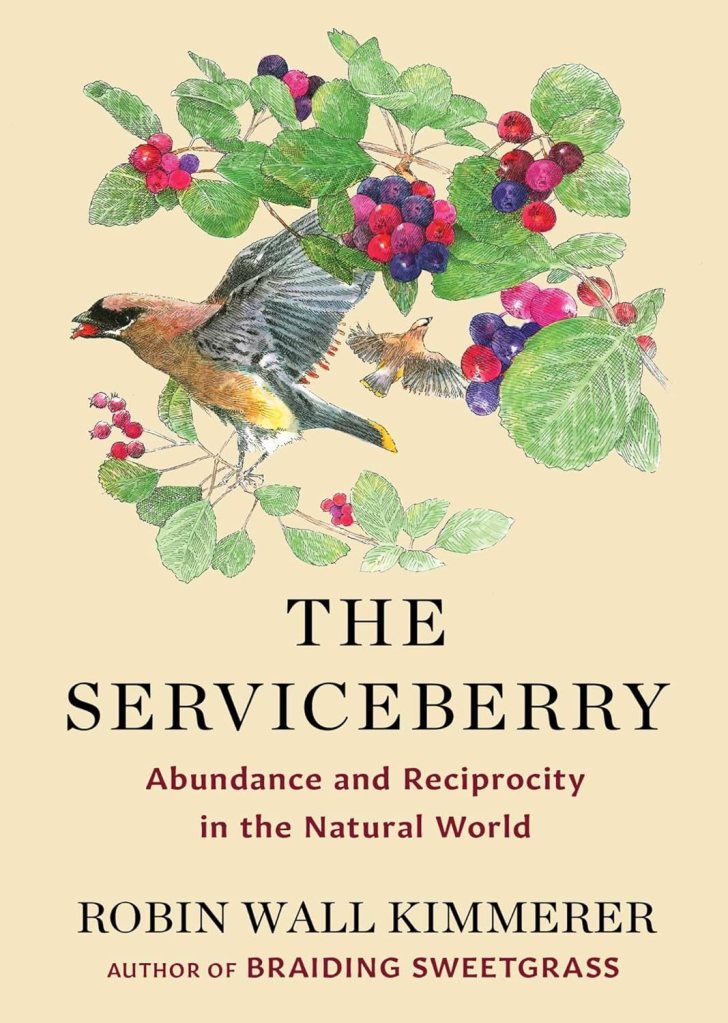
Review of “The Serviceberry: Abundance and Reciprocity in the Natural World” by Robin Wall Kimmerer
This beautiful little book gives you plenty to think about. The illustrations complement the text perfectly and help convey it’s sweet message. I expected it to be a bit longer, but it’s the expansion of an essay/article done previously.
I love the author’s insights based on her Native American heritage. There is so much wisdom there. The core message of the analogy to the serviceberry is reflected in the subtitle, “Abundance and Reciprocity in the Natural World.” Everything we have and need comes from the Earth as a gift. We should take only what we need. Greed and hoarding are not how nature operates. When do we attain the feeling of “enoughness?”
It’s message is also nicely expressed in Chief Seattle’s quote, “Take only memories, leave only footprints” from a speech he gave on honoring the environment.
Sharing builds friends and community. Giving back benefits both the donor and the recipient. She states, “Gratitude and reciprocity are the currency of a gift economy, and they have the remarkable property of multiplying with every exchange, their energy concentrating as the pass form hand to hand, a truly renewable resource.”
She tells the story of a little wooden “Free Farm Stand” that was placed by the road where excess produce was left for people to take. The irony was that when winter approached and the stand was shut down, someone took the sign literally and actually took the stand itself! Fortunately, a young man in the area was working on his Eagle Scout Award and planned to build a new one as his project.
Many years ago I lived in a community that dated back to the 1800s where everyone knew each other. Probably more than half of them were related, progeny of the town’s founders. Our children played together, we shared our talents and our harvests. We bartered, eggs for fresh milk and various other exchanges.
This is fairly easy to do in a small community. She mentions potlatches, which I was not familiar with, so I looked it up. The American Heritage Dictionary defines it as “A ceremonial feast among Indian tribes on the northwest Pacific coast to which the host distributes gifts requiring reciprocation.”
I have seen that on a smaller scale, where you would take a treat or dinner to someone and tell them to pay it forward to someone else as opposed to paying it back to the giver. To think this was a inherent part of Indigenous culture is thought provoking at the least.
These practices are more easily accomplished in small neighborhoods where everyone knows each other. It brings to mind something I read in Nancy Red Star’s book, “Star Ancestors,” about a great migration that occurred thousands of years ago. The people were advised not to stop and build cities, but of course some of them did.
If you look at cities today you can see the wisdom of that advice. In cities people lose touch with one another. Jean-Jacques Rousseau, clear back in the 18th Century, argued that humans were happier and more virtuous in a “state of nature.” Cities, civilization, and fancy social structures just made people fake, greedy, and miserable. He saw city life as the root of inequality and moral decay. He believed living close to nature, simple living, and smaller, self-sufficient communities — not the crowded, artificial world of cities, was the way to live. Centuries later, Henry David Thoreau echoed the same sentiment in Walden Pond.
Going deeper into that subject opens Pandora’s Box, so I’ll leave that for another day.
Indigenous cultures had a beautiful concept of community and taking care of one other. Small communities often operate in a similar manner. Each of us could start with our families by instilling the concept of giving, reciprocity, and gratitude, then expanding it to friends, neighbors, and relatives.
After all, it’s the family where such beliefs should begin.
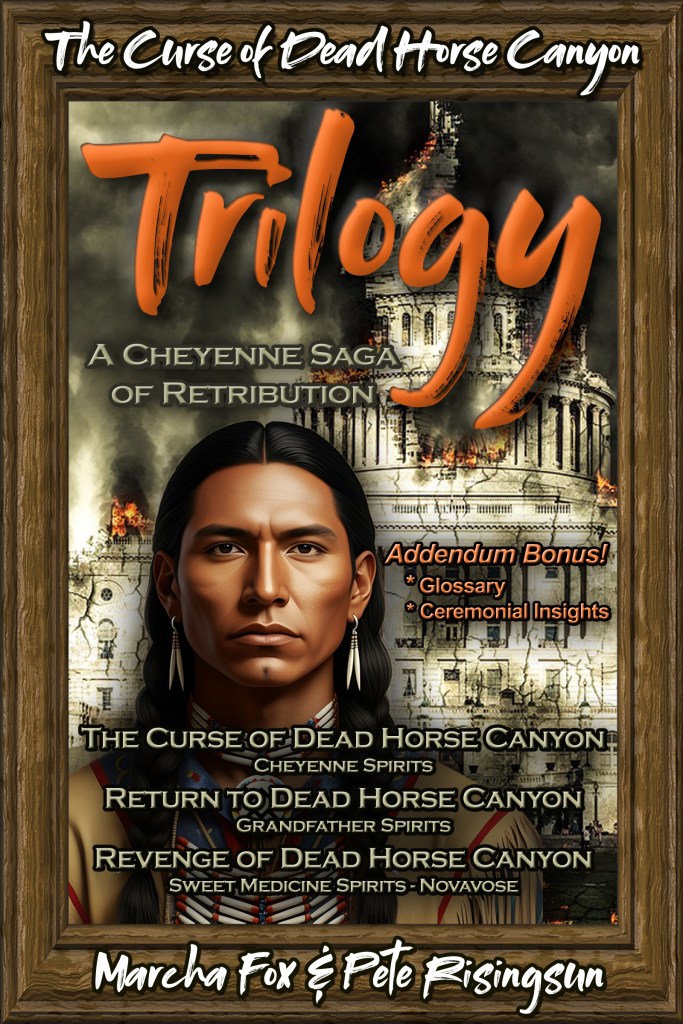
Grab your reading glasses and find a comfortable chair! Reader’s Guides for all three books in The Curse of Dead Horse Canyon Trilogy are now complete! You can download each one in pdf format below as well as on each book’s respective page on this website.
Note that there are two for each book. The “Thematic” version is much shorter and addresses the book as a whole. The Reader’s Guides are more comprehensive, especially for Books Two and Three. These proceed chapter by chapter while they’re grouped for Book One.
Just for fun, trivia, a playlist and even a few recipes are included. Why? To further relay the tone, feeling, and in some cases, taste, of the books.
Along those lines, here’s a link to some indigenous music I love to get you in the mood. It’s not Cheyenne, it’s Australian, but who can resist that beat? Why is it here? This is what Charlie and Sara are listening to when they’re searching for Bryan’s data! This scene is found in Chapter 42, Canopus, of The Curse of Dead Horse Canyon: Cheyenne Spirits.
This trilogy not only lent itself to reader’s guides, but demanded them. Why? Serious readers, including book club members, crave a deep dive into complex stories. This trilogy is loaded with characters, each with their own agenda. So many that a dramatis personae was included in each book to help keep them straight. Greedy oil barons, corrupt government officials, and lobbyists on one side with charismatic indigenous men and women reestablishing a culture white men tried to destroy on the other–plus a wide variety of other supporting characters.
Their destiny? Light the fuse on a 19th Century curse.
Here are a few comments from emails I received:
“…intrigued, not only by the depth of the storyline, but by how seamlessly you blend Indigenous prophecy, science, and spiritual awakening. That balance isn’t easy to strike, yet your work does it with power and purpose.”
“You two are such a powerful creative force, and this story is proof of what fiction can be when it’s written with purpose, cultural depth, and emotional honesty. The pacing, the point of view shifts, the drama, the reverence– even the surprising emotional pivots and that healing ceremony…wow came together in a way that felt epic, yet deeply personal.”
“An explosive conclusion blending conspiracy, cultural heritage, and spiritual awakening is an incredible hook. The depth you’ve woven from Cheyenne prophecy to modern corruption creates a narrative that’s both gripping and profound.”
What are you waiting for? Dive in today, armed with a Reader’s Guide that will assure you don’t miss a thing. If you do, it’s okay. Multiple readers have reported reading the books more than once, catching details they previously missed.
And when you’ve finished devouring the saga please leave a review! Reviews help other readers find books they’ll like and help authors as well. If you read reviews before you buy something, then you know how important they are.
The Curse of Dead Horse Canyon: Cheyenne Spirits (Book 1)
If you’ve read any books in the Dead Horse Canyon trilogy you’ve encountered numerous instances where Charlie received a message from something other than another human being. In the Cheyenne culture these messengers are known as the maiyun, or spirit helpers. When I was writing these stories and Charlie would come across one, I always wondered if it was a stretch, my imagination getting out of hand. However, my coauthor, Pete Risinsun, always assured me they were quite typical in his culture.
If we focused on tuning into nature, considering we’re all part of the same greater, spiritual whole, we could hear them, too. You could start with noticing spirit animals, which is when you spot anything from a spider, bird, squirrel, or other wild animal that gets your attention. What is he or she trying to tell you? Often it will relate to one or more of its characteristics that you would do well to replicate. You can find a previous blog on spirit animals here.
If relating to an indigenous culture is too much of a stretch, try reading about the experiences of someone from a more familiar western way of life; someone whose work provides a bridge of sorts between the two belief systems. One I’ve learned from is medium, Rob Gutro, who has first-hand experience with the world of spirits.
I first discovered his books when I stumbled upon his “Pets and the Afterlife” series after losing one of my fur babies, an 18 year old Bengal named Ophelia. He not only channels humans, but pets as well, providing information he couldn’t possible know or understand, yet has meaning to grieving pet parents. I found considerable comfort in the stories, which include information on signs to watch for that your pet is paying you a visit from beyond the Rainbow Bridge.
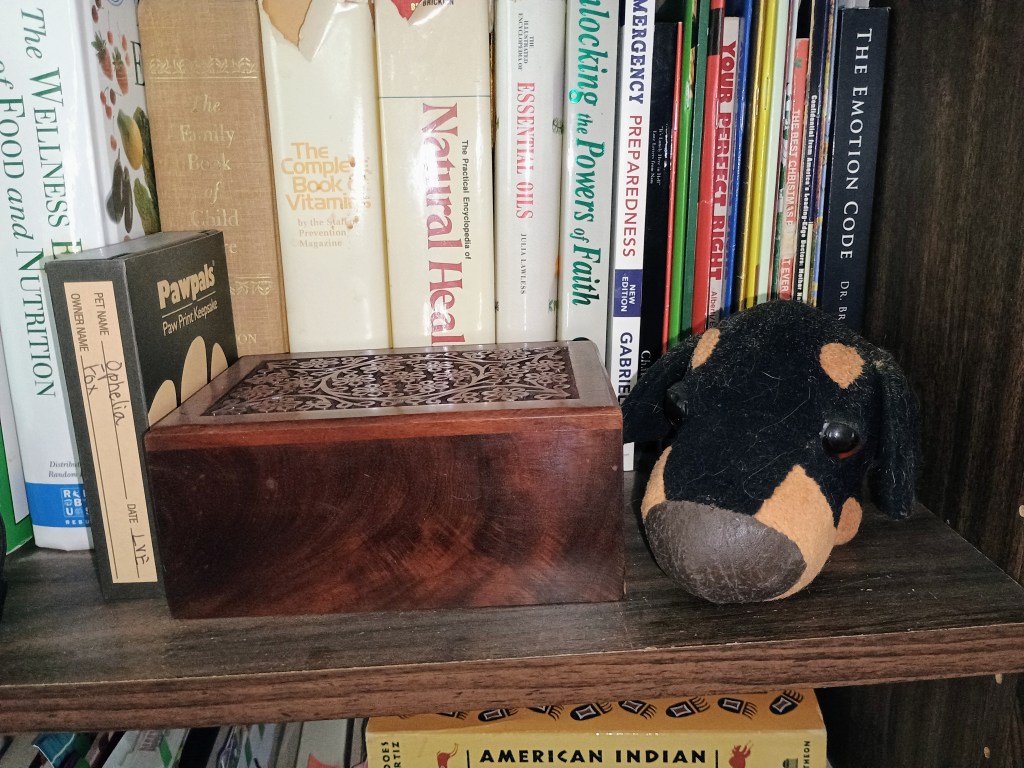
Indeed, shortly after reading the first book in that series, Ophelia did, indeed, come to visit one night. I have her cremated remains on a bookshelf in a little wooden box. Next to it is her favorite toy that she used to carry around. When she did, she would meow as Bengals do which, with the toy in her mouth, came out as a distorted blood-curdling yowl.
She loved her “baby” and often slept with it. And one morning, when I got up, her “baby” was on the floor. There was no other way it could have gotten there since it was out of reach of my other two cats. Furthermore, there was a chair stacked with pillows in front of it, so it should have fallen on top. If one of the cats had jumped on it, the pillows would have fallen. However, the toy was not only on the floor, but underneath the chair.
I’m sure she’s come by other times as well, most likely with her much larger brother, who passed in 2020, which I suspect is what’s going on when my other two cats are staring with wide eyes at something I cannot see.
If you have ever lost a beloved pet, I highly recommend this series. I had the first two books, both of which I’ve given away to friends and family when they were grieving a similar loss.
Thus, when I encountered another of Gutro’s book, “Kindred Spirits: When a Medium Befriends a Spirit” I was fascinated. The other books were very informative about the Spirit World, so I wondered what else I might learn. A few details came out that were new and directly related to the Cheyenne concept of maiyuns.
One very basic concept is that our deceased loved ones are not as far away as we may think. He explains how spirits are those who “go into the light” when they pass while ghosts remain in a fixed location for some reason known only to them. Sometimes they’re lost or confused and can be helped to cross over, which Gutro has done on occasion.
If you’ve read the Dead Horse Canyon books, you may recall White Wolf and Charlie talking about doing that in book 2 when they drove to Billings to get a new alternator for the Explorer and perceived spirits along the highway, which according to Gutro’s explanations, would have been ghosts.
Gutro noted that spirits can interact with anything living. There are various instances in the trilogy where Charlie encountered just that. What comes to mind is whether it was the spirit of the aspen tree (Book 1, Chapter 6), or the squirrel (Book 3, Chapter 43) that spoke to him, or was it a spirit of one of his ancestors prompting the interaction?
According to Gutro, visiting spirits often leave something for you to find, like a coin. In most cases its date will relate to the person in some way, such as their birth or death year, or other key time, for example when you met. Such an example in the books is the arrowhead Charlie came upon during a trail ride. (Book 2, Chapter 39). Later, in Book 3, White Wolf told him that a maiyun spooked the horse so that he would fall off and find it.
Gutro also mentioned how a person’s energy is retained in their cherished possessions. This is what “sentimental value” is all about. What do you have that is quite possibly just sitting around collecting dust, but you simply can’t get rid of it because it means something to you or did to someone you cared about and is now gone?
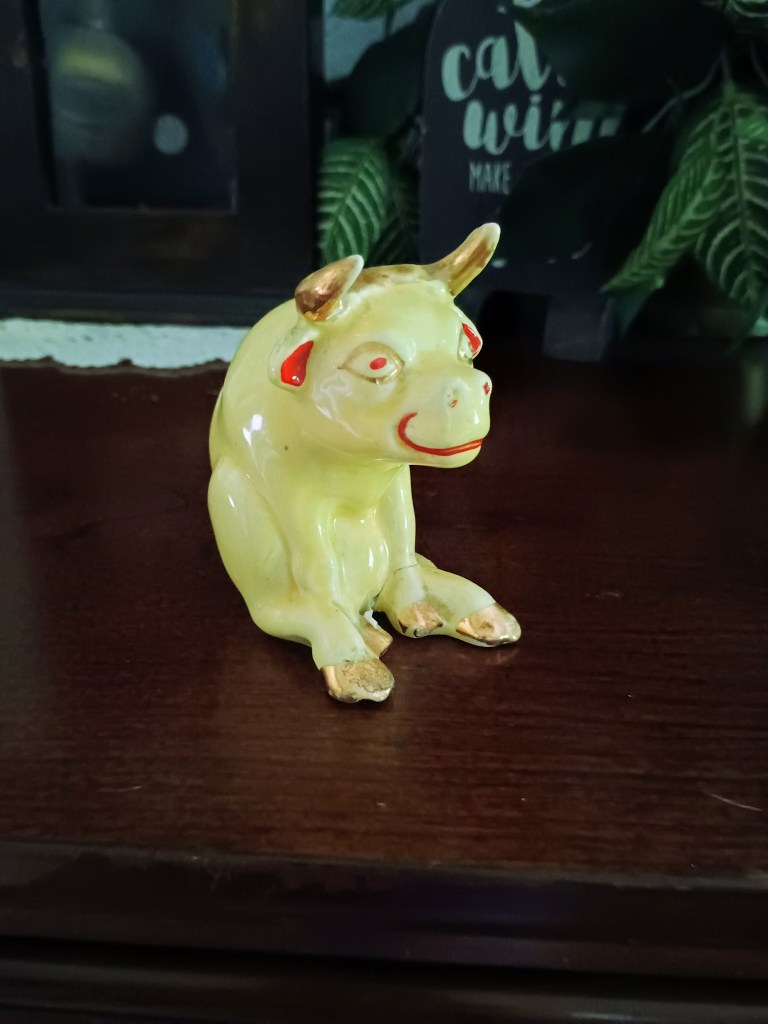
Here’s an example of such an object I have doing just that. That little knick knack,
which is older than I am and at one time cost $0.79, which is inked on the bottom, belonged to my mom. As long as I can remember it sat on the kitchen windowsill. I have no idea what it meant to her or why, but it was always there, and has been broken and repaired numerous times. For whatever weird reason, I think I would protect that little bull with my life! (Maybe not, but you get the idea.) Something about that little guy touches my heart.
Not long ago, a friend sent me something and when I received it I could feel the affection it contained. That made me rethink my usual practice of having presents drop-shipped to save money rather than reshipping them myself. Should I be infusing these gifts with affection, like Star did with the gifts for Sara and her family in Book 2? And what about Amasani’s blanket, (Book 1, Chapter 24) that conveyed her love and comfort to Charlie?
I can’t help wondering about trickster maiyuns, like the ones that always caused minor household problems whenever White Wolf and Charlie were away from home. If you’ve ever had a friend or relative who was prone to practical jokes, could that be their origin? Still up to no good in the afterlife?
Gutro’s knowledge of the Spirit World has vast similarities with what the Northern Cheyenne and other indigenous cultures not only know but take for granted. Spiritually enlightened people continue to remind us we are all connected and love is the strongest energy there is. We can always hope that daily living spirituality is making a comeback.
The real question is not only why but when was it lost to the white man, but not indigenous people?
History undoubtedly holds the answer.
[Note:–The Dead Horse Canyon Trilogy mega-ebook that contains all three Dead Horse Canyon volumes is now on Kindle Unlimited! If you haven’t yet indulged in this series and don’t have Kindle Unlimited, you can get your copy for only $7.99, a 38% savings over buying the ebooks separately, plus a special addendum is included.]
Have you ever wondered how Pete Risingsun, a Northern Cheyenne elder living on the tribe’s reservation in southeastern Montana, and Marcha Fox, a science fiction author living in Texas, became coauthors? If so, you’ll want to read the article published by the staff of Soaring Eagle, the charitable organization that supports the Heritage Living Center for Northern Cheyenne elders where Pete resides. You can find it in the Spring edition on their website here. That organization was key to facilitating this incredible partnership that has produced three award-winning novels over the past five years.
Pete and Marcha have never met face-to-face and he does not even have a computer! Phone calls, texting, and snail mail were the vehicles used to communicate, collaborate, and produce over 1400 pages of an incredible three-volume story.
The response to the article was great, as shown by a significant increase in book sales. Of particular interest was a letter, which you can see below, that was sent to Soaring Eagle by a woman who read the newsletter and as a result purchased and read the three books.
The biggest challenge for most authors, especially those that are self-published, is finding their audience. The Dead Horse Canyon Saga is unique, making this even more difficult since it doesn’t fit a single genre. However, with multiple story themes including a government conspiracy, murder, a detailed glimpse at Cheyenne history and ceremony, deep bonds of family and friendship, to say nothing of Charlie Littlewolf’s transformational journey back to his roots, there is something for everyone.
So far the three volumes have captured a total of 13 awards. This includes 5-stars and glowing reviews from Readers’ Favorite for each book, along with prestigious Book Excellence Awards.
Fans of the Longmire series (Craig Johnson’s books as well as the TV series) or the Leaphorn and Chee stories by Tony Hillerman and continued by his daughter, Anne, (novels and the Dark Winds TV series) are likely to enjoy these books. Dead Horse Canyon takes an even deeper dive into native culture and history with characters the reviewer from The Book Commentary described as “lovable,” while an Amazon reviewer of the third book described them as “Characters you will fall in love with. Characters you will fantasize horrible death wishes for with fingers crossed. And sleepless nights as you read it.“
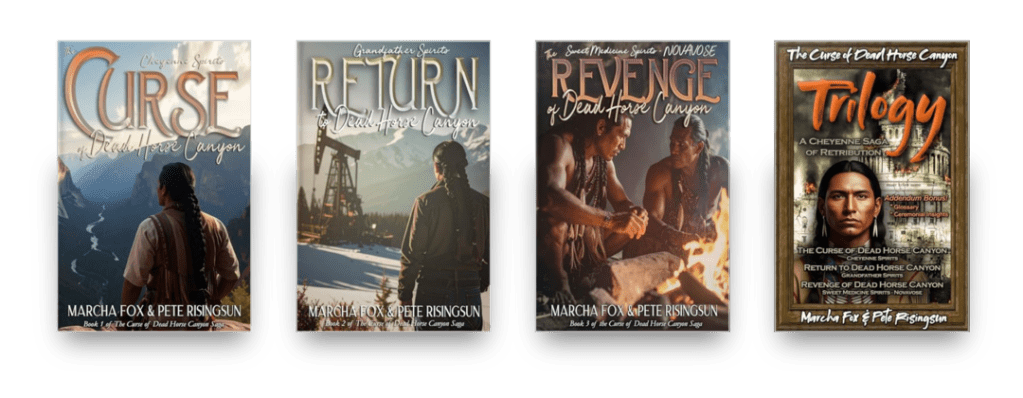
It’s been said, “Do not to judge a book by its cover.” Just in case this is an issue, new covers are coming the end of June! Stay tuned!
Pete Risingsun, my coauthor, and I did a vast amount of research when we wrote “The Curse of Dead Horse Canyon” trilogy. The depiction of the Cheyenne culture is accurate. The history referred to in the stories really happened, save that which was clearly made-up, though even that was feasible. Abandoned mines definitely are a pollution issue. The astrology is actual for the time and place and characters involved, which is weird and another blog in itself.
But if there was one thing that was made up it was the source of the conspiracy, i.e., the Pearson Underground Residence Facility (PURF).
Or was it?
My jaw dropped when a friend sent me this article about just that, such a facility on an even grander scale than I have in our novel! Check it out here.
The article in The New York Post linked above opens with the following paragraph, “The federal government has secretly spent trillions building an elaborate network of subterranean ‘cities’ where the rich and powerful can shelter during a ‘near-extinction event,’ a former Bush White House official sensationally claimed.”
Much of its source and, if you’ll excuse the expression “from the horse’s mouth,” can be found in this short video (12 minutes) where Elizabeth Austin Fitts, who served as the assistant secretary of Housing and Urban Development for Housing between 1989 and 1990, talks about it on Tucker Carson’s podcast.
While I knew there were plenty of underground bases (because the History Channel says so, right?) which made PURF credible, I had no idea it was even worse than I imagined!
So if anyone out there thinks that part of the story is a stretch, bear in mind that they have actually spent even more, by several orders of magnitude, than I have noted in the books. We’re talking TRILLIONS whereas in the story it was BILLIONS.
The money probably came from those “magic money machines” the DOGE team found, right? The actual corruption coming out these days makes my fictitious situation pale by comparison.
While Pete and I were writing these books I was amazed by how many actual situations–historical and otherwise–fit perfectly. Particularly, as we researched Cheyenne ceremonies, much came out that drove and further defined the storyline. I didn’t know anything about the Massaum as the Earth Giving Ceremony, the meeting of Indigenous leaders at Walker Lake, Nevada, or any number of other things when I conceived this story. I knew how it would end but I had no idea how.
As I look back, I can’t help but wonder where this story came from? Mine and Pete’s imagination? I may have mentioned this before, but I’m what they call a “pantser,” not a “plotter.” In other words, I write “by the seat of my pants.”
I start with a very general idea/theme in mind. I populate it with characters and turn them loose. I’m more of a scribe than an author making the story up. I simply watch what they do and write it down. My characters repeatedly get themselves into scrapes where I have absolutely no idea how they’ll get out.
But they do. Usually in some way I never dreamed of.
Did I channel these books rather than make them up?
I think most of us can agree there are other dimensions out there. Psychic phenomena are very real and no doubt operate in some other reality beyond what we can currently detect. Did these stories actually take place in one of them?
I had much the same experience while writing the Star Trails Tetralogy, especially in “The Terra Debacle: Prisoners at Area 51″ in developing the science behind a telepathic walking plant.
One of the reasons I love research is all the amazing, serendipitous factoids I uncover that fit and often drive the plot and action. It’s as if the story is already out there, just waiting for some writer’s muse to whisper it in their ear.
I must say, not knowing what will happen makes writing as much fun as reading. I like to think that if it has me in suspense that such will be conveyed to my readers as well.
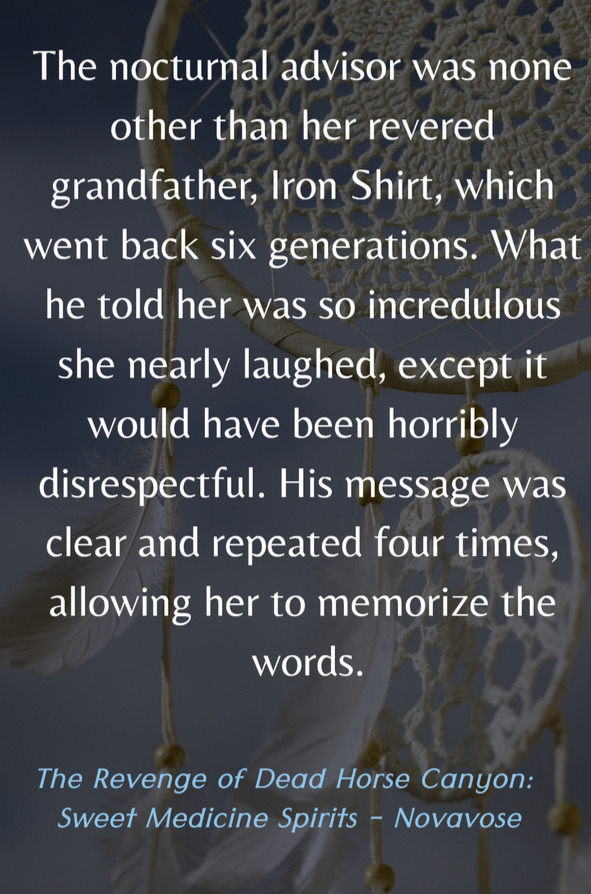
Here’s one teaser from “Revenge of Dead Horse Canyon: Sweet Medicine Spirits – Novavose” where I had absolutely no idea what would happen. The character in question popped up quite late in the book, but she fit perfectly.
If you’d like to get the entire trilogy in a single mega-ebook that also includes some bonus material about that Earth Giving Ceremony, you can pick one up on Amazon here.
Let me know in the comments what you think regarding where stories come from as well as whether you find my stories predictable. Like I say, I know how they’ll end, but rarely if ever know how it comes about.
I believe that most artists, like myself, are basically insecure. Especially those of us who are perfectionists. We’re acutely aware of any flaws in our work and cringe at their discovery. Nonetheless, authors look forward to readers’ reviews, albeit with fingers crossed, that they’ll be good.
Imagine my horror when my latest release got an abysmal 2-star nasty review! Not only had I made a mistake that she gleefully pointed out, but said it was “long and boring.”
OMG!
Part of what she criticized actually was a mistake (and perfectionist that I am, immediately corrected), but clearly she didn’t have the same experience I had with how some Texans butcher English grammar.
It’s been said that a book doesn’t have true credibility until it has a few “bad” reviews. True as that may be, it’s not much consolation when it’s your book. Especially when it was only the second review posted, so it dragged the rating down significantly, as you can see above.
I immediately turned to people I know who’d read it as well as the previous two books and asked for their honest opinion. I really wanted to know if it was that bad, not fishing for unworthy praise. If it was truly that awful I was ready to unpublish it and do some serious editing. I was told that it was just fine, there was nothing wrong with it, the person simply didn’t “get it.”
Only slightly consoled, I decided to follow the advice of a fellow author’s blog which stated to check out the bad reviews given to some of the classics.
Such as this 1-star review of Hemingway’s “Farewell to Arms” that states, “This is, according to critics, one of Hemingway’s best books. If so, I really cannot fathom his greatness. Really boring book that feels neither exciting nor, for that matter, educational. Just dry…”
That helped.
Then I found this 3-star review for Charles Dickens’ classic, “A Tale of Two Cities:” It’s dense, wordy, and often confusing, making the story tough to follow and, at times, flat-out boring. The writing felt clunky, not lyrical, bogging down the epic scope with unclear details and slow pacing.
By then I was starting to see my reader friends were right. It’s all a matter of “getting” the story’s meaning. Having the mental and emotional depth to comprehend something that’s not the usual straight-line plot loaded with continual action is not every reader’s superpower.
Did being described as “boring” rank me with other great misunderstood authors?
Probably not, but it was a pleasant, albeit fleeting, thought. 😉
The reviewer admitted she’d “skipped” several parts and hated the ending. No doubt by skipping certain parts she missed the context leading up to the finale, detracting from its impact and meaning.
As I write this, I know of at least one reader who is already reading it for the second time. Her first read was a marathon race to whiz through it, just wanting to know what happened. Now she’s reading it to savor and absorb all that it contains.
The book has 569 pages. That is definitely long.
Why?
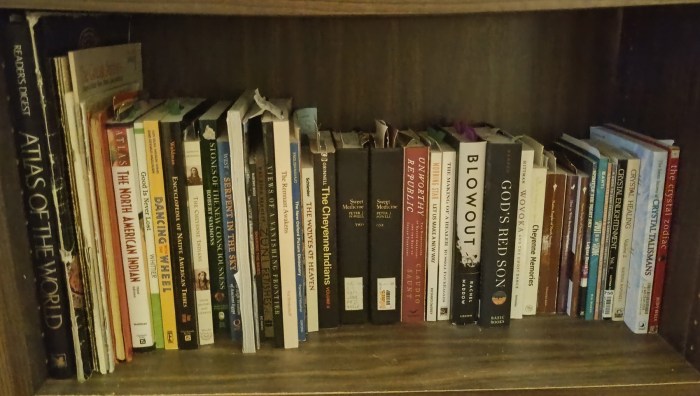
Let’s just say I have more than one shelf filled with books used researching this story along with my co-author, Pete Risingsun.
We read thousands of pages. More time was spent researching and crafting the story than writing it. Our idea of “perfection” was to present an accurate representation of Cheyenne culture, ancient and modern, as well as all they suffered at the hands of the U.S. Government. Their ceremonies have deep spiritual meaning, often beyond the comprehension of readers whose view of Native Americans hails from watching old TV shows like Gunsmoke depicting the “Old West” with its “cowboys and Indians.”
A 5-star review I found for Dickens’ “A Tale of Two Cities” helps explain this syndrome. This wise reviewer states, “I feel that this book is not viewed as being one of the top tier of Dickens works due to the fact that it is thrust upon grade 9 students as an introduction to literary classics and, being so, its impact and overall cultural power has become diluted due to the audience that initially received it. It is not in regards to the content of the work itself. The intellectual abilities of students of this educational level are not able to understand the historical era, appreciate the fluent descriptive nature of the writing nor to comprehend the literary nuances that the author presents.”
And there you have it.
Readers may consider a story “boring” when they can’t grasp its depth, context, and meaning.
Granted, many books lack all three and are the ones I’d be likely to give a 2-star review along with those riddled with typos, poor formatting, grammatical errors, plot holes, and so forth.
Reviews say as much about the reviewer as they do about the book. If they scare away readers like themselves that’s a good thing if it precludes more unfavorable reviews, right?
Forgive me for sounding defensive, but the fact the book earned both a Book Excellence Award and 5-stars from Readers’ Favorite since that horrific review helped restore my confidence. Hopefully, those awards also restore enough credibility for the story to highlight that bad review for what it is.
In the aftermath of that 2-star slam, truly the worst I’ve ever had, I cherish the Readers’ Favorite reviewer’s statement.
“This finale succeeds with a perfect 10 landing. Very, very highly recommended.”
It brought tears to my eyes. Thank you, thank you, thank you!
Needless to say, I’m beyond grateful that she “got it.”
My method of writing is generally referred to as a “pantser,” i.e., I write by the seat of my pants. The other prevalent writing style that of a “plotter,” where the author determines the entire story, scene by scene, in an outline. I tried plotting, but my characters persistently got out of hand. They’d refuse to follow my plan and do their own thing. It didn’t take long to discover they had a better grip on the story than I did. Thus, I became a “pantser.” I populate my story idea with characters, then sit back to watch what they do as would a dutiful scribe.
I began work on this saga before connecting with my co-author, Pete Risingsun. I had a handle on the story’s government conspiracy angle, but lacked cultural knowledge of my main character, Cheyenne Charlie Littlewolf. I wrote what he told me to, but didn’t know whether it was feasible.
As a science fiction author, I wondered.
Was my imagination getting carried away?
I tend to obsess over accuracy and can get carried away with research. I started reading books on Native American cultures, but I needed to find a Cheyenne elder who could let me know if what I had written from Charlie’s point of view was accurate or too off-the-wall.
When Pete got involved he assured me that the various incidents I’d included were indeed realistic in the Cheyenne world. I smiled, relieved to learn Charlie was not leading me astray.
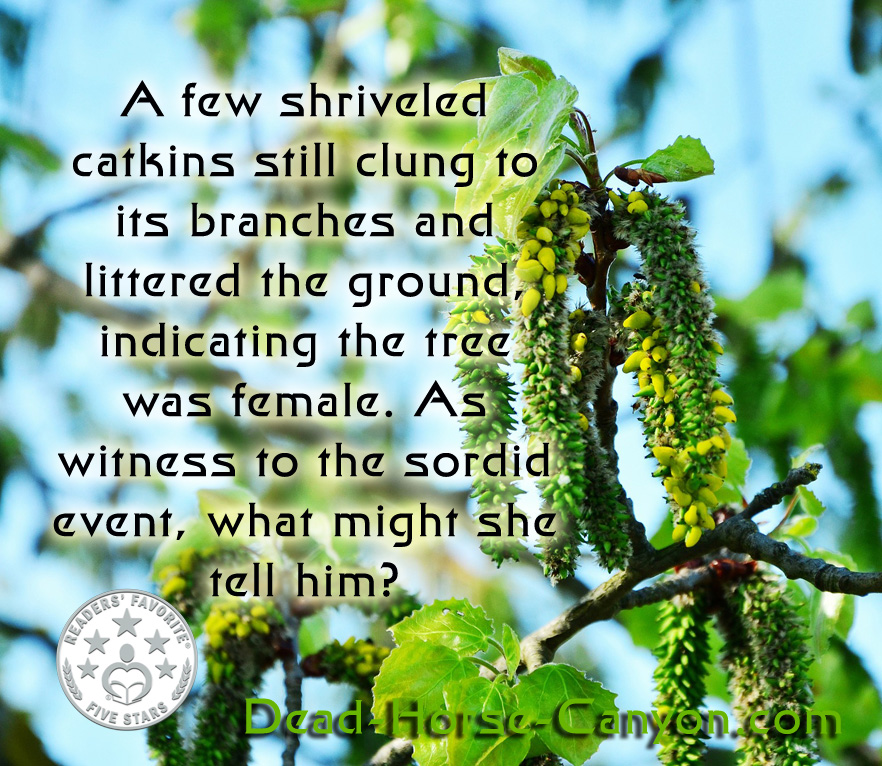
One incident that I wondered about is depicted in chapter six, “The Aspen,” of the first book, “The Curse of Dead Horse Canyon: Cheyenne Spirits.” It’s there that Charlie receives a message from the aspen tree that witnessed the wreck that killed his best friend. Besides numerous others, another one of my favorites is in the second book, “Return to Dead Horse Canyon: Grandfather Spirits,” where in chapter thirty-nine, “Trail Ride,” Charlie finds an ancient arrowhead that tells him and his brother, Winter Hawk, (cousin in western culture), that their prayer regarding the fate of the murderer had been heard.
As work on the saga continued, more and more research came into play. The works of George Bird Grinnell as well as Peter John Powell were excellent sources, but had limitations. I find it ironic that some of the most detailed information on ancient Cheyenne (Tsistsistas) beliefs and ceremonies is conveyed by German anthropologist, Karl H. Schlesier. His book “The Wolves of Heaven” was priceless while writing this trilogy, especially his detailed description of the Massaum, the Earth Giving Ceremony, that plays a key role in the final volume. In a typical episode of serendipity, I found Schlesier’s book on Amazon, attracted by its subtitle, “Cheyenne Shamanism, Ceremonies, and Prehistoric Origins.”
Or was it a maiyun who brought it to my attention?
What is a maiyun?
Schlesier tells us they are powerful spirits that associate with human beings. There are also the hematasoomaeo, which he describes as “the immortal spiritual forms of plants, animals, and human beings. . . .The maiyun most responsible for physical life on earth belong either to the deep earth or to the sky places. In Tsistsistas ceremonies they are celebrated especially and represented through plant and animal forms.”
The lodge of the maiyun is the Sacred Mountain, i.e., Novavose. (You’ll meet plenty of them in “Revenge of Dead Horse Canyon: Sweet Medicine Spirits – Novavose.”)
Why have western religions denied the existence of such things? Claim that animals do not have souls, a belief with which any pet owner, farmer, or rancher will disagree? Slowly the world is awakening to the reality of other dimensions; recognizing the thin veil between life and death and the elusive nature of time.
Things ancient peoples took for granted.
Speaking of animals, a few months ago, my precious 18 year old feline fur baby, Ophelia, crossed over. I hoped that when she did, that she was reunited with her half-brother, Hamlet, who’d left this life four years before. Thus, I was drawn to the “Pets and the Afterlife” book series by Rob Gutro. He’s a medium who specializes in connecting with pets in the spirit world. These books contain dozens of stories of such experiences. The truth of what he envisions is validated by multitudes of grieving pet owners when he provides details of the encounter that he couldn’t possibly have known.
As I read Gutro’s books I couldn’t help but think of the maiyun–spirit helpers that indigenous people have relied on for millennia. What are “civilized” people missing by tuning out these messages and connections?
I am beyond grateful for my introduction to this marvelous world while writing these three tomes with Pete. My heart and mind lived there from July 2018 when this story was conceived until the final book was published in January 2025. My life is enriched beyond measure for the experience.
Two of my favorite quotes related to this lost wisdom were spoken by Tȟašúŋke Witkó (Crazy Horse), the Oglala Lakota Leader who said:
The red nation shall rise again and it shall be a blessing for a sick world; a world filled with broken promises, selfishness and separations; a world longing for light again. I see a time of seven generations when all the colors of mankind will gather under the sacred tree of life and the whole earth will become one circle again. . . In that day, there will be those among the Lakota who will carry knowledge and understanding of unity among all living things and the young white ones will come to those of my people and ask for this wisdom.
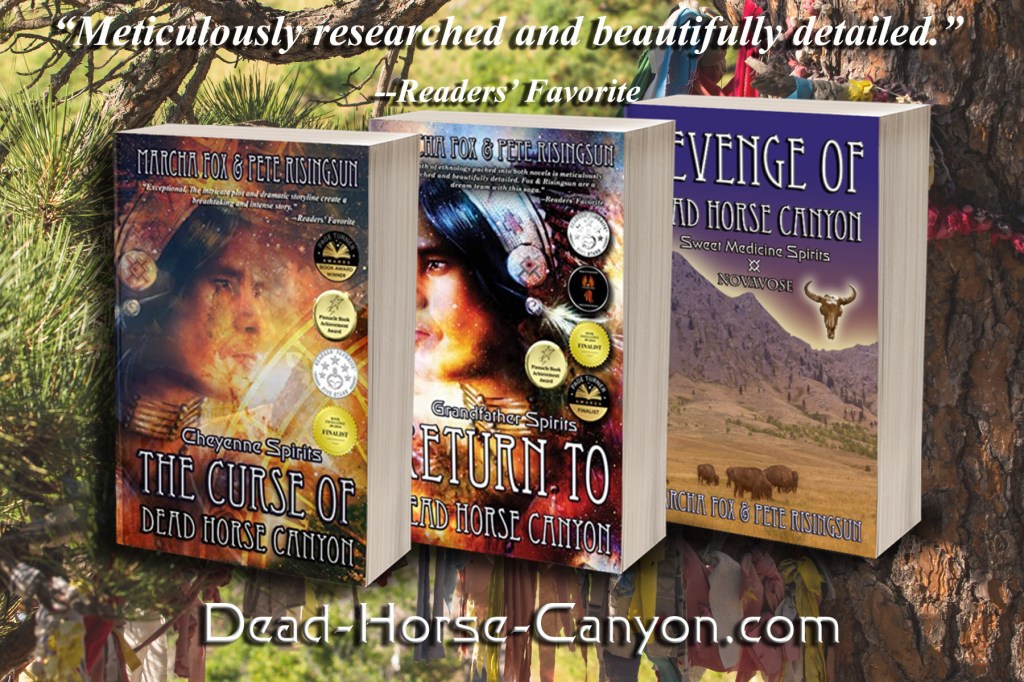
The Curse of Dead Horse Canyon Trilogy is a lengthy saga that is more than a juxtaposition of a corrupt government’s clash with Cheyenne spirituality. It’s an introduction to a world too many don’t yet see.
But as Crazy Horse declared, they will.
You can find the trilogy on Amazon and other online vendors.
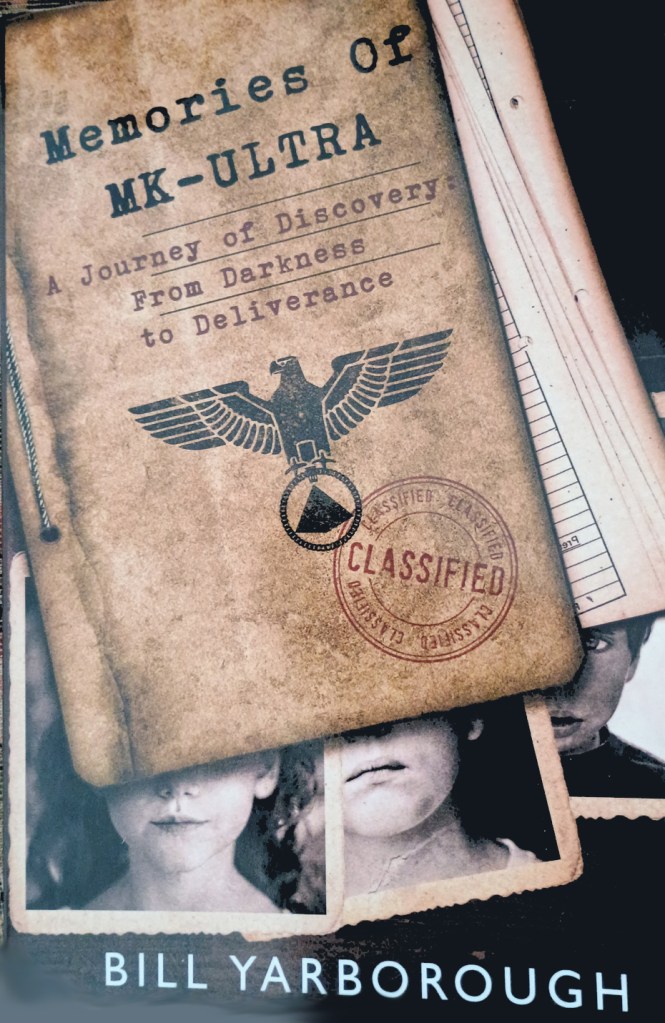
This book deserves to be a Best Seller for more reasons than I can count. For one thing, it’s informative. If you’ve never heard of MK-ULTRA, this will give you a close-up-and-personal view of what it was about. If you’re naive or unaware of some of the things that the U.S. Government has done, then it’s going to enlighten you in that area, also.
Indigenous people were not the only people the government lied to and abused. Many of their own natural-born citizens were used in experiments, often without their knowledge, much less consent.
Previous to reading this story I knew the basics of this program, specifically that it involved the CIA following up on work in mind-control techniques conducted by the Nazis during WWII. That alone, much less being highly classified, should be enough to demonstrate it was nothing short of evil.
I happened upon this book at an opportune time. Based on what I knew, I used MK-ULTRA as a backstory for a character in my latest book, “Revenge of Dead Horse Canyon: Sweet Medicine Spirits – Novavose.”
Oddly enough, while writing the story, MK-ULTRA arrived at my muse’s bidding and I wondered if it was a credible explanation for one of the character’s idiosyncrasies. My research seemed to validate it, but it was gratifying when nothing in this story contradicted what I’d assumed. Numerous scenarios in this book fit my character’s odd traits perfectly. Synchronicity, perhaps?
Actually, I have some very sharp muses who lead me to all sorts of things that turn out to be accurate and a perfect fit for the plot. Which is what I love about writing fiction.
The fact that the author is an MK-ULTRA survivor says it all. While written as a novel, the level of detail is such that its reality is inescapable. It pulls you right in, moving along at a fast pace and alternating between Tommy Matthews’ life after being subject to their experiments and flashbacks indicating what was done to him to motivate it.
While all the antagonists in the story are certainly evil, some are darker than others. From the purely scientific side, understanding how the brain and memory work is fascinating, useful data. It helps psychiatrists understand and help their patients. But when it turns to controlling another person’s life by programming them as an innocent child to pursue a malevolent destiny it’s another story. Using torture such as isolation, hallucinatory drugs, electric shock, and ritual sexual abuse to achieve it definitely treads on criminal as well as unethical ground.
Preventing this sort of thing is what the post-WWII Nuremburg Trials were all about!
It was fascinating to read of Tommy’s perceptions, then learn how that particular impression was programmed into him in the next chapter. One question that ran in the back of my mind was how on earth could responsible parents subject their children to such experiments? This was clarified by the end, which made it even more tragic. Some people simply should not be allowed to have children.
Yet who is qualified to define the criteria? Years ago, Indigenous people were subjected to forced sterilization as a means of genocide. Again, by the U.S. Government. See what I mean? Who decides who’s qualified to be a proper parent? Certainly not the government!
If brain research tell us anything, it’s that there are other realities outside the corporeal world and that “consciousness” goes beyond what is visible with our natural eyes. Aliens, UFOs, remote viewing, prophecy, shamanism, near-death experiences (NDEs), and everything else defined as “paranormal” are elusive when it comes to scientific investigation. Thus, closed-minded people dismiss them as hoaxes, imagination, superstitions, and so forth.
While this story did not emphasize the paranormal, there were enough references to sense its presence, which gave it all the more interest. My jaw literally dropped when I read the last sentence in Chapter 76.
When the three children grow up and start to remember and compare notes, it’s impossible to put the book down. I’m not a fan of “horror stories” and elements in this story fall into that realm, some downright gruesome, cruel, and heartbreaking. While it’s shocking that these innocent children and numerous others were subjected to these horrific experiments, the author presented them in an objective, journalistic way rather than exploit them in a graphic, gratuitous manner. Nonetheless, you cannot “unsee” what was revealed.
Anyone who doesn’t believe that a battle for the minds and souls of men has existed for millennia needs to read this book. If you know nothing about MK-ULTRA you are likely to be shocked. But being blind to unpleasant realities is what allows evil to persist, often right beneath our noses.












 The Curse of Dead Horse Canyon