Pete Risingsun, my coauthor, and I did a vast amount of research when we wrote “The Curse of Dead Horse Canyon” trilogy. The depiction of the Cheyenne culture is accurate. The history referred to in the stories really happened, save that which was clearly made-up, though even that was feasible. Abandoned mines definitely are a pollution issue. The astrology is actual for the time and place and characters involved, which is weird and another blog in itself.
But if there was one thing that was made up it was the source of the conspiracy, i.e., the Pearson Underground Residence Facility (PURF).
Or was it?
My jaw dropped when a friend sent me this article about just that, such a facility on an even grander scale than I have in our novel! Check it out here.
The article in The New York Post linked above opens with the following paragraph, “The federal government has secretly spent trillions building an elaborate network of subterranean ‘cities’ where the rich and powerful can shelter during a ‘near-extinction event,’ a former Bush White House official sensationally claimed.”
Much of its source and, if you’ll excuse the expression “from the horse’s mouth,” can be found in this short video (12 minutes) where Elizabeth Austin Fitts, who served as the assistant secretary of Housing and Urban Development for Housing between 1989 and 1990, talks about it on Tucker Carson’s podcast.
While I knew there were plenty of underground bases (because the History Channel says so, right?) which made PURF credible, I had no idea it was even worse than I imagined!
So if anyone out there thinks that part of the story is a stretch, bear in mind that they have actually spent even more, by several orders of magnitude, than I have noted in the books. We’re talking TRILLIONS whereas in the story it was BILLIONS.
The money probably came from those “magic money machines” the DOGE team found, right? The actual corruption coming out these days makes my fictitious situation pale by comparison.
While Pete and I were writing these books I was amazed by how many actual situations–historical and otherwise–fit perfectly. Particularly, as we researched Cheyenne ceremonies, much came out that drove and further defined the storyline. I didn’t know anything about the Massaum as the Earth Giving Ceremony, the meeting of Indigenous leaders at Walker Lake, Nevada, or any number of other things when I conceived this story. I knew how it would end but I had no idea how.
As I look back, I can’t help but wonder where this story came from? Mine and Pete’s imagination? I may have mentioned this before, but I’m what they call a “pantser,” not a “plotter.” In other words, I write “by the seat of my pants.”
I start with a very general idea/theme in mind. I populate it with characters and turn them loose. I’m more of a scribe than an author making the story up. I simply watch what they do and write it down. My characters repeatedly get themselves into scrapes where I have absolutely no idea how they’ll get out.
But they do. Usually in some way I never dreamed of.
Did I channel these books rather than make them up?
I think most of us can agree there are other dimensions out there. Psychic phenomena are very real and no doubt operate in some other reality beyond what we can currently detect. Did these stories actually take place in one of them?
I had much the same experience while writing the Star Trails Tetralogy, especially in “The Terra Debacle: Prisoners at Area 51″ in developing the science behind a telepathic walking plant.
One of the reasons I love research is all the amazing, serendipitous factoids I uncover that fit and often drive the plot and action. It’s as if the story is already out there, just waiting for some writer’s muse to whisper it in their ear.
I must say, not knowing what will happen makes writing as much fun as reading. I like to think that if it has me in suspense that such will be conveyed to my readers as well.
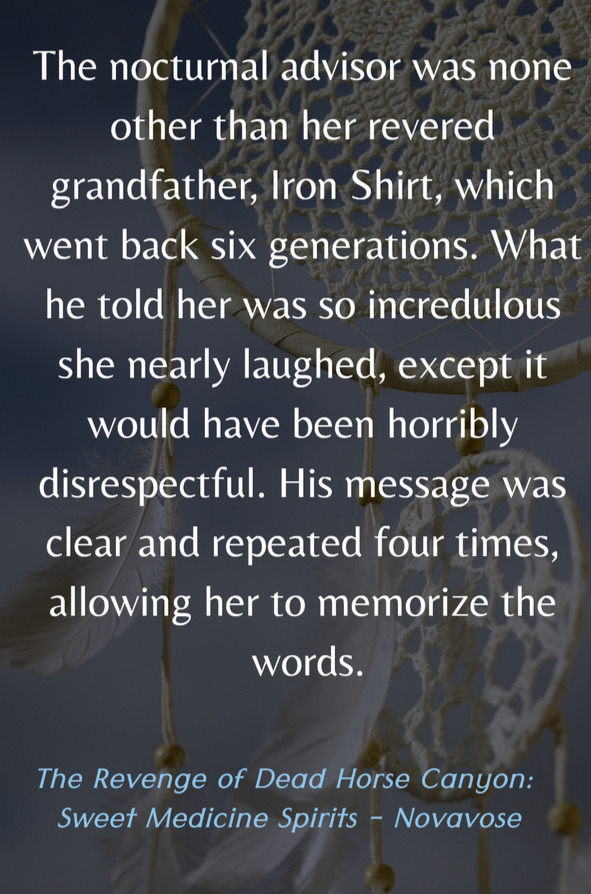
Here’s one teaser from “Revenge of Dead Horse Canyon: Sweet Medicine Spirits – Novavose” where I had absolutely no idea what would happen. The character in question popped up quite late in the book, but she fit perfectly.
If you’d like to get the entire trilogy in a single mega-ebook that also includes some bonus material about that Earth Giving Ceremony, you can pick one up on Amazon here.
Let me know in the comments what you think regarding where stories come from as well as whether you find my stories predictable. Like I say, I know how they’ll end, but rarely if ever know how it comes about.
Join me in standing with Native communities in their grief and anger over their stolen sisters and children. This MMIW Awareness Day, we remember all those who were never found and those who live with trauma and without the peace that justice can bring. I stand with Native communities in calling for reform and action from local and national governments and law enforcement so we can all work together towards #NoMoreStolenSisters.
For more information about Missing and Murdered Indigenous Women, follow Native Hope.
Watch the dramatization of an actual incident in the video below for further insights into this heartbreaking situation.
Missing and murdered indigenous women and girls (MMIWG) is but another critical issue that never makes it to the news. This is even more likely if you don’t live in one of the states most highly affected such as Arizona, New Mexico, Oklahoma, Montana, and various others. Major highways known for drug and human trafficking often cross remote areas of Indian reservations, conditions that make the victims easy prey.
The following is a direct excerpt from the Native Hope website that sums up much of the issue:
What People Get Wrong
Stereotypes of Native Americans Perpetuate Injustice
Due to the lack of tribal jurisdiction beyond reservation borders, Urban Indians receive less than adequate assistance when a loved one goes missing. America has written a stereotypical narrative for its First People:
They are lazy, drug addicts, and alcoholics who rely on the government to survive.”
Moreover, this modern stereotype was created through acts of colonization and cultural assimilation. Pre-colonization, Native societies traditionally revered and honored the sacredness of women. Women held positions of authority and did a large portion of labor within their camps, but the European colonists with patriarchal views took the women as slaves to the men. Soon, Native women had been victims of rape, violence, and submission. This mistreatment can be traced throughout America’s history. Natives were viewed as “savages.”
In Andrea Smith’s paper “Not an Indian Tradition: The Sexual Colonization of Native Peoples,” she explores the connection between sexual violence and colonialism in the lives of Native people in the United States. Smith reveals that Natives were viewed as “dirty” for their lack of clothing which in the minds of the colonists made them “polluted with sexual sin.” They were seen as less-than-human—therefore, “rapable.”
Now, when a Native woman is reported missing, these negative stereotypes hinder the search process. Law enforcement tends to turn a blind eye, fail to take the report seriously, and do little to assist. The media rarely picks up on the story and if they do, there is normally a negative spin on the story making the victim seem at fault.
The following video further explains this tragic situation. It points out that too many agencies can be responsible due to blurry lines between jurisdictions, creating cracks for cases to fall through. Lack of resources coupled with the absence of accurate data is also a major problem. Sadly, most deaths are attributed to “exposure.”
Tomorrow, May 5, is MMIWG Awareness Day. You can support the effort by spreading the word and wearing red.
May 5th is MMIW Day, a day to raise awareness for the widespread anger and sadness in First Nation communities because of the missing and murdered women and children in their communities. A red hand over the mouth has become the symbol of a growing movement toward awareness, accountability, and advocacy. The red hand represents the silence of the media, law enforcement and government agencies on this issue, as well as the oppression and subjugation of Native women throughout history. Join Native Communities on May 5th by wearing red and raising awareness in the call for #NoMoreStolenSisters.
This is something few know about other than those directly effected by it. The following video will give you a closer look.
Shocking and another way Native Americans have been marginalized and discounted. Awareness is key to officials taking action. Pray that the focus on ending human trafficking will focus on this issue which has been a reality for indigenous people for decades.
I believe that most artists, like myself, are basically insecure. Especially those of us who are perfectionists. We’re acutely aware of any flaws in our work and cringe at their discovery. Nonetheless, authors look forward to readers’ reviews, albeit with fingers crossed, that they’ll be good.
Imagine my horror when my latest release got an abysmal 2-star nasty review! Not only had I made a mistake that she gleefully pointed out, but said it was “long and boring.”
OMG!
Part of what she criticized actually was a mistake (and perfectionist that I am, immediately corrected), but clearly she didn’t have the same experience I had with how some Texans butcher English grammar.
It’s been said that a book doesn’t have true credibility until it has a few “bad” reviews. True as that may be, it’s not much consolation when it’s your book. Especially when it was only the second review posted, so it dragged the rating down significantly, as you can see above.
I immediately turned to people I know who’d read it as well as the previous two books and asked for their honest opinion. I really wanted to know if it was that bad, not fishing for unworthy praise. If it was truly that awful I was ready to unpublish it and do some serious editing. I was told that it was just fine, there was nothing wrong with it, the person simply didn’t “get it.”
Only slightly consoled, I decided to follow the advice of a fellow author’s blog which stated to check out the bad reviews given to some of the classics.
Such as this 1-star review of Hemingway’s “Farewell to Arms” that states, “This is, according to critics, one of Hemingway’s best books. If so, I really cannot fathom his greatness. Really boring book that feels neither exciting nor, for that matter, educational. Just dry…”
That helped.
Then I found this 3-star review for Charles Dickens’ classic, “A Tale of Two Cities:” It’s dense, wordy, and often confusing, making the story tough to follow and, at times, flat-out boring. The writing felt clunky, not lyrical, bogging down the epic scope with unclear details and slow pacing.
By then I was starting to see my reader friends were right. It’s all a matter of “getting” the story’s meaning. Having the mental and emotional depth to comprehend something that’s not the usual straight-line plot loaded with continual action is not every reader’s superpower.
Did being described as “boring” rank me with other great misunderstood authors?
Probably not, but it was a pleasant, albeit fleeting, thought. 😉
The reviewer admitted she’d “skipped” several parts and hated the ending. No doubt by skipping certain parts she missed the context leading up to the finale, detracting from its impact and meaning.
As I write this, I know of at least one reader who is already reading it for the second time. Her first read was a marathon race to whiz through it, just wanting to know what happened. Now she’s reading it to savor and absorb all that it contains.
The book has 569 pages. That is definitely long.
Why?
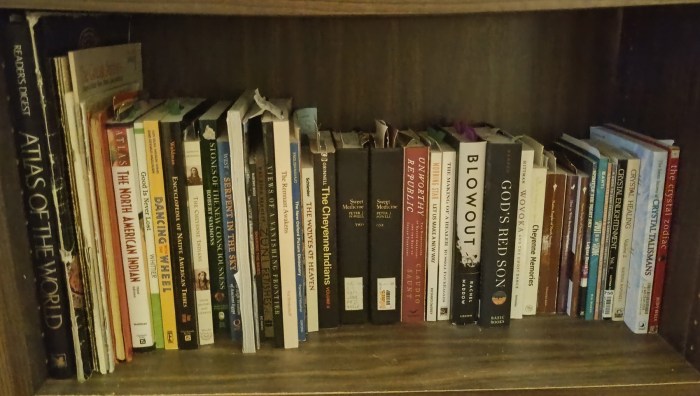
Let’s just say I have more than one shelf filled with books used researching this story along with my co-author, Pete Risingsun.
We read thousands of pages. More time was spent researching and crafting the story than writing it. Our idea of “perfection” was to present an accurate representation of Cheyenne culture, ancient and modern, as well as all they suffered at the hands of the U.S. Government. Their ceremonies have deep spiritual meaning, often beyond the comprehension of readers whose view of Native Americans hails from watching old TV shows like Gunsmoke depicting the “Old West” with its “cowboys and Indians.”
A 5-star review I found for Dickens’ “A Tale of Two Cities” helps explain this syndrome. This wise reviewer states, “I feel that this book is not viewed as being one of the top tier of Dickens works due to the fact that it is thrust upon grade 9 students as an introduction to literary classics and, being so, its impact and overall cultural power has become diluted due to the audience that initially received it. It is not in regards to the content of the work itself. The intellectual abilities of students of this educational level are not able to understand the historical era, appreciate the fluent descriptive nature of the writing nor to comprehend the literary nuances that the author presents.”
And there you have it.
Readers may consider a story “boring” when they can’t grasp its depth, context, and meaning.
Granted, many books lack all three and are the ones I’d be likely to give a 2-star review along with those riddled with typos, poor formatting, grammatical errors, plot holes, and so forth.
Reviews say as much about the reviewer as they do about the book. If they scare away readers like themselves that’s a good thing if it precludes more unfavorable reviews, right?
Forgive me for sounding defensive, but the fact the book earned both a Book Excellence Award and 5-stars from Readers’ Favorite since that horrific review helped restore my confidence. Hopefully, those awards also restore enough credibility for the story to highlight that bad review for what it is.
In the aftermath of that 2-star slam, truly the worst I’ve ever had, I cherish the Readers’ Favorite reviewer’s statement.
“This finale succeeds with a perfect 10 landing. Very, very highly recommended.”
It brought tears to my eyes. Thank you, thank you, thank you!
Needless to say, I’m beyond grateful that she “got it.”
Wednesday this week was “Name Yourself Day.” That reminded me of naming conventions among various Native American cultures. With all the research I’ve done with the “Curse of Dead Horse Canyon” trilogy, I’ve become familiar with numerous unusual names and often wondered at their origin, for example Starving Elk, Sleeping Rabbit, and White Frog, to name a few.
Co-author, Pete Risingsun, chose that name to honor one of his ancestors. He also has another name. To quote from his biography, “Pete wears his grandfather’s Cheyenne name, Mo’ȯhtáveaénohe (Black Hawk), who was a member of the Council of Forty-Four Chiefs.”
It’s my understanding when a tribal member does something worthy of recognition or has an experience that sets them apart that they often change their name. The greatly revered Cheyenne chief, Morningstar, is also known as Dull Knife, a derogatory moniker supposedly given by his brother because he wanted peace instead of war. Not that Western culture doesn’t do much the same with nicknames.
It makes sense that children were often not named until they were old enough to inspire one that fit. I’ve had a similar experience with my children, but much earlier. At least two of my six children got different names than the one planned. The moment I held them and looked into their eyes I could tell it simply didn’t fit.
While doing genealogy research it was common to find similar names running in families. Some of my children and grandchildren have middle names of family members. My mother and her three sisters all had middle names that were surnames of close family friends.
Naming characters in my novels is always fun. It usually just comes to me, once I get a grip on their persona. Most likely they’re telling me who they are. As I’ve noted before, my characters drive the story and I just record what they do, never knowing what they’ll do next. When they get themselves in a fix, I have no idea how they’ll escape, but they always figure it out.
With your name a major part of your identity, it’s no wonder they receive so much attention. I know at least one person who changed the spelling of his name so it had a more favorable number in numerology.
“You name it, you claim it” often relates to adopting a pet while “Nomen est Omen” implies your name relates to your destiny. This principle applies in astrology where a planet, asteroid, or star emits an energy related to the archetype for which its named.
However, there’s at least one instance where a planet was possibly misnamed. According to astrologer, Richard Tarnas, in his book “Prometheus the Awakener,” the planet Uranus should have been named for the renegade trickster god who gave us fire, whose archetype is closer to the influence that planet exudes, which includes surprises, upsets, rebellion, innovation, and explosions.
Do you like your name? Apparently, lots of people don’t. 85,000 people changed their name by deed poll in 2015. According to AI the reasons include:
Marriage/Divorce: Taking/ditching a spouse’s last name is a common reason.
Anglicizing: Some people change their names to make them easier to pronounce or more familiar in English-speaking countries.
Personal preference: People may choose a name for its sound or meaning, or to establish a unique identity.
Fresh start: Some individuals change their name to escape a difficult past or create a new identity.
Legal reasons: Changes may be required for legal or administrative reasons.
Religious reasons: Religious beliefs can also be a factor in name changes.
When I was younger I never liked my name because it was constantly mispronounced. As a kid, that was horrifically embarrassing, especially since it was coupled with an eleven-letter French-German surname. On the first day of school I’d slouch down in my seat wishing myself invisible as the teacher came to it and just stood there with a puzzled look on their face. I’d raise my hand, mutter, “Here,” and be glad that was over, at least until the next year. No doubt it influenced my marriage to someone named Fox.
While I never liked my name, after carrying it for over seven decades I’ve somehow grown into it. It’s too ingrained to abandon. If I still had that cumbersome maiden name, it would be another story. I no longer cringe when it’s mispronounced. It’s unique, which somehow fits. I’ve done too many unconventional things in my life to be Barbara, Nancy, or Linda. Even the more conventional spelling, Marsha, doesn’t feel right.
It’s been noted that its empowering to change your name. I get that. Years ago, I may have done it myself.
What about you? What name would you give yourself?
I am very pleased to report that “The Revenge of Dead Horse Canyon: Sweet Medicine Spirits – Novavose” has received both a Book Excellence Award and a 5-star review from Readers’ Favorite. I give tremendous credit to the reviewer, Jamie Michele, who had a heavy task, dealing with the final book in this long, complex saga. I’m beyond grateful she was clearly up to it, however, and comprehended the significance and import of the events. Here is what she had to say:
“The Revenge of Dead Horse Canyon: Sweet Medicine Spirits – Novavose by Marcha Fox and Pete Risingsun is the finale to the Dead Horse Canyon Saga. In books one and two, Sara Reynolds recalls only her husband Bryan’s dying plea to discover his killers after a deadly crash. With the help of Bryan’s friend, Charlie Littlewolf, and ancient ceremonies, they uncover the truth behind Bryan’s murder, sending their lives into turmoil.
“As Charlie roils with conflict over his oil drilling job, he also faces his true destiny on the Northern Cheyenne reservation. Meanwhile, Sara risked her life to expose a government conspiracy that was ready to silence her permanently. Now, Sara fights for survival after the attack that left her paralyzed, and Charlie vows to help her heal. His journey to Bear Butte reveals a destiny tied to restoring the ancient Massaum ceremony. As corrupt officials celebrate a secret facility’s opening, Indigenous leaders gather, fulfilling long-held prophecies that could change the fate of Dead Horse Canyon forever.
“’Do not become afraid when the Sweet Medicine Spirits come to you. Do not disobey them. Be humble and do what you are told.’
“The Revenge of Dead Horse Canyon by Marcha Fox and Pete Risingsun stands out for its sharp writing and complete ability to immerse readers, especially in Charlie’s spiritual transformation. Poor Sara just cannot get a break. Attacked, paralyzed, kidnapped, and then labeled a domestic terrorist and sanctioned! This isn’t just a fight for survival; this is about the power of truth in the face of overwhelming opposition.
“Charlie fits into this description, with a spectacular ceremony for Sara’s healing, but also as a powerful catalyst when he is in the presence of Grandmother Earth and the consequences of his actions. Fox and Risingsun are a dream writing team in every way, and, culturally, this portrayal of Charlie’s heritage is painted from the sky to the smallest pebble and the fire burning in between. The pacing is elevated by point of view shifts and all the drama, but also a surprising relationship transformation as well. Ultimately, this finale succeeds with a perfect 10 landing.
“Very, very highly recommended.”
Every author believes in their work but receiving validation from an objective reviewer who doesn’t know you from Adam is worth its weight in gold. Self-promotion is not my superpower, making me appreciate the kudos even more.
If you haven’t yet read the trilogy, all three volumes are coming out April 18 as a box set ebook on Amazon. You can preorder your copy here.
Are you a reader like my daughter who avoids serials* until all volumes have been released?
Like the Curse of Dead Horse Canyon trilogy?
Sorry about the wait, folks. Two factors slowed down the saga’s completion: Disruptions to both authors’ lives and research.
Especially research!
If you’ve been waiting, (even though book 3 came out awhile back), your patience is about to pay off.
All three novels will be released as a single mega boxset ebook on April 18!
Preorder now to reserve your copy at a bargain price of $9.99 with the ebook delivered electronically as soon as its released. All three books are complete and unabridged, 2266 pages worth plus an addendum not found anywhere else.
See? Good things come to those who wait.
Assuming you haven’t read book 3, “The Revenge of Dead Horse Canyon: Sweet Medicine Spirits – Novavose,” you’ll find it has a different pace than the others, especially once Charlie embarks on his ceremonial four-day fast.
Be prepared for a deep dive into Cheyenne history, culture, and ceremonies seldom represented in fiction! Those of you who relish immersion in anthropology through fictitious characters and situations imbued with historical truth will treasure these chapters.
Not so much if you’re looking for wham-bang suspense with no other substance.
I must warn you, however, if you’re tempted to skip the fasting sequence, be aware it’s the most consequential part, not only of the third book, but the entire saga. Consider that it drove the title as well as the picture of the Sacred Mountain on the original cover. The ending has far less meaning without that context, as one disgruntled reader expressed in a very nasty review.
Readers’ Favorite, however, gave it 5-stars and a glowing review that among other complimentary things states, “Stands out for its sharp writing and complete ability to immerse readers, especially in Charlie’s spiritual transformation. [His] heritage is painted from the sky to the smallest pebble and the fire burning in between. This finale succeeds with a perfect 10 landing. Very, very highly recommended.”
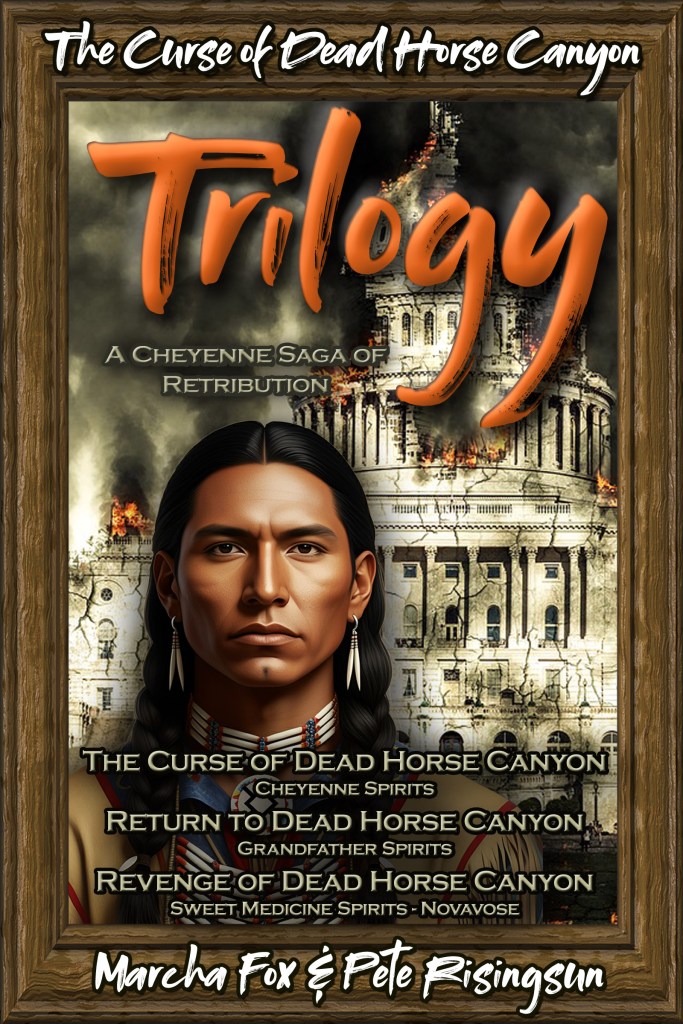
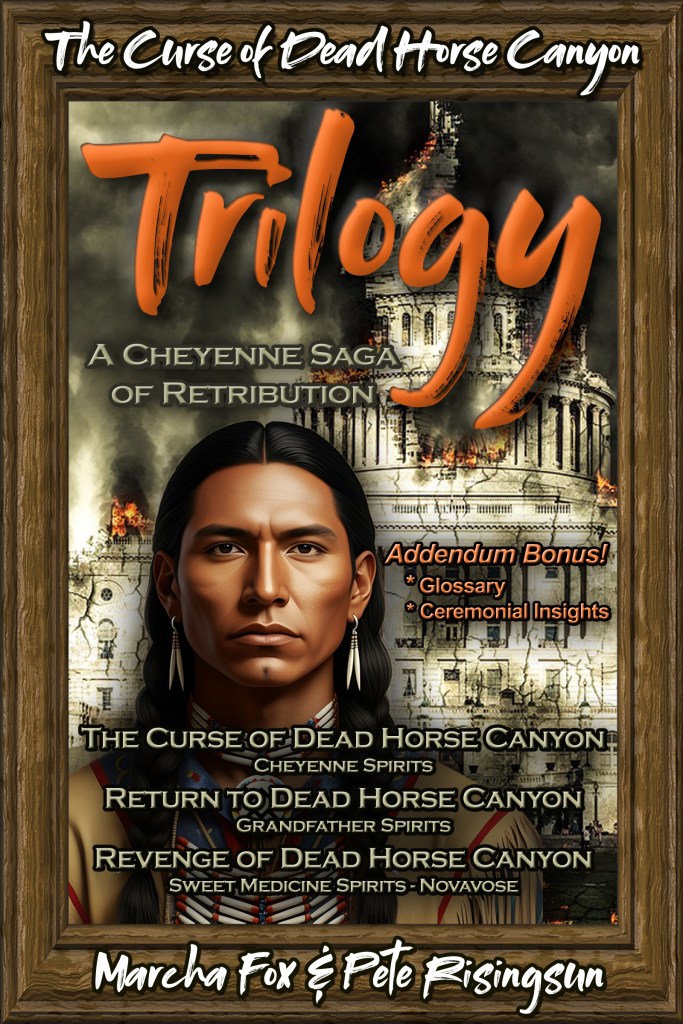
The cover for the ebook trilogy is a bit different than the others. Not only does it feature “AI Charlie,” whom you may have already met in the trailer video, but blatantly captures the saga’s overall theme. The trilogy’s description has a different spin when viewed from the ten-thousand foot level. Same novels, but the collective vibe is slightly different. Furthermore, upon request, a glossary of Native American words and phrases has been added along with a closer look at the Earth Giving Ceremony too detailed to include in the story.
Its online description states:
The Curse of Dead Horse Trilogy ebook includes all three books of this multi-award winning saga! If you hate cliffhangers and waited until it was complete, this is what you’ve been waiting for. Furthermore, the addendum includes a glossary as well as additional information on Cheyenne practices with a comprehensive look at their Earth Giving Ceremony.
Order your copy now and prepare to be consumed by a story that brings a vast government conspiracy face-to-face with Cheyenne history, prophesy, and ceremony. After centuries of lies, oppression and broken treaties will justice be served at last?
I hope you enjoy the completion of this saga. I must admit that I knew exactly how it was going to end from the first book, but didn’t know how it would transpire until Charlie’s fast. The research was worth its weight in gold showing how the ending was not so much of a stretch after all. Prophesy tends to be fulfilled, sooner or later.
*Per Google AI, “While both “serial” and “series” refer to a sequence of things, “series” generally describes a collection of related items or events, while “serial” specifically implies a story or narrative told in installments, often with an ongoing plot.”
Waste, fraud, and abuse of federal funds is being exposed like never before. However, if you’ll forgive the cliche, they need to stop throwing the baby out with the bath water.
I worked as a NASA contractor for twenty-one years. I saw a lot of sketchy activities that showed that agency was not immune to corruption. One example I encountered personally was the scheme where someone would come up with an idea, such as a space experiment, satellite, space vehicle, or whatever. The first step in such an endeavor is a concept study. If that passes, then there’s the feasibility study, design study, etc, etc.
I worked on a few of these, which I believed were good ideas. However, just before it would get to the phase where it would actually get built, it would be cancelled. All groundwork was essentially wasted, except, perhaps, if it turned out not to be a good idea after all and thus applied to a future project. What shocked me, however, was to find out in many cases the intent was never to build it.
Rather, it was to line the pockets of people who’d retired (or in some cases, been fired) from NASA (i.e., their fishing buddies) who’d become highly paid consultants. The “Good ol’ boy” system at its best. It was demoralizing enough to work hard on such a study, be enthusiastic for its potential, then have it cancelled. It was even more painful to find out it was never intended to come to fruition, but no more than a high tech boondoggle.
I witnessed too many civil servants whose only work-related activity comprised thinking up busy work for contractors. They loved what they called “metrics,” i.e., an attempt to measure our productivity. Of course we could have done more real, meaningful work, if we weren’t figuring out ways to measure it and report it in a way they could understand it. Most had no clue what we did, so how could they possibly manage it? There were numerous times when we kept the Space Shuttle program running just fine when the civil servants were gone because of one of those budget situation government shutdowns.
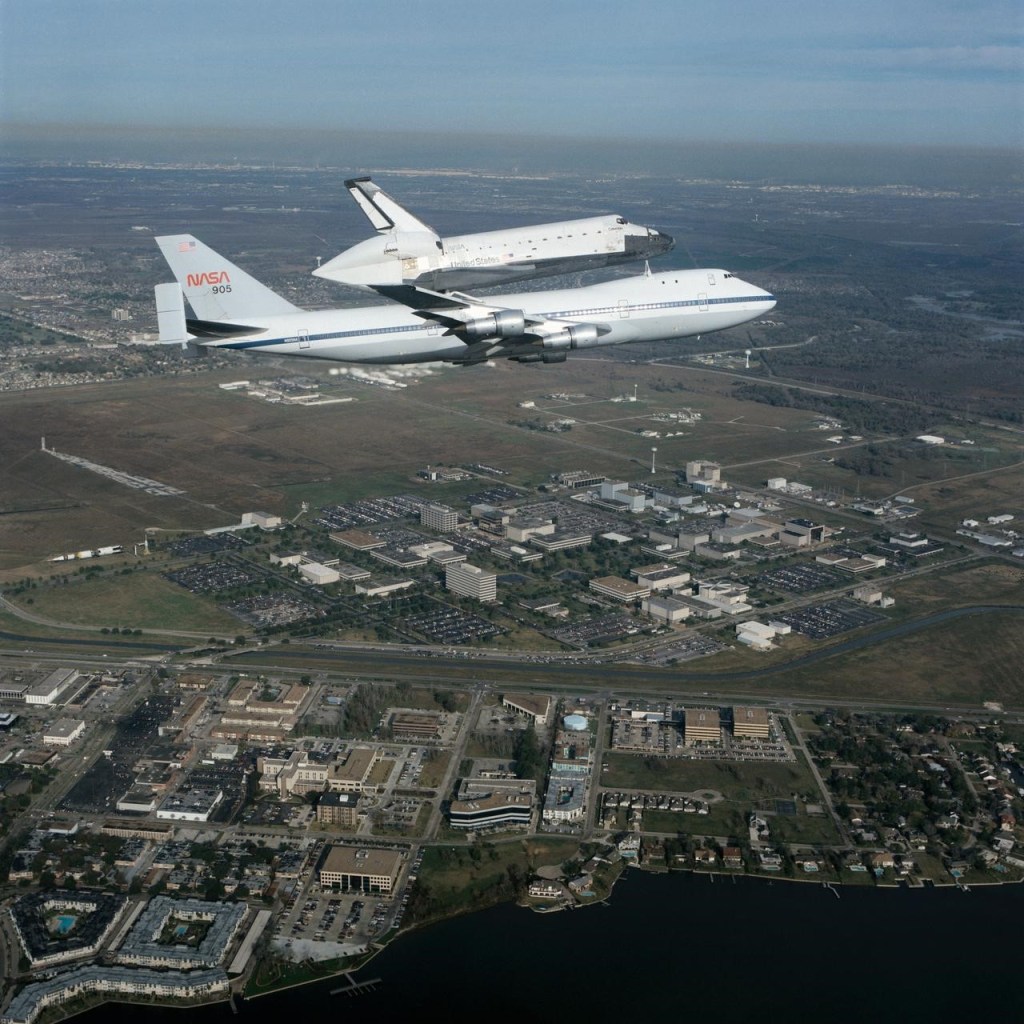
Air-to-air view of Columbia, OV-102, atop SCA NASA 905 flying over JSC site NASA ID: S90-55294 S90-55294 (19 Dec. 1990) — Johnson Space Center employees and neighbors on the ground didn’t get quite this closeup of a view of the Dec. 19 1990 flyover of the Space Shuttle Columbia mounted piggyback atop NASA’s Shuttle Carrier Aircraft (SCA–NASA 905). However, hundreds were able to spot it as it passed nearby en route to Florida from California following the successful STS-35 mission. Almost the entire 1625-acre site of the Johnson Space Center is visible in the background, along with a number of businesses and residences in the nearby municipality of Nassau Bay. The air-to-air photograph was taken by Pete Stanley of JSC’s Image Services Division who was a passenger in a T-38 jet aircraft.
Another thing I observed was referred to as “Empire Building.” Civil Servants got promotions based on how many people reported to them. They would claim to need more people than there was work for, just to inflate their numbers. As a contractor manager, I’d be told to hire more engineers when the ones I had barely stayed busy.
Yes, that’s the way it was, in an agency highly admired, especially our youth, even aspired to work for–I know, because I was one of them. I got a physics degree at the age of 39 so I could work there. Sadly, I came away disappointed in many things I saw as an insider, especially the safety area where we knew all the dirty little secrets of why missions failed, inevitable when engineers were ignored by upper management.
Did NASA do some amazing things? Unquestionably! Did I have some wonderful experiences while I was there? Absolutely!
That picture above? I saw that from the ground and it was awesome. But this does not mean that there isn’t a lot of waste that needs to be eliminated. Since I retired in 2009, much has happened already with the retirement of the Space Shuttle Program and availability of commercial rockets.
I could go on and on with examples, but that is not the purpose of this blog. I simply wanted to make a point that what the Department of Government Efficiency (DOGE) is doing is needed and in many respects a very good thing. I recently heard indirectly from someone who works at the Federal Reserve that only about 6% of Federal employees report to an office daily.
What? Really?
More fallout, I suppose, from the COVID-19 debacle, which allowed people to work from home. As a former NASA contractor manager I was well aware that only a small handful of my personnel could be trusted to be productive working from home.
You Don’t Prune a Rosebush with a Chainsaw
However, that said, I believe DOGE may be figuratively pruning a rose bush with a chainsaw. Some of these agencies may be totally worthless, saving the taxpayers from paying for frivolous and even criminal activities, which is desperately needed. But we must remember, for the most part, the majority of agencies had something beneficial for at least some segment of the populace at their core when they were created.
Rebuilding the U.S. economy, creating jobs, and being self-sufficient as a country, especially when it comes to energy, make sense. But I don’t agree with decimating our forests, public lands or environment. Agencies should be pruned carefully with lopping shears at worst, trimmers at best.
For example, laying off Forest Rangers and those who watch over our National Parks, both the wildlife and visitors from around the world, is ill-thought-out. These individuals serve the citizenry! These are not the slackers! C’mon!
It’s my opinion that we need to keep a close eye on what’s being eliminated and speak up when they’re ill-advised for the damage they’ll do. As a senior citizen I have a perspective that those making such decisions may not have. Audit them all, definitely, and cut back as warranted. But let’s bring some finesse into the process before causing irreparable damage.
For example, a petition landed in my email inbox recently about the Environmental Protection Act being totally ignored. You can find it here.
I love nature and wildlife. That’s why I live in the boonies where I can look out my office window and see everything from rabbits, squirrels, and chipmunks to wild turkeys, deer, foxes, and even fisher cats, which I never heard of before moving to Western New York State. True, some are a threat to our livestock, but that’s another story. Trees, diverse vegetation, and wildlife feed my soul.
While the land immediately around me is privately owned, I shudder to think if it were Federal land and some logging company came in and stripped the mountainsides bare. That not only impacts the aesthetics, but the wildlife that calls that forest home.
Same goes for oil exploration. Having lived in Texas for 35 years, I know enough about that industry to recognize how dirty and dangerous it is. Essential, yes. But it could be done in a safer, more discriminatory manner so as to cause less damage. Fracking threatens water supplies with toxic chemicals and has been proven to cause earthquakes. Do we really want our National Parks subjected to that?
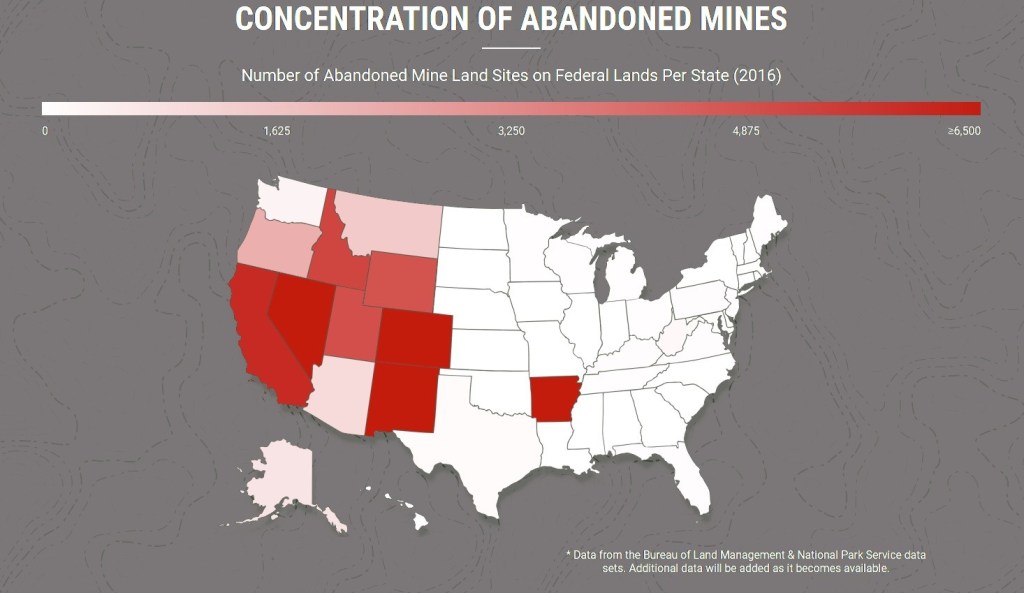
In the 19th Century mining activity in the Rocky Mountains caused considerable damage. These corporations do not care about the mess they leave behind, only profits. Some regulations are essential, which should be enforced with integrity, not bribes, and involve fines that are painful enough to motivate compliance. When I was writing The Curse of Dead Horse Canyon Trilogy my research made me aware of how bad that century-old situation was as well as oil exploration, both situations making it into the plot of the story.
I highly recommend Robin Wall Kimmerer’s “Braiding Sweetgrass” for more perspectives on that issue. You can see my review of this beautifully written book here.
Harming Vulnerable First Americans
Eliminating the Department of Education is another issue. While some research indicates the USA is not “dead last” but 8th out of 41 countries, in 2022, the U.S. ranked 16th in science, ninth in reading, and 34th in math. Not particularly stellar, to say the least.
Having had six children go through public schools, I’m well aware of the flaws in that system, too, e.g. using our children as test subjects (no pun intended) without our consent. Lunacy such as “New Math” and various other indulgences, like not teaching phonetics, and other “experiments” which deprive our youth of a decent education. This has gone on for decades, even predates the Department of Education, much less the “No child left behind” edict, which had its pros and cons as well.
The system, with or without the Department of Education, is deeply flawed. Indeed, they shot themselves in the foot when they started demanding all school districts incorporate the reigning political party’s “woke” agenda and various other idiotologies [not a typo] to which a vast majority of the population objected as proven by the 2024 election results.
Again, rather than throwing the Department of Education away like last year’s test scores, why not fix it? Our “throwaway” mentality should not relate to matters that affect human lives. Granted, sometimes fixing something, whether it’s your car or washing machine, is less cost-effective than buying a new one. But unless an agency is thoroughly corrupt to the core, you don’t delete it without closer examination regarding whether any part of it is worth salvaging.
One useful function of the Department of Education relates strongly to financial aid to poor districts. Its loss will be particularly hard on Native Americans. To quote from a recent email sent out by Native American College Fund president, Cheryl Crazy Bull:
We must raise our voice and let our representatives know that this bill cannot pass.
What you may not realize is that the Department of Education’s main role is financial. Dismantling it would disrupt programs that disburse federal student aid, negatively impacting all students that receive student loans and Pell grants. To qualify for a Pell grant, you must show need and the majority of College Fund and Tribal scholars demonstrate that financial need.
The Department of Education also provides federal funding for public schools and the ability to enforce civil rights protections for all students in education, including characteristics like disability, religion, and sex.
Native students are at the center of this attack and will experience tremendous hardships.”
If you don’t know how to contact your representatives, you can find that information here.
This very useful tool also includes your state officials, who often need prodding as well.
Getting rid of corruption is important. Saving taxpayers from enriching crooked politicians is essential. But the government is expected to provide some services. We just need to make our voices heard demanding that it be done in a wiser, more selective and sensitive manner.
In closing, as citizens, what we allow will continue. Whether its waste, fraud, and abuse or cutting things back so brutally and thoughtlessly that we never recover what good there was.
My method of writing is generally referred to as a “pantser,” i.e., I write by the seat of my pants. The other prevalent writing style that of a “plotter,” where the author determines the entire story, scene by scene, in an outline. I tried plotting, but my characters persistently got out of hand. They’d refuse to follow my plan and do their own thing. It didn’t take long to discover they had a better grip on the story than I did. Thus, I became a “pantser.” I populate my story idea with characters, then sit back to watch what they do as would a dutiful scribe.
I began work on this saga before connecting with my co-author, Pete Risingsun. I had a handle on the story’s government conspiracy angle, but lacked cultural knowledge of my main character, Cheyenne Charlie Littlewolf. I wrote what he told me to, but didn’t know whether it was feasible.
As a science fiction author, I wondered.
Was my imagination getting carried away?
I tend to obsess over accuracy and can get carried away with research. I started reading books on Native American cultures, but I needed to find a Cheyenne elder who could let me know if what I had written from Charlie’s point of view was accurate or too off-the-wall.
When Pete got involved he assured me that the various incidents I’d included were indeed realistic in the Cheyenne world. I smiled, relieved to learn Charlie was not leading me astray.
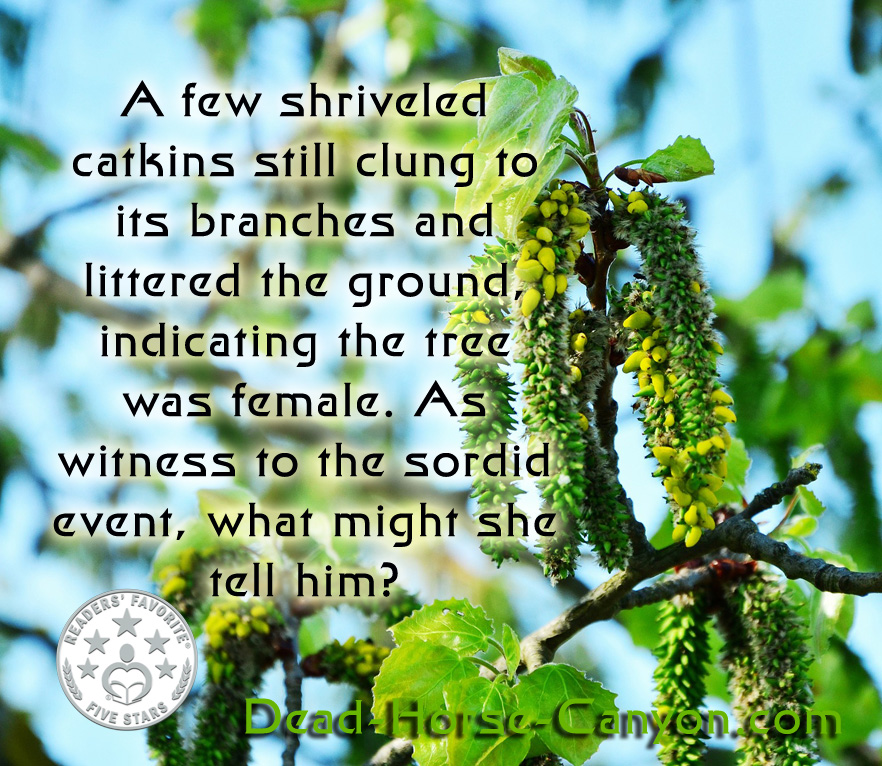
One incident that I wondered about is depicted in chapter six, “The Aspen,” of the first book, “The Curse of Dead Horse Canyon: Cheyenne Spirits.” It’s there that Charlie receives a message from the aspen tree that witnessed the wreck that killed his best friend. Besides numerous others, another one of my favorites is in the second book, “Return to Dead Horse Canyon: Grandfather Spirits,” where in chapter thirty-nine, “Trail Ride,” Charlie finds an ancient arrowhead that tells him and his brother, Winter Hawk, (cousin in western culture), that their prayer regarding the fate of the murderer had been heard.
As work on the saga continued, more and more research came into play. The works of George Bird Grinnell as well as Peter John Powell were excellent sources, but had limitations. I find it ironic that some of the most detailed information on ancient Cheyenne (Tsistsistas) beliefs and ceremonies is conveyed by German anthropologist, Karl H. Schlesier. His book “The Wolves of Heaven” was priceless while writing this trilogy, especially his detailed description of the Massaum, the Earth Giving Ceremony, that plays a key role in the final volume. In a typical episode of serendipity, I found Schlesier’s book on Amazon, attracted by its subtitle, “Cheyenne Shamanism, Ceremonies, and Prehistoric Origins.”
Or was it a maiyun who brought it to my attention?
What is a maiyun?
Schlesier tells us they are powerful spirits that associate with human beings. There are also the hematasoomaeo, which he describes as “the immortal spiritual forms of plants, animals, and human beings. . . .The maiyun most responsible for physical life on earth belong either to the deep earth or to the sky places. In Tsistsistas ceremonies they are celebrated especially and represented through plant and animal forms.”
The lodge of the maiyun is the Sacred Mountain, i.e., Novavose. (You’ll meet plenty of them in “Revenge of Dead Horse Canyon: Sweet Medicine Spirits – Novavose.”)
Why have western religions denied the existence of such things? Claim that animals do not have souls, a belief with which any pet owner, farmer, or rancher will disagree? Slowly the world is awakening to the reality of other dimensions; recognizing the thin veil between life and death and the elusive nature of time.
Things ancient peoples took for granted.
Speaking of animals, a few months ago, my precious 18 year old feline fur baby, Ophelia, crossed over. I hoped that when she did, that she was reunited with her half-brother, Hamlet, who’d left this life four years before. Thus, I was drawn to the “Pets and the Afterlife” book series by Rob Gutro. He’s a medium who specializes in connecting with pets in the spirit world. These books contain dozens of stories of such experiences. The truth of what he envisions is validated by multitudes of grieving pet owners when he provides details of the encounter that he couldn’t possibly have known.
As I read Gutro’s books I couldn’t help but think of the maiyun–spirit helpers that indigenous people have relied on for millennia. What are “civilized” people missing by tuning out these messages and connections?
I am beyond grateful for my introduction to this marvelous world while writing these three tomes with Pete. My heart and mind lived there from July 2018 when this story was conceived until the final book was published in January 2025. My life is enriched beyond measure for the experience.
Two of my favorite quotes related to this lost wisdom were spoken by Tȟašúŋke Witkó (Crazy Horse), the Oglala Lakota Leader who said:
The red nation shall rise again and it shall be a blessing for a sick world; a world filled with broken promises, selfishness and separations; a world longing for light again. I see a time of seven generations when all the colors of mankind will gather under the sacred tree of life and the whole earth will become one circle again. . . In that day, there will be those among the Lakota who will carry knowledge and understanding of unity among all living things and the young white ones will come to those of my people and ask for this wisdom.
The Curse of Dead Horse Canyon Trilogy is a lengthy saga that is more than a juxtaposition of a corrupt government’s clash with Cheyenne spirituality. It’s an introduction to a world too many don’t yet see.
But as Crazy Horse declared, they will.
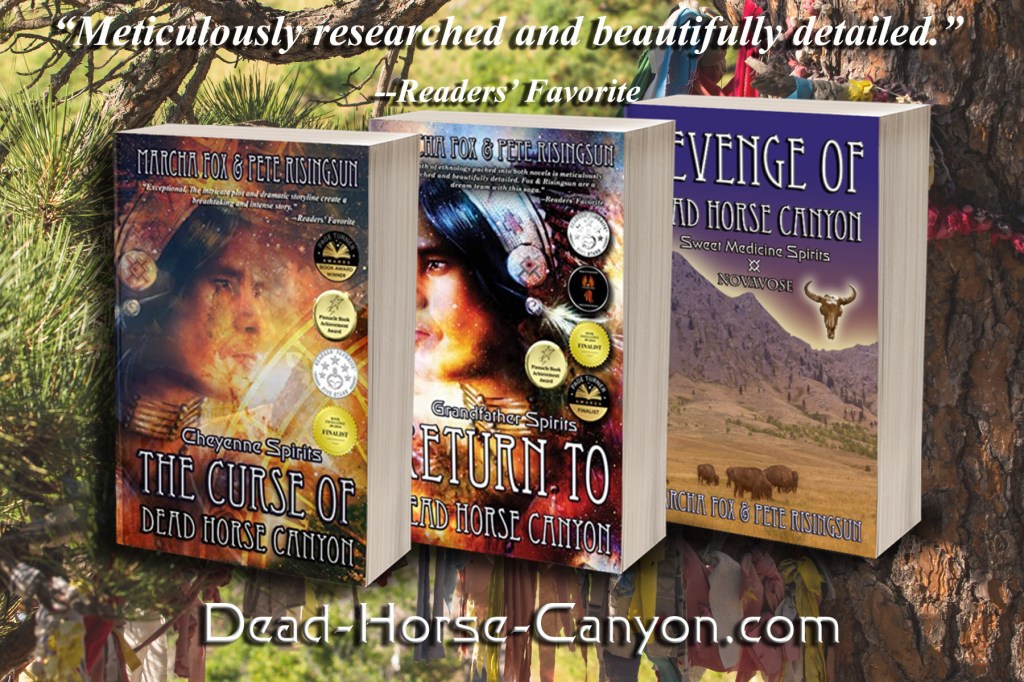
You can find the trilogy on Amazon and other online vendors.















 The Curse of Dead Horse Canyon