November is Native American Heritage month! To kick it off, the organization, IllumiNative, has produced a short video highlighting Native American accomplishments.
Our world has so much to gain by recognizing and adopting Native American principles. Take a few moment to browse the IllumiNative website to see the many influences that have not received the publicity they deserve. Native influence is everywhere! Celebrate and share!
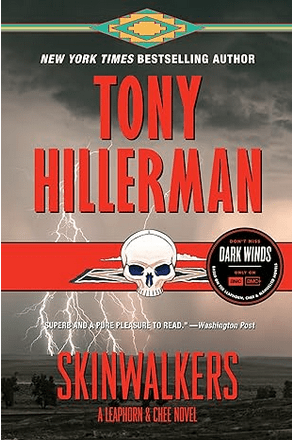
After binge watching the first two seasons of Dark Winds with my granddaughter, I wanted to see what the Hillerman books are like. I chose this one hoping for the mystery and intrigue seen in the TV rendition of another novel in the series, “Listening Woman,” which comprised the basis for the first season.
The story centers around three murders that Navajo Tribal Police Lieutenant, Joe Leaphorn, is trying to connect and solve. Someone has also tried to kill Officer Jim Chee by firing a shotgun into his trailer. Strange bone beads are found in the victims, one of which is also found in Chee’s trailer, which are what introduces the possibility of witchcraft into the story.
While I enjoyed it, it lacked the creepy sense of magic I expected. It had plenty of plot twists and the usual suspense regarding “whodunnit” but didn’t quite measure up to what I was hoping for, especially with such an intriguing title. Very little was mentioned about those entities, much less sorcery and the dark side of the Navajo culture, other than in a vague, informative way. All it touched on was the belief that such existed and that it may have been behind the murders. Needless to say, this is something that Navajos don’t like to talk about, but makes fascinating stories.
There were a few good tidbits about the Navajo culture, however, such as not mentioning the name of the deceased and “wearing out their name.” The significance of the bone beads was likewise fascinating, but not as creepy or scary with paranormal implications as they could have been described.
No doubt the TV show “The Secret of Skinwalker Ranch” on the History Channel, which is indeed fascinating, gripping, and usually creepier and scarier than this book, is going to send readers to this series and more specifically this particular book. If that’s your motivation, be warned you are likely to be disappointed, as I was.
I may try another book in the series, perhaps a newer one written by Anne Hillerman, Tony’s daughter, who assumed writing the series upon her father’s passing. Far be it from me as a fellow author to criticize books that are best sellers, but as a reader it did not measure up to what I expected. (The problem with being an author yourself is you’re not an unbiased reader anymore, but part editor and part critic.)
This book was written in 1986 and they’ve updated the cover, but I don’t know if they’ve also reprinted it. The hardcover copy I received from an Amazon vendor was clearly used and had a pricetag on it from Goodwill for $4.99 while I paid $17.62.
You can pick up a copy on Amazon here:
or try https://www.bookfinder.com for a better deal on books that are out of print or been around for awhile.
The quote above is often attributed to Henry Ford, but in trying to confirm that, I struck out. Several have said something similar and millions agree.
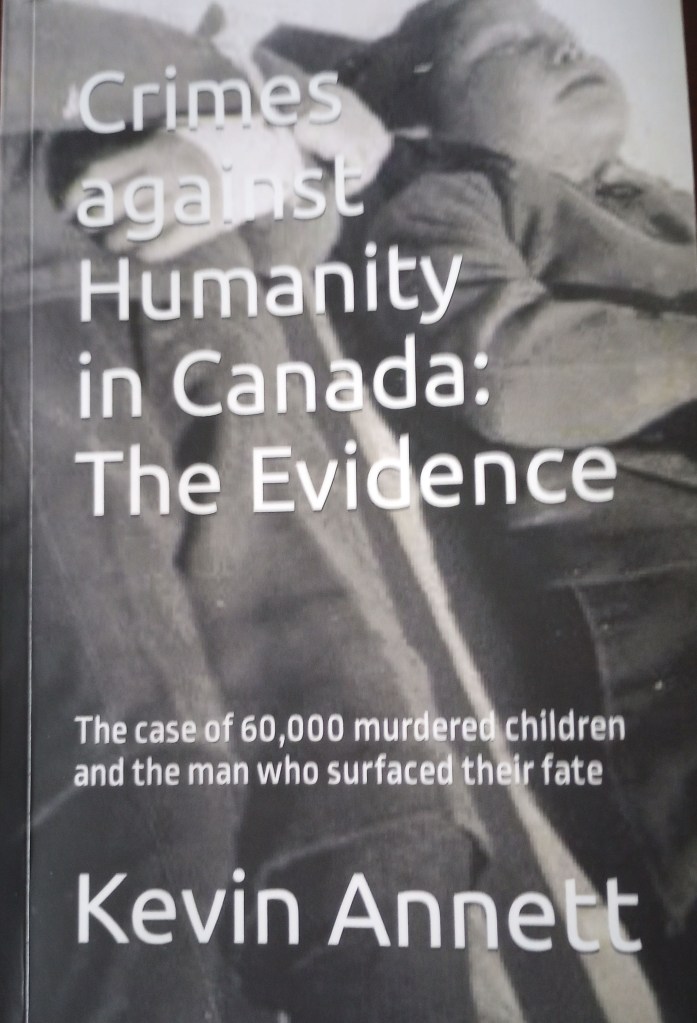
The evidence is in this book, which is both shocking and heartbreaking. Its essence is captured in its subtitle: “The case of 60,000 murdered children and the man who surfaced their fate.”
The author, Kevin Annett, was a priest associated with the United Church in Canada. In the course of his ministry he uncovered evidence of the genocide committed against Native American children in the government sponsored Residential Schools. Witnesses who’d survived the schools told horror stories of children being murdered before their eyes. He proceeded to take it upon himself over the course of decades to expose these crimes and achieve justice for the victims and the survivors. Note that these “schools” weren’t closed down until 1996!
“The day I saw my little brother Benny get beaten to death by a Catholic priest, I prayed to the Great Mystery to someday give me the chance to get justice for him.” — Albert House of the Anishinaabe-Ojibwe nation
Naturally, governments and churches wield their power to protect their own, making exposing their crimes an herculean task. In February 1998 Annett and survivor Harriett Nahanee launched a campaign to publicize the death camp crimes and prosecute those responsible.
This led to the first public inquiry in June 1998. It convened under the auspices of the United Nations affiliate, International Human Rights Association of American Minorities (IHRAAM). IHRAAM recommended to the United National Human Rights Commission that Canada and its churches be formally charged with genocide. But diplomatic pressure prevented such action and IHRAAM withdrew its statements.
How typical.
Ten years later in 2008 Canada admitted to some of it, yet whitewashed it by indemnifying and exonerating all the guilty parties. Meanwhile, Harriett Nahanee had been murdered in prison.
In 2010 Annett helped found the International Tribunal of Crimes of Church and State (ITCCS) which sponsored the International Common Law Court of Justice (ICLCJ) that tried and convicted Canada and its churches of genocide and compelled Pope Benedict and three Catholic cardinals to resign their offices during 2013. Their success sparked a worldwide movement to establish common law courts and sovereign Republics to replace criminally convicted churches and governments.
Today genocide continues as part of China’s economic penetration of North America to seize oil and gas resources by displacing indigenous communities in northern British Columbia and Alberta. This is being done with the support of the Canadian government, the Royal Canadian Mounted Police (RCMP), and the same churches, which continue to traffic and murder indigenous children. More native people die in police custody in Vancouver than any city in Canada.
Needless to say, you’re not going to hear about any of this in the mainstream media. Anyone who thinks that genocide ended with World War 2 needs to wake up. More information about these incidents can be found at the website https://www.murderbydecree.com
Of course Annett was “punished” for his actions by the United Church by defrocking him as a minister in a shamelessly biased kangaroo court. He was never told what he was accused of, witnesses in his favor were disallowed, and there were clear conflicts of interest with those conducting the hearings. All details of the bogus procedures are described in the book. Furthermore, they paid his wife to divorce him and set out to do everything possible to destroy his life and livelihood.
“Physical assaults and public smears against Kevin increased and his native supporters began to be killed by police or while in jail or in the hospital.” (p. 50)
I can’t begin to summarize the background any better than what is stated in the book and I quote:
“Between the years 1889 and 1996 tens of thousands of indigenous children across Canada were deliberately and systematically murdered by the Crown of England, the Canadian government, and the Roman Catholic, Anglican, and United Church. These killings occurred in internment camps operated by these churches and authorized by the Crown, and deceptively called ‘Indian residential schools.’
“For the first year of their operation, the annual death rate in these camps was between 25% and 70%: A genocidal mortality rate that continued for over half a century. As a result, more than 60,000 of these children died.
“This enormous mortality was caused by a deliberate and continual practice by all the churches of starving children and housing the healthy ones with those sick and dying from tuberculosis and smallpox while denying them medical treatment and any form of care; in short, by a regime of institutionalized germ warfare designed to “find a final solution to the Indian Problem,” according to Duncan Campbell Scott, the Deputy-Superintendent of Indian Affairs, in May, 1910.
“Every crime defined as genocide under international law was perpetrated in these Christian internment camps, including murder, mental and physical torture, starvation, slave labor, systematic beatings, gang rape, sex trafficking, destruction of family, sexual sterilizations, involuntary drug testing, medical experimentation, and daily, mandatory brutality.
“When I was six years old, I saw a little girl killed right in front of me by a nun… The girl she killed…was five years old. The nun kicked her hard in the side of the heck and I heard this terrible snap. She fell to the floor and didn’t move. She died right in front of us. Then the nun told us to step over her body and go to class. That was in 1966.” –Steven H, St. Paul’s Catholic Day School
“These crimes were inflicted on children as young as four years old according to a mandatory death quota and torture regimen established by these churches and the government. The purpose of this operation was genocidal: to exterminate the remaining indigenous nations and seize their lands and resources by killing off or enslaving most of their children.
“From its inception, this genocide was authorized, perpetrated, and concealed by every level of state, judicial, police, and church authority in Canada until the camps officially closed in 1996. The master plan for this genocidal operation was adopted on November 25, 1920 at a meeting in Ottawa of top officials of the Canadian government and the Roman Catholic, Anglican, Presbyterian, and Methodist churches (the latter two being the forerunners of the United Church of Canada, formed in 1925 by an Act of Parliament.”
“The master genocidal plan was made Canadian law by a special Order in Council on July 1, 1920. It required every indigenous child seven years or older to be interned in an ‘Indian school’ or face arrest and imprisonment.” (p. 11-14)
Unless you’ve had your head in the sand the past few years and/or have a naive and horrendously misplaced trust of government and various powerful institutions including the Vatican and main stream media, this should not come as a surprise. I must say I was nonetheless shocked by the scope and blatant actions of church and state, but had no trouble believing it.
“Richard Rubenstein, a chronicler of the Nazi Holocaust, observed that modern states have the legal power to render their own citizens into stateless people without rights prior to their wholesale destruction.” (p. 6)
The evidence in this book is sickening but irrefutable.
It’s essential for everyone to wake up. Recognize what is going on and that the COVID debacle is more of the same. Indigenous people have been the target for centuries.
Who’s next?
Bear in mind that no one of any skin color, religion, national origin, or ethnicity can be assured that it won’t be them.
One more thing.
For those of you who are white like myself, can you begin to understand why our race is hated?
In February 2021 Texas temperatures plunged into the single digits. This historic freeze also brought an ice storm. Such frigid weather is far from normal in the Lone Star State. Usually we’re enjoying paper-whites blooming and planning our spring garden. We don’t have snow plows standing by and our homes are not designed for extreme cold. Rather we typically worry more about the heat!
This picture of the paper-whites was taken the day before the historic storm rolled in. You can see what they looked like afterward in the last picture below where their remains are by the birdbath behind the water tank.
Over 700 died during this freeze when the power grid nearly failed. The only way to keep it operating was to have blackouts and rolling blackouts. A tremendous amount of bad decisions at numerous levels caused this weather event to be far worse than it should have been. I could go on and on about what those bad decisions and mistakes were, but I want to focus on my own experience.
Fortunately, I’m pretty much a “homebody” and don’t go out much. I usually have plenty of food on hand since I only shop every couple of weeks.
I also believe in being as self-sufficient as possible. I have a propane stove that works just fine with no power as well as a few other items that were helpful. As noted earlier, being cold is not usually an issue here.
I have a fireplace and had some firewood. The power was out for 14 hours and during that time the house got pretty chilly, but the fireplace saved the day. When the rolling blackouts started, they were on a schedule so when the power was on you ran the heater and anything else, then braced for the next outage.
At one point there was only a trickle of running water. I live in a community that comprises several vacation homes. Any of these empty homes that hadn’t turned off their water at the meter had ruptured pipes. Some who were home also had ruptured pipes that flooded their entire home. Plumbing here is often in the ceiling and not insulated for such extreme temperatures.
I had an on-demand water heater mounted on the outside of my house. My efforts to protect it were vain with no power. Thus, the pipes froze and ruptured. A few days later when things started to thaw out, I went out my backdoor to take something to the trash can and found a mini-Niagara Falls spewing from it.
I hightailed it to the meter to turn it off and was lucky enough to have my plumber driving by at the time. Long story short, it took three weeks to get a new water heater installed. Needless to say, that was 3 weeks without running hot water. Taking sponge baths courtesy of a spaghetti pot with water heated on my propane stove (thank heaven for that!) was definitely different that my usual warm, cozy showers.
There was actually a similar freeze this past February, but not as severe. The power stayed on and my new water heater, which has a built-in heater, survived. I learned a lot during that week in 2021. I hope to think I’m better prepared now.
However, it was a sobering thought that there are many people in the USA who live with no heat and no running water as a matter of course. The majority of these people live on Indian Reservations. If there’s an ethnic group in this country who has been forgotten it’s the indigenous people who occupied this great land for millennia before the white man “discovered” it. Other races have a variety of valid complaints, but none compare to what was done to Native Americans.
I’m not going to enumerate what those offenses were other than the obvious ones: stealing their land and attempted genocide. If you can find it in your heart to help these people, this blog from a few years ago lists 20+ ways you can make a difference.
The entire month of November is Native American Heritage Month. The point of these designations is to highlight something that deserves attention coupled with an opportunity to learn more. One way to learn more about Native American culture, or more specifically the Northern Cheyenne, is to read our multi-award winning books in the Dead Horse Canyon saga!
The most gratifying review we ever received was from Asher Syed on behalf of Readers’ Favorite who gave us 5-stars and said, “The depth of ethnology packed into both novels is meticulously researched and beautifully detailed. Fox and Risingsun are a dream team with this saga.”
Today we recognize September 23, 2022, as Native American Day, the perfect time to honor Cheyenne Culture Hero, Sweet Medicine.
As with most tales preserved by oral tradition, there are different versions regarding Sweet Medicine’s origin. One version (from Cheyenne Memories by John Stands in Timber and Margot Liberty) tells of a young woman who lived with her parents. She had a dream where someone said, “Sweet Root will come to you, because you are clean, and a young woman.” She thought it was just a dream, but it repeated the next three nights. At this point she told her mother who said it was nothing and not to worry.
But as time passed, she began to feel as if she were expecting a baby, which her parents noticed as well. Yet this made no sense, since she never met anyone, other than the voice in the dreams.
When it was time to give birth, she left the village and went down by a creek where she built a small shelter and had a baby boy. Rather than take him home, however, she left him there, since she and her parents were ashamed.
Later that day an old woman was down by the creek collecting rye grass as bedding when she heard the baby crying. She found him and brought him home. Her husband was very happy and said “That’s our grandson. And his name shall be Sweet Medicine.”
The similarities to the virgin birth of Christ are hard to miss. Perhaps this shows a Christian influence creeping into later versions of the story. The Cheyenne’s high moral standards encouraged their women to be virtuous, so would embrace such a detail.
(If you’re a fan of The History Channel’s Ancient Aliens program, you may notice parallels to UFO abduction stories, many of which date back centuries. Native American connections with extraterrestrial visitors are well-documented, including Nancy Red Star’s book, Star Ancestors.)
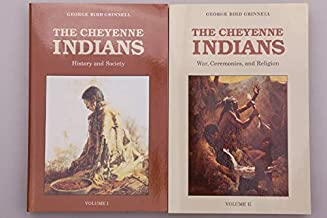
The version of Sweet Medicine’s beginnings in George Bird Grinnell’s The Cheyenne Indians: Their History and Ways of Life (Volume II) is less dramatic. It states that Sweet Medicine was the second born child of a married woman, but nonetheless a very unusual child and individual.
Sweet Medicine was said to have performed various miracles, from conjuring up a buffalo calf when the tribe was hungry, to being able to elude pursuit by covering vast distances in record time, i.e., shades of Superman’s ability “to leap tall buildings in a single bound.”
Specific laws and ceremonies were among his most important contributions to Cheyenne culture. He organized the original four warrior societies, Swift Foxes, Elks, Red Shields, and Bowstrings. He instituted a sophisticated leadership structure that included ten chiefs from each of the four societies, plus four “old man chiefs,” one of whom carried the sacred medicine bundle he gave them. This brought stability to the Cheyenne that other tribes lacked.
“You chiefs are peacemakers. Though your son might be killed in front of your tepee, you should take a peace pipe and smoke. Then you would be called an honest chief. You chiefs own the land and the people. If your men, your soldier societies, should be scared and retreat, you are not to step back, but take a stand to protect your land and your people.“
He admonished chiefs to be examples of peace and courage. As stated in Cheyenne Memories, Sweet Medicine said, “Listen to me carefully, and truthfully follow up my instructions. You chiefs are peacemakers. Though your son might be killed in front of your tepee, you should take a peace pipe and smoke. Then you would be called an honest chief. You chiefs own the land and the people. If your men, your soldier societies, should be scared and retreat, you are not to step back, but take a stand to protect your land and your people.”
Generosity was another requirement imposed on chiefs. “When you meet someone, or he comes to your tepee asking for anything, give it to him. Never refuse. Go outside your tepee and sing your chief’s song, so all the people will know you have done something good.”
The four Sacred Arrows were another gift along with the sacred medicine bundle. Two arrows were for hunting and two for war, a detailed ceremony provided for renewing their power, which was lost should a Cheyenne murder a member of the tribe.
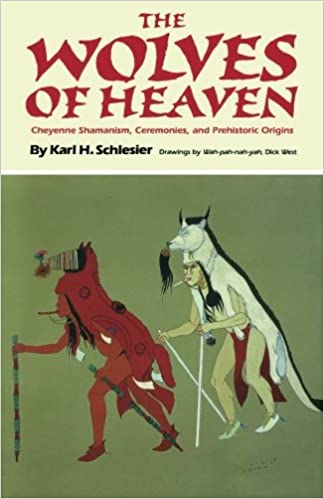
He taught the complex ceremony known as the Massaum, a.k.a. Animal or Crazy Dance, which bears some resemblance to an origin story among Plains Indians referred to as “The Great Race.” The Wolves of Heaven by Karl H. Schlesier is a comprehensive work focused on the Massaum. As an anthropologist, Schlesier places the ceremony’s origins, and thus Sweet Medicine, in the 500 – 300 BCE timeframe.
So where did Sweet Medicine gain his profound wisdom?
The legend states that Sweet Medicine and his wife disappeared for four years, which was spent deep inside the Sacred Mountain where they were taught by spiritual beings known as maiyun. (This is very similar to stories about other important spiritual leaders as expressed on Ancient Aliens, Season 18/Episode 20, “Secrets of Inner Earth.”)
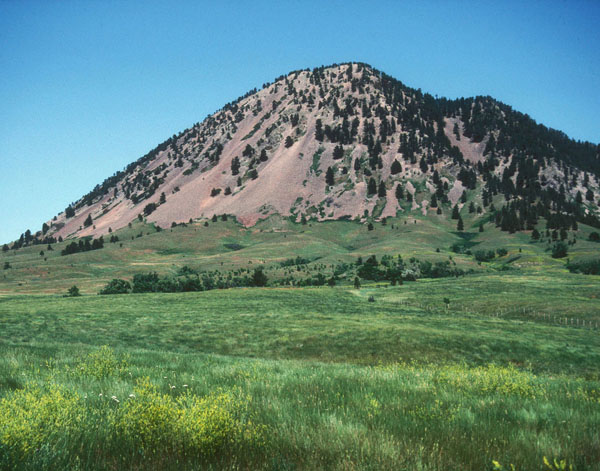
Thus, the tradition arose of fasting on the Sacred Mountain for four days to commune with the holy people. Bear Butte in South Dakota is the Cheyenne’s Sacred Mountain while other tribes have their own versions. There are numerous references to Devil’s Tower in Wyoming in these stories, another location infamous for UFO sightings, as immortalized in Steven Spielberg’s 1977 movie, Close Encounters of the Third Kind.
Cheyenne Sacred Mountain, a.k.a. Bear Butte, South Dakota
Before Sweet Medicine died at a very old, but undetermined age, he gave his final address, which included admonitions along with a prophesy:
“I have brought you many things, sent by the gods for your use. You live the way I have taught you and follow the laws. You must not forget them, for they have given you strength and the ability to support yourselves and your families.
“There is a time coming, though, when many things will change. Strangers called Earth Men will appear among you. Their skins are light-colored, and their ways are powerful. They clip their hair short and speak no Indian tongue. Follow nothing that these Earth Men do, but keep your own ways that I have taught you as long as you can.
“The buffalo will disappear, at last, and another animal will take its place, a slick animal with a long tail and split hoofs, whose flesh you will learn to eat. But first there will be another animal you must learn to use. It has a shaggy neck and tail almost touching the ground. Its hoofs are round. This animal will carry you on his back and help you in many ways. Those far hills that seem only a blue vision in the distance take many days to reach now; but with this animal you can get there in a short time, so fear him not. Remember what I have said.
“But at last you will not remember. Your ways will change. You will leave your religion for something new. You will lose respect for your leaders and start quarreling with one another. You will lose track of your relations and marry women from your own families. You will take after the Earth Men’s ways and forget good things by which you have lived and in the end become worse than crazy.
“I am sorry to say these things, but I have seen them, and you will find that they come true.”
So who exactly was Sweet Medicine?
A real person?
Or no more than another figure in the realm of folklore and mythology?
We may never know, but his prophesy’s accuracy is pretty hard to ignore.
An author never knows how a sequel will be received in a contest. Without the backstory presented in the previous book, the judges may be lost or unimpressed, thinking there are too many unanswered questions. All you can do when you submit it is cross your fingers and hope for the best.
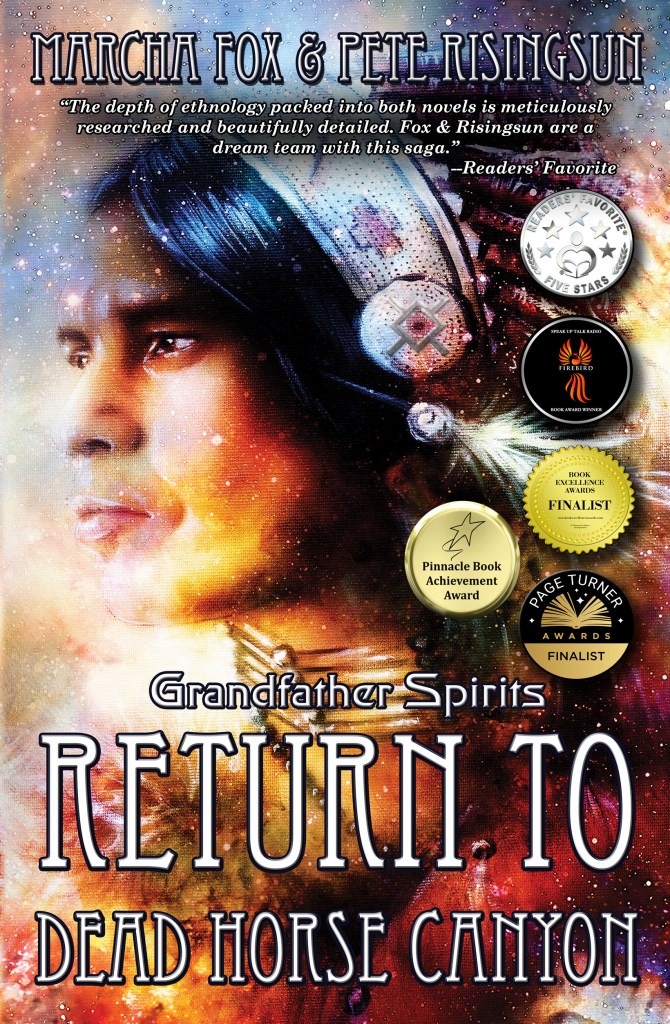
Clearly, this was not a problem with Return to Dead Horse Canyon: Grandfather Spirits. So far it has done as well as its precursor, plus winning a Firebird Book Award, but The Curse of Dead Horse Canyon: Cheyenne Spirits was not entered in that particular competition.
Each of the awards is described on the book page, so I won’t repeat that information here. While winning another award is always a good day for authors, the one that impressed me the most was the wonderful review rendered by Asher Syed on behalf of Readers’ Favorite.
It was beyond gratifying to see that he comprehended the message Pete and I were trying to convey. Not only that, but that he actually went back and read the first book when that was not required. Yet, he did so, and provided very complimentary comments about that as well. Calling us a “dream team” truly made that day and several since! To be perfectly honest, it made me cry.
Many thanks to the various individuals who have read our work and provided us with such valued feedback. Nothing makes all the work more worthwhile than being recognized by complete strangers. Thank you, one and all.
Our goal with this ongoing saga is to provide readers with a glimpse of the beautiful Northern Cheyenne culture about which most know little, if anything. Pete and I are learning more about it as well. The conclusion to this trilogy is in work with the goal to be well underway by the time we celebrate Native American Heritage Month in November. The challenge upon us is to make the conclusion even better than the first two installments.
I am pleased to report that “Return to Dead Horse Canyon: Grandfather Spirits” has been awarded a 5-star review by Readers’ Favorite. Recognition such as this is always highly appreciated by authors, especially from a professional reviewer when it contains such complimentary comments. Here is what reviewer, Asher Syed, had to say:
“Return to Dead Horse Canyon: Grandfather Spirits” by Marcha Fox and Pete Risingsun is a conspiracy suspense novel and the second book in the Dead Horse Canyon Saga, preceded by the series’ critically acclaimed and award-winning first book, “The Curse of Dead Horse Canyon: Cheyenne Spirits.”
Two characters drive this saga, a widow named Sara Reynolds whose husband Bryan was murdered, and she very nearly along with him, after discovering corruption at a massive scale; and Charlie Littlewolf, Bryan’s dearest friend, whose connection to the history of the land, his Cheyenne roots and the spirits that reside in both is far deeper than believed.
The mission to avenge Bryan’s murder and get the truth about the government’s project out to the public is the driving force behind all of Sara’s actions, no matter how dangerous they are. Charlie shares in this but is also confronted with a battle of conscience, memories, physical and emotional trauma, and the wise words of family, both now and in the past, to reconcile who he has become and who he is meant to be. “Until you have seen death, you cannot comprehend life. Experience provides the path to understanding which leads to wisdom.”
I went into “Return to Dead Horse Canyon” not having read the first book and while it does read comfortably as a stand-alone, after just a couple of chapters I actually went back to read “The Curse of Dead Horse Canyon” before restarting book two. It was an excellent decision. The building of the Cheyenne history is critical to the story and had I not understood Sara’s complete motivation and Charlie’s fully fleshed-out roots, I’d have missed out on so much more than just a good read.
Sara’s plight is noble and even as she is met with roadblocks at every turn, she is not dissuaded. The peril she faces is amplified and pushed to maximum pacing when she pulls a Snowden-esque rabbit from her hard drive. However, it’s Charlie that is most compelling to me.
My gosh, the depth of ethnology packed into both novels is meticulously researched and beautifully detailed. There are moments of lessons hard learned and realized, a standout being a conversation at his grandfather’s deathbed and another is when Charlie is finally able to harness a previously dormant and profoundly spiritual faculty. Co-authors Marcha Fox and Pete Risingsun are a dream team with this saga and I’m really looking forward to the third and final installment of their trilogy.
The fact that this reviewer was so dedicated that he took time to read “The Curse of Dead Horse Canyon: Cheyenne Spirits” first went far beyond expectations in assessing a sequel. Needless to say, this is the kind of review author’s dream of. Many thanks to Mr. Syed for his thoughtful words.
Here’s some additional good news if your Texas library is a member of Biblioboard. If so, you can read this story for free here as part of the Indie Author Project. “The Curse of Dead Horse Canyon: Cheyenne Spirits” is also available there.
If your library is not a member, you can request IAP to invite them to learn more by submitting their name here.
See the many titles available in the Indie Texas collection here.
If you’re an author or know one who might want to consider being included more information can be found here. Librarians seeking more information about the IAP program and how it at can help them reach their patrons is available at this link.
If you enjoy Native American themed media, check out the new AMC series, Dark Winds, based on Tony Hillerman’s novel, Listening Woman. This intense, action-packed drama set on the Navajo Reservation in Arizona in the 1970s is not for the faint-hearted.
You may recognize the main character played by Zahn McClarnon. His interest in acting goes back to high school as evidenced by his long list of film and televisions credits, including the role of Mathias, tribal police chief in the Longmire series.
Per Wikipedia, he grew up in Nebraska, South Dakota, North Dakota, Minnesota, Wyoming, and Montana, his mother was Hunkpapa Lakota with his father of Irish descent, as reflected in his name. He has a fraternal twin brother.
McClarnon’s first name is in honor of his maternal great-great-uncle, Frank “Frances” B. Zahn, who was an artist and Lakota elder of Standing Rock Indian Reservation. McClarnon’s middle name, Tokiya-ku, loosely translates to mean: “first one to come.”
“For millennia, from Mexico to Montana, women have mounded up the earth and laid these three seeds in the ground, all in the same square foot of soil.” –Robin Wall Kimmerer in Braiding Sweetgrass
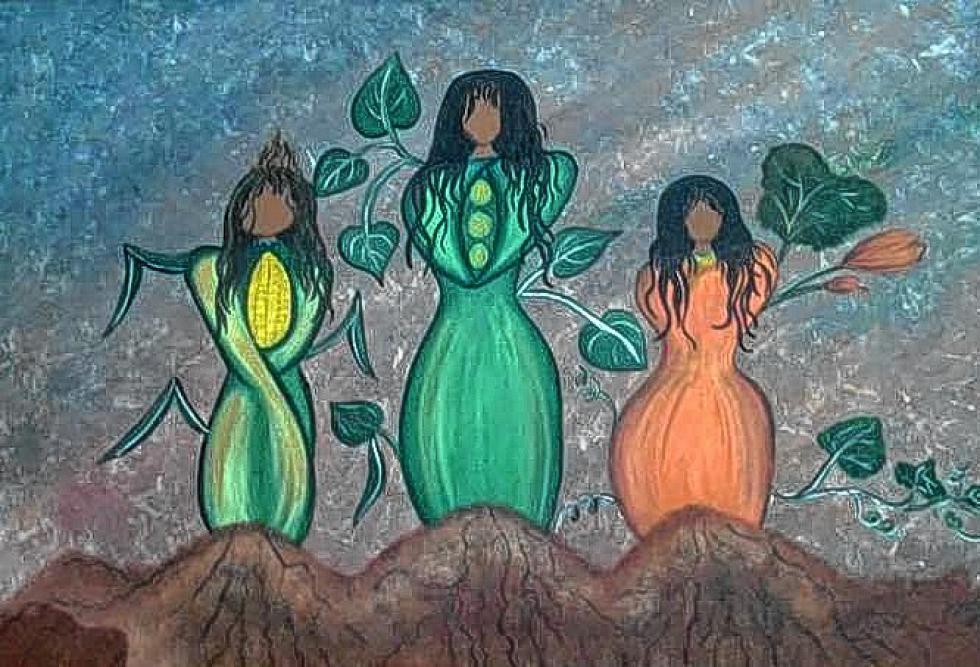
A legend tells of Indigenous people who were suffering from hunger during an exceptionally long winter. One snowy night, three beautiful women came to visit. One was tall, dressed in yellow with long flowing hair, another wore green, and the third wore an orange robe. They sought shelter from the cold and were invited to sit by the fire.
There wasn’t much food, but the family shared what they had with the mysterious visitors. In gratitude for their generosity, the three sisters revealed their true identities as corn, beans, and squash, then gave themselves to the people so they’d never go hungry again.
The true beauty of the story is that the Three Sisters represent far more than three random food crops. They comprise a synergistic garden trio that epitomizes companion planting. Like the legend, this genius method originated with Indigenous people, whose closeness to nature inspired this amazing botanical analogy of reciprocity and cooperation.
“The organic symmetry of forms belongs together; the placement of every leaf, the harmony of shapes speak their message. Respect one another, support one another, bring your gift to the world and receive the gifts of others, and there will be enough for all.”
If you’re unfamiliar with gardening, here’s how it works: The corn provides a trellis for the beans to climb while the squash’s huge leaves provide shade that discourages weeds and helps retain moisture in the ground. Furthermore, beans host nitrogen fixing bacteria, which benefits the corn, while the squash’s prickly leaves discourage caterpillars and some insects.
And it gets even better. The trio is nutritionally sound. Corn and beans combine to form a complete protein while squash provides additional vitamins in its carotene-rich flesh. Utilizing mostly vertical space, even a small garden can yield not only a generous harvest, but a reasonably balanced diet as well.
Some add sunflowers , expanding this harmonious group to a quartet. You can find detailed instructions on how to plant the Three Sisters here. The site includes various patterns developed by Indigenous tribes in different geographical areas. Some include sunflowers for yet another dimension of function and beauty. Note you do not plant them all at once, but give the corn a chance to get established, i.e., about four inches tall, before planting the beans to assure it has the strength to support the vines.
Depending on how long the growing season is in your area, it is a bit late to get started, but could be worth a try. With a potential food shortage looming due to the price of fuel, if nothing else use this Native American wisdom to stock up on dried beans, canned corn, and winter squash at the grocery store, even if you can’t grow your own. The trio produces an appealing culinary chorus as well.
If you’re just learning about the Cheyenne (Tsistsistas), this book is likely to be considerably over your head. I’m glad that I read Book One of Peter J. Powell’s “Sweet Medicine” first, which went into enough detail to make this one a good follow-up, though Powell’s Book Two, which I am currently reading, would have been helpful, too.
The author, Karl Schlesier, is a German anthropologist who did a tremendous job researching the existing body of knowledge on the subject, including that of George Grinnell and Powell, then synthesizing it with his own research to arrive at some interesting and well-founded conclusions.
One thing he establishes is that the Tsistsistas were in the northern Plains from about 500 B.C. to A.D. 800. Their language is in the Algonquian family, which the archaeological record indicates first manifested in North America around 8000 B.C.
So when the Cheyenne claim the land was given to their ancestors thousands of years ago, Schlesier has shown that be true.
In her book “Braiding Sweetgrass,” Robin Kimmerer pointed out what it meant to be indigenous to an area. Those of us like myself who has lived in numerous locations have difficulty relating to this concept. Yet those who are living in the same town or region where their grandparents or other ancestors were born, lived, and are now buried, may comprehend what that means.
If your entire life, as well as that of generations of your family, has been spent in a specific area, there’s a sense of ownership, attachment, and love for the land and all it represents.
I’ve been a “move-in” various times and the “locals” always scope out newcomers with a jaundiced eye. To an outsider this feels somewhat clannish, projects a sense of seniority or even superiority. They may appear friendly, but you know you’ll always be suspect and never make it into the “inner circle.”
I lived in a small town in Northern Utah for 15 years and was always considered a move-in by those whose great-grandparents founded the town in the 19th century. Where I live now in Central Texas has similar vibe. I shudder to think what it would be if they realized that by birth I’m a Yankee! They think I’m from Houston, but even that doesn’t count.
City folk are suspect, too.
Put yourself in the local’s shoes for a moment. First of all, move-ins change things. For example, they may scoop up land for sale by a local farmer who’s decided to retire. None of his family members are interested in agriculture, so he sells for a good price and retires in town. Good news for the farmer. However, for his neighbors and community at large, what happens when the buyer is a developer who proceeds to put in a large tract of new homes complete with a few shopping centers?
Community development leaders in small towns, who are often likewise move-ins, are often guilty of the same thing. Their goal is to build up the economy and make money. They don’t care that they are forever changing the lifestyle of people whose roots go back a century or more. More than once I’ve purposely moved to a rural location only to have it build up over the years, heading toward the environment I purposely left. Currently, Austin, Texas is creeping closer and closer to my Hill Country retreat. I wasn’t born here, but I don’t like it, either.
Now think about the Cheyenne, who’d been given their land by their creator god, Maheo, thousands of years before. Furthermore, the concept of land ownership by indigenous people is entirely foreign. Then one day the white man comes along, tells them they have to leave, and proceeds to call them savages when they fight to keep it.
Thousands of years, folks. Thousands of years.
If some foreigner turned up on your land and told you to leave, what would you do?
So this book validated the fact that the Tsistsistas did indeed occupy the northern Plains, including parts of Montana, North Dakota, and Canada for millennia.
Literally.
The main focus of this book is to describe an ancient ceremony known as the Massaum. Its complexity and production requirements rival any pageant, to say nothing of its symbolism. It’s most basic tenet is that of an earth-giving ceremony, in remembrance of what they were taught by their Creator and how they were told to live. (For comparison, think of how many thousands of times the Christmas Story has been retold in pageants.)
The Tsistsistas summer ceremonial period was timed by the respective heliacal risings of the stars Aldebaran, Sirius, and Rigel. The fifth day of the Massaum began upon Rigel’s rising, a magnificent blue star. The author states, “In the Massaum, the blue star design . . . was painted on the buffalo skull placed on the deep earth on the west side of the wolf lodge and on the faces of [the participants.]“
While he never states it explicitly, my conclusion is that this is the design found on the Cheyenne flag, in this case white on a field of blue, with blue the color associated with Maheo. I found this extremely fascinating because I’d wondered what the symbol’s origin was and this fit beautifully.
It also clearly incorporates the cardinal as well as the four sacred directions (southeast, southwest, northwest, and northeast) tended by the maheyuno, the four sacred guardians of the Universe.
How cool is that? Gives it a lot more depth of meaning, other than an unusual geometric design that’s a bit hard to describe.
The author definitely did his homework and painted a fascinating picture of the Tsistsistas as an ancient culture with rich traditions and ceremonies. From time to time he’d digress into the practices of other tribes, which didn’t necessarily add anything to the Cheyenne story other than the interesting fact that indigenous tribes in Siberia share numerous things in common, suggesting similar origins.
This book is not a light, leisurely read any more than Powell’s “Sweet Medicine” volumes unless you love the scholarly details behind Cheyenne culture. If you’re seriously interested, you won’t be disappointed. For me it’s research material for Dead Horse Canyon Book 3 along with a huge pile of other books. I’m one of those crazy authors who enjoys the research phase as much as weaving it throughout the story itself, with various factoids having a way of enriching the plot. If you’re so inclined, you can find it in paperback on Amazon.















 The Curse of Dead Horse Canyon