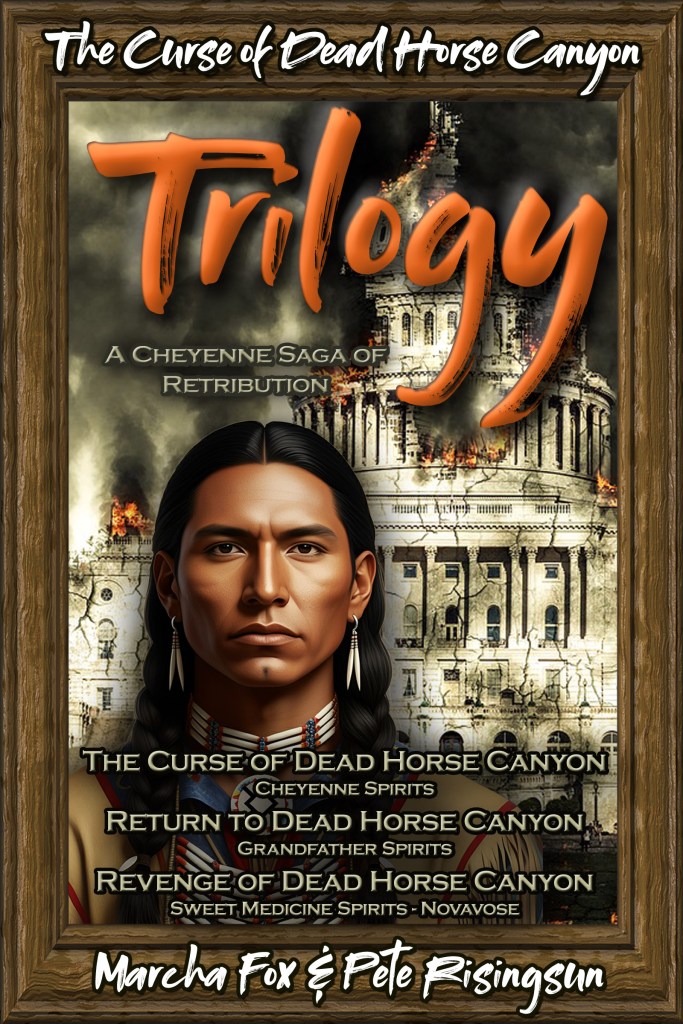
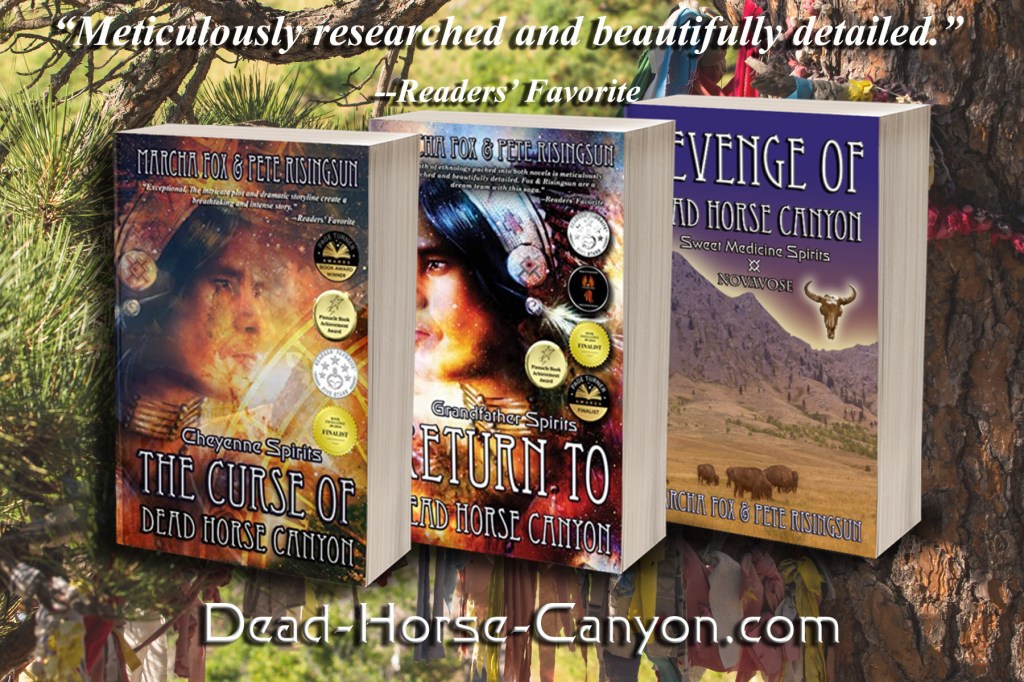
Grab your reading glasses and find a comfortable chair! Reader’s Guides for all three books in The Curse of Dead Horse Canyon Trilogy are now complete! You can download each one in pdf format below as well as on each book’s respective page on this website.
Note that there are two for each book. The “Thematic” version is much shorter and addresses the book as a whole. The Reader’s Guides are more comprehensive, especially for Books Two and Three. These proceed chapter by chapter while they’re grouped for Book One.
Just for fun, trivia, a playlist and even a few recipes are included. Why? To further relay the tone, feeling, and in some cases, taste, of the books.
Along those lines, here’s a link to some indigenous music I love to get you in the mood. It’s not Cheyenne, it’s Australian, but who can resist that beat? Why is it here? This is what Charlie and Sara are listening to when they’re searching for Bryan’s data! This scene is found in Chapter 42, Canopus, of The Curse of Dead Horse Canyon: Cheyenne Spirits.
This trilogy not only lent itself to reader’s guides, but demanded them. Why? Serious readers, including book club members, crave a deep dive into complex stories. This trilogy is loaded with characters, each with their own agenda. So many that a dramatis personae was included in each book to help keep them straight. Greedy oil barons, corrupt government officials, and lobbyists on one side with charismatic indigenous men and women reestablishing a culture white men tried to destroy on the other–plus a wide variety of other supporting characters.
Their destiny? Light the fuse on a 19th Century curse.
Here are a few comments from emails I received:
“…intrigued, not only by the depth of the storyline, but by how seamlessly you blend Indigenous prophecy, science, and spiritual awakening. That balance isn’t easy to strike, yet your work does it with power and purpose.”
“You two are such a powerful creative force, and this story is proof of what fiction can be when it’s written with purpose, cultural depth, and emotional honesty. The pacing, the point of view shifts, the drama, the reverence– even the surprising emotional pivots and that healing ceremony…wow came together in a way that felt epic, yet deeply personal.”
“An explosive conclusion blending conspiracy, cultural heritage, and spiritual awakening is an incredible hook. The depth you’ve woven from Cheyenne prophecy to modern corruption creates a narrative that’s both gripping and profound.”
What are you waiting for? Dive in today, armed with a Reader’s Guide that will assure you don’t miss a thing. If you do, it’s okay. Multiple readers have reported reading the books more than once, catching details they previously missed.
And when you’ve finished devouring the saga please leave a review! Reviews help other readers find books they’ll like and help authors as well. If you read reviews before you buy something, then you know how important they are.
The Curse of Dead Horse Canyon: Cheyenne Spirits (Book 1)
If you’ve read any books in the Dead Horse Canyon trilogy you’ve encountered numerous instances where Charlie received a message from something other than another human being. In the Cheyenne culture these messengers are known as the maiyun, or spirit helpers. When I was writing these stories and Charlie would come across one, I always wondered if it was a stretch, my imagination getting out of hand. However, my coauthor, Pete Risinsun, always assured me they were quite typical in his culture.
If we focused on tuning into nature, considering we’re all part of the same greater, spiritual whole, we could hear them, too. You could start with noticing spirit animals, which is when you spot anything from a spider, bird, squirrel, or other wild animal that gets your attention. What is he or she trying to tell you? Often it will relate to one or more of its characteristics that you would do well to replicate. You can find a previous blog on spirit animals here.
If relating to an indigenous culture is too much of a stretch, try reading about the experiences of someone from a more familiar western way of life; someone whose work provides a bridge of sorts between the two belief systems. One I’ve learned from is medium, Rob Gutro, who has first-hand experience with the world of spirits.
I first discovered his books when I stumbled upon his “Pets and the Afterlife” series after losing one of my fur babies, an 18 year old Bengal named Ophelia. He not only channels humans, but pets as well, providing information he couldn’t possible know or understand, yet has meaning to grieving pet parents. I found considerable comfort in the stories, which include information on signs to watch for that your pet is paying you a visit from beyond the Rainbow Bridge.
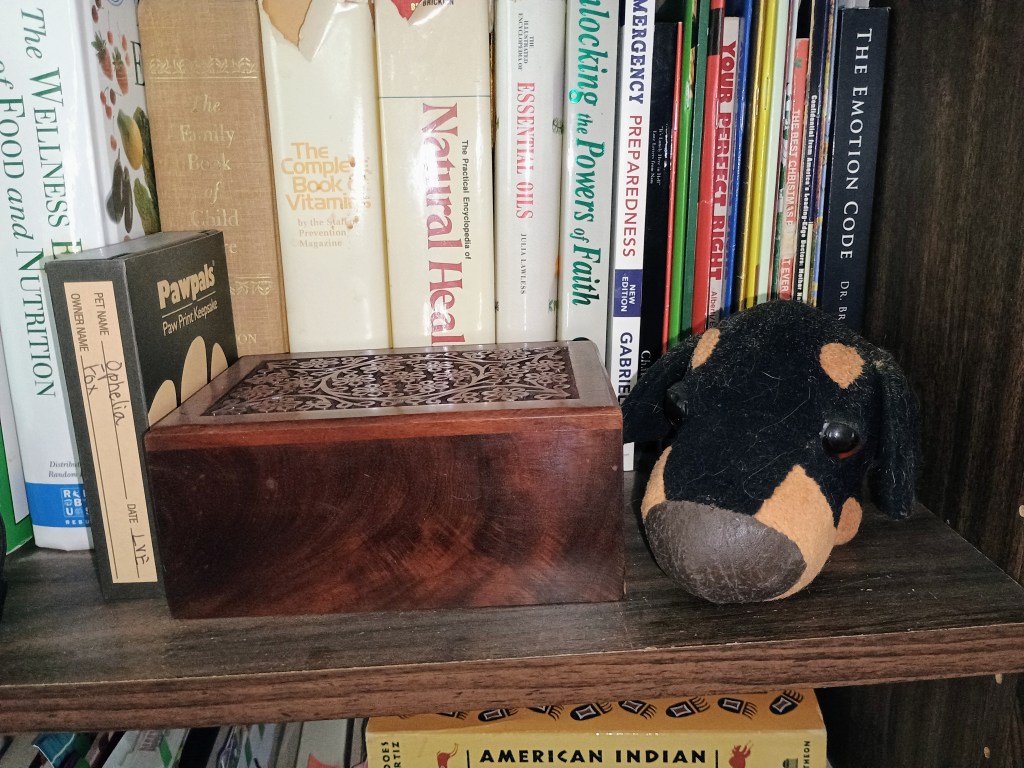
Indeed, shortly after reading the first book in that series, Ophelia did, indeed, come to visit one night. I have her cremated remains on a bookshelf in a little wooden box. Next to it is her favorite toy that she used to carry around. When she did, she would meow as Bengals do which, with the toy in her mouth, came out as a distorted blood-curdling yowl.
She loved her “baby” and often slept with it. And one morning, when I got up, her “baby” was on the floor. There was no other way it could have gotten there since it was out of reach of my other two cats. Furthermore, there was a chair stacked with pillows in front of it, so it should have fallen on top. If one of the cats had jumped on it, the pillows would have fallen. However, the toy was not only on the floor, but underneath the chair.
I’m sure she’s come by other times as well, most likely with her much larger brother, who passed in 2020, which I suspect is what’s going on when my other two cats are staring with wide eyes at something I cannot see.
If you have ever lost a beloved pet, I highly recommend this series. I had the first two books, both of which I’ve given away to friends and family when they were grieving a similar loss.
Thus, when I encountered another of Gutro’s book, “Kindred Spirits: When a Medium Befriends a Spirit” I was fascinated. The other books were very informative about the Spirit World, so I wondered what else I might learn. A few details came out that were new and directly related to the Cheyenne concept of maiyuns.
One very basic concept is that our deceased loved ones are not as far away as we may think. He explains how spirits are those who “go into the light” when they pass while ghosts remain in a fixed location for some reason known only to them. Sometimes they’re lost or confused and can be helped to cross over, which Gutro has done on occasion.
If you’ve read the Dead Horse Canyon books, you may recall White Wolf and Charlie talking about doing that in book 2 when they drove to Billings to get a new alternator for the Explorer and perceived spirits along the highway, which according to Gutro’s explanations, would have been ghosts.
Gutro noted that spirits can interact with anything living. There are various instances in the trilogy where Charlie encountered just that. What comes to mind is whether it was the spirit of the aspen tree (Book 1, Chapter 6), or the squirrel (Book 3, Chapter 43) that spoke to him, or was it a spirit of one of his ancestors prompting the interaction?
According to Gutro, visiting spirits often leave something for you to find, like a coin. In most cases its date will relate to the person in some way, such as their birth or death year, or other key time, for example when you met. Such an example in the books is the arrowhead Charlie came upon during a trail ride. (Book 2, Chapter 39). Later, in Book 3, White Wolf told him that a maiyun spooked the horse so that he would fall off and find it.
Gutro also mentioned how a person’s energy is retained in their cherished possessions. This is what “sentimental value” is all about. What do you have that is quite possibly just sitting around collecting dust, but you simply can’t get rid of it because it means something to you or did to someone you cared about and is now gone?
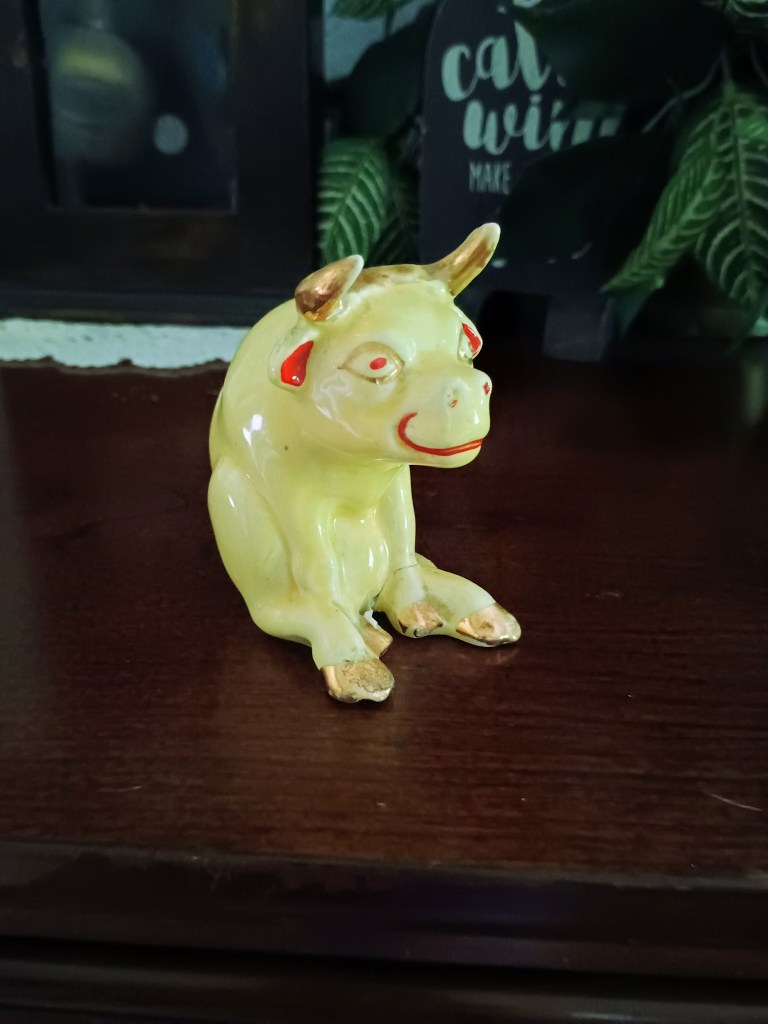
Here’s an example of such an object I have doing just that. That little knick knack,
which is older than I am and at one time cost $0.79, which is inked on the bottom, belonged to my mom. As long as I can remember it sat on the kitchen windowsill. I have no idea what it meant to her or why, but it was always there, and has been broken and repaired numerous times. For whatever weird reason, I think I would protect that little bull with my life! (Maybe not, but you get the idea.) Something about that little guy touches my heart.
Not long ago, a friend sent me something and when I received it I could feel the affection it contained. That made me rethink my usual practice of having presents drop-shipped to save money rather than reshipping them myself. Should I be infusing these gifts with affection, like Star did with the gifts for Sara and her family in Book 2? And what about Amasani’s blanket, (Book 1, Chapter 24) that conveyed her love and comfort to Charlie?
I can’t help wondering about trickster maiyuns, like the ones that always caused minor household problems whenever White Wolf and Charlie were away from home. If you’ve ever had a friend or relative who was prone to practical jokes, could that be their origin? Still up to no good in the afterlife?
Gutro’s knowledge of the Spirit World has vast similarities with what the Northern Cheyenne and other indigenous cultures not only know but take for granted. Spiritually enlightened people continue to remind us we are all connected and love is the strongest energy there is. We can always hope that daily living spirituality is making a comeback.
The real question is not only why but when was it lost to the white man, but not indigenous people?
History undoubtedly holds the answer.
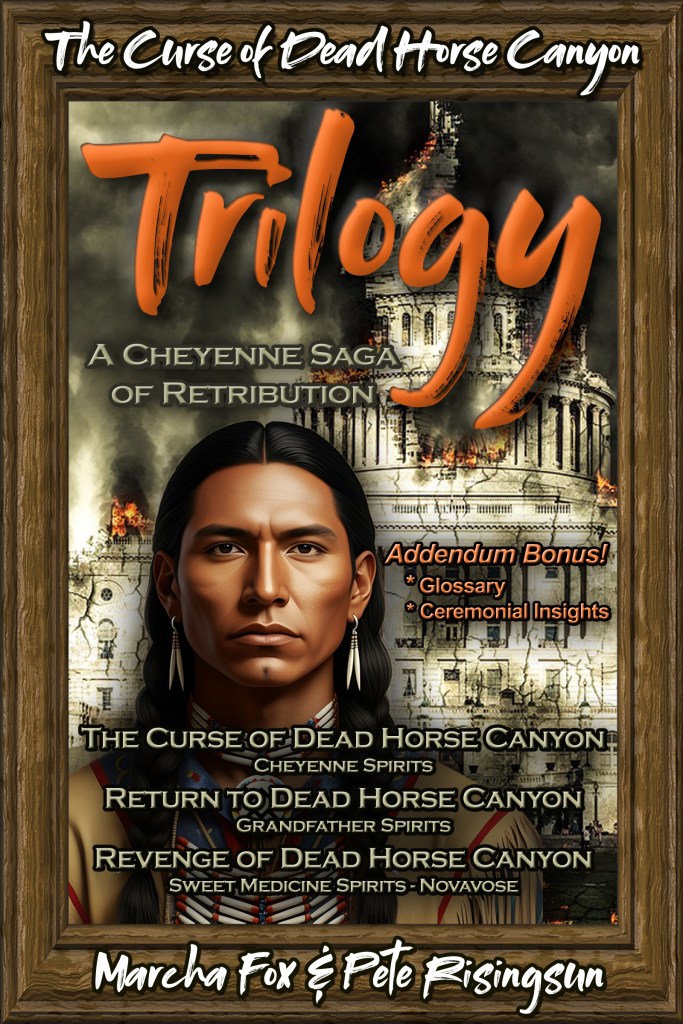
[Note:–The Dead Horse Canyon Trilogy mega-ebook that contains all three Dead Horse Canyon volumes is now on Kindle Unlimited! If you haven’t yet indulged in this series and don’t have Kindle Unlimited, you can get your copy for only $7.99, a 38% savings over buying the ebooks separately, plus a special addendum is included.]
Have you ever wondered how Pete Risingsun, a Northern Cheyenne elder living on the tribe’s reservation in southeastern Montana, and Marcha Fox, a science fiction author living in Texas, became coauthors? If so, you’ll want to read the article published by the staff of Soaring Eagle, the charitable organization that supports the Heritage Living Center for Northern Cheyenne elders where Pete resides. You can find it in the Spring edition on their website here. That organization was key to facilitating this incredible partnership that has produced three award-winning novels over the past five years.
Pete and Marcha have never met face-to-face and he does not even have a computer! Phone calls, texting, and snail mail were the vehicles used to communicate, collaborate, and produce over 1400 pages of an incredible three-volume story.
The response to the article was great, as shown by a significant increase in book sales. Of particular interest was a letter, which you can see below, that was sent to Soaring Eagle by a woman who read the newsletter and as a result purchased and read the three books.
The biggest challenge for most authors, especially those that are self-published, is finding their audience. The Dead Horse Canyon Saga is unique, making this even more difficult since it doesn’t fit a single genre. However, with multiple story themes including a government conspiracy, murder, a detailed glimpse at Cheyenne history and ceremony, deep bonds of family and friendship, to say nothing of Charlie Littlewolf’s transformational journey back to his roots, there is something for everyone.
So far the three volumes have captured a total of 13 awards. This includes 5-stars and glowing reviews from Readers’ Favorite for each book, along with prestigious Book Excellence Awards.
Fans of the Longmire series (Craig Johnson’s books as well as the TV series) or the Leaphorn and Chee stories by Tony Hillerman and continued by his daughter, Anne, (novels and the Dark Winds TV series) are likely to enjoy these books. Dead Horse Canyon takes an even deeper dive into native culture and history with characters the reviewer from The Book Commentary described as “lovable,” while an Amazon reviewer of the third book described them as “Characters you will fall in love with. Characters you will fantasize horrible death wishes for with fingers crossed. And sleepless nights as you read it.“
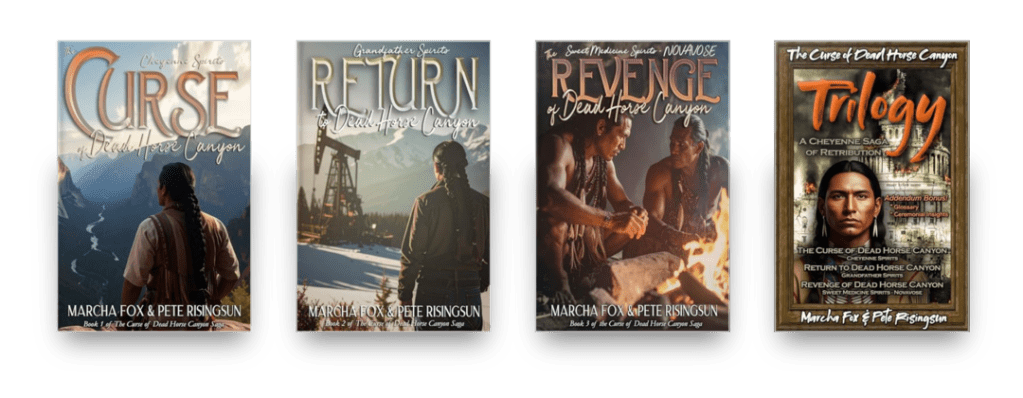
It’s been said, “Do not to judge a book by its cover.” Just in case this is an issue, new covers are coming the end of June! Stay tuned!
I believe that most artists, like myself, are basically insecure. Especially those of us who are perfectionists. We’re acutely aware of any flaws in our work and cringe at their discovery. Nonetheless, authors look forward to readers’ reviews, albeit with fingers crossed, that they’ll be good.
Imagine my horror when my latest release got an abysmal 2-star nasty review! Not only had I made a mistake that she gleefully pointed out, but said it was “long and boring.”
OMG!
Part of what she criticized actually was a mistake (and perfectionist that I am, immediately corrected), but clearly she didn’t have the same experience I had with how some Texans butcher English grammar.
It’s been said that a book doesn’t have true credibility until it has a few “bad” reviews. True as that may be, it’s not much consolation when it’s your book. Especially when it was only the second review posted, so it dragged the rating down significantly, as you can see above.
I immediately turned to people I know who’d read it as well as the previous two books and asked for their honest opinion. I really wanted to know if it was that bad, not fishing for unworthy praise. If it was truly that awful I was ready to unpublish it and do some serious editing. I was told that it was just fine, there was nothing wrong with it, the person simply didn’t “get it.”
Only slightly consoled, I decided to follow the advice of a fellow author’s blog which stated to check out the bad reviews given to some of the classics.
Such as this 1-star review of Hemingway’s “Farewell to Arms” that states, “This is, according to critics, one of Hemingway’s best books. If so, I really cannot fathom his greatness. Really boring book that feels neither exciting nor, for that matter, educational. Just dry…”
That helped.
Then I found this 3-star review for Charles Dickens’ classic, “A Tale of Two Cities:” It’s dense, wordy, and often confusing, making the story tough to follow and, at times, flat-out boring. The writing felt clunky, not lyrical, bogging down the epic scope with unclear details and slow pacing.
By then I was starting to see my reader friends were right. It’s all a matter of “getting” the story’s meaning. Having the mental and emotional depth to comprehend something that’s not the usual straight-line plot loaded with continual action is not every reader’s superpower.
Did being described as “boring” rank me with other great misunderstood authors?
Probably not, but it was a pleasant, albeit fleeting, thought. 😉
The reviewer admitted she’d “skipped” several parts and hated the ending. No doubt by skipping certain parts she missed the context leading up to the finale, detracting from its impact and meaning.
As I write this, I know of at least one reader who is already reading it for the second time. Her first read was a marathon race to whiz through it, just wanting to know what happened. Now she’s reading it to savor and absorb all that it contains.
The book has 569 pages. That is definitely long.
Why?
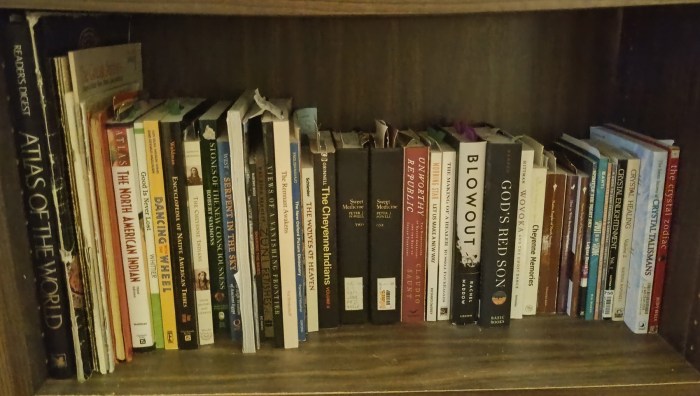
Let’s just say I have more than one shelf filled with books used researching this story along with my co-author, Pete Risingsun.
We read thousands of pages. More time was spent researching and crafting the story than writing it. Our idea of “perfection” was to present an accurate representation of Cheyenne culture, ancient and modern, as well as all they suffered at the hands of the U.S. Government. Their ceremonies have deep spiritual meaning, often beyond the comprehension of readers whose view of Native Americans hails from watching old TV shows like Gunsmoke depicting the “Old West” with its “cowboys and Indians.”
A 5-star review I found for Dickens’ “A Tale of Two Cities” helps explain this syndrome. This wise reviewer states, “I feel that this book is not viewed as being one of the top tier of Dickens works due to the fact that it is thrust upon grade 9 students as an introduction to literary classics and, being so, its impact and overall cultural power has become diluted due to the audience that initially received it. It is not in regards to the content of the work itself. The intellectual abilities of students of this educational level are not able to understand the historical era, appreciate the fluent descriptive nature of the writing nor to comprehend the literary nuances that the author presents.”
And there you have it.
Readers may consider a story “boring” when they can’t grasp its depth, context, and meaning.
Granted, many books lack all three and are the ones I’d be likely to give a 2-star review along with those riddled with typos, poor formatting, grammatical errors, plot holes, and so forth.
Reviews say as much about the reviewer as they do about the book. If they scare away readers like themselves that’s a good thing if it precludes more unfavorable reviews, right?
Forgive me for sounding defensive, but the fact the book earned both a Book Excellence Award and 5-stars from Readers’ Favorite since that horrific review helped restore my confidence. Hopefully, those awards also restore enough credibility for the story to highlight that bad review for what it is.
In the aftermath of that 2-star slam, truly the worst I’ve ever had, I cherish the Readers’ Favorite reviewer’s statement.
“This finale succeeds with a perfect 10 landing. Very, very highly recommended.”
It brought tears to my eyes. Thank you, thank you, thank you!
Needless to say, I’m beyond grateful that she “got it.”
I am very pleased to report that “The Revenge of Dead Horse Canyon: Sweet Medicine Spirits – Novavose” has received both a Book Excellence Award and a 5-star review from Readers’ Favorite. I give tremendous credit to the reviewer, Jamie Michele, who had a heavy task, dealing with the final book in this long, complex saga. I’m beyond grateful she was clearly up to it, however, and comprehended the significance and import of the events. Here is what she had to say:
“The Revenge of Dead Horse Canyon: Sweet Medicine Spirits – Novavose by Marcha Fox and Pete Risingsun is the finale to the Dead Horse Canyon Saga. In books one and two, Sara Reynolds recalls only her husband Bryan’s dying plea to discover his killers after a deadly crash. With the help of Bryan’s friend, Charlie Littlewolf, and ancient ceremonies, they uncover the truth behind Bryan’s murder, sending their lives into turmoil.
“As Charlie roils with conflict over his oil drilling job, he also faces his true destiny on the Northern Cheyenne reservation. Meanwhile, Sara risked her life to expose a government conspiracy that was ready to silence her permanently. Now, Sara fights for survival after the attack that left her paralyzed, and Charlie vows to help her heal. His journey to Bear Butte reveals a destiny tied to restoring the ancient Massaum ceremony. As corrupt officials celebrate a secret facility’s opening, Indigenous leaders gather, fulfilling long-held prophecies that could change the fate of Dead Horse Canyon forever.
“’Do not become afraid when the Sweet Medicine Spirits come to you. Do not disobey them. Be humble and do what you are told.’
“The Revenge of Dead Horse Canyon by Marcha Fox and Pete Risingsun stands out for its sharp writing and complete ability to immerse readers, especially in Charlie’s spiritual transformation. Poor Sara just cannot get a break. Attacked, paralyzed, kidnapped, and then labeled a domestic terrorist and sanctioned! This isn’t just a fight for survival; this is about the power of truth in the face of overwhelming opposition.
“Charlie fits into this description, with a spectacular ceremony for Sara’s healing, but also as a powerful catalyst when he is in the presence of Grandmother Earth and the consequences of his actions. Fox and Risingsun are a dream writing team in every way, and, culturally, this portrayal of Charlie’s heritage is painted from the sky to the smallest pebble and the fire burning in between. The pacing is elevated by point of view shifts and all the drama, but also a surprising relationship transformation as well. Ultimately, this finale succeeds with a perfect 10 landing.
“Very, very highly recommended.”
Every author believes in their work but receiving validation from an objective reviewer who doesn’t know you from Adam is worth its weight in gold. Self-promotion is not my superpower, making me appreciate the kudos even more.
If you haven’t yet read the trilogy, all three volumes are coming out April 18 as a box set ebook on Amazon. You can preorder your copy here.
Waste, fraud, and abuse of federal funds is being exposed like never before. However, if you’ll forgive the cliche, they need to stop throwing the baby out with the bath water.
I worked as a NASA contractor for twenty-one years. I saw a lot of sketchy activities that showed that agency was not immune to corruption. One example I encountered personally was the scheme where someone would come up with an idea, such as a space experiment, satellite, space vehicle, or whatever. The first step in such an endeavor is a concept study. If that passes, then there’s the feasibility study, design study, etc, etc.
I worked on a few of these, which I believed were good ideas. However, just before it would get to the phase where it would actually get built, it would be cancelled. All groundwork was essentially wasted, except, perhaps, if it turned out not to be a good idea after all and thus applied to a future project. What shocked me, however, was to find out in many cases the intent was never to build it.
Rather, it was to line the pockets of people who’d retired (or in some cases, been fired) from NASA (i.e., their fishing buddies) who’d become highly paid consultants. The “Good ol’ boy” system at its best. It was demoralizing enough to work hard on such a study, be enthusiastic for its potential, then have it cancelled. It was even more painful to find out it was never intended to come to fruition, but no more than a high tech boondoggle.
I witnessed too many civil servants whose only work-related activity comprised thinking up busy work for contractors. They loved what they called “metrics,” i.e., an attempt to measure our productivity. Of course we could have done more real, meaningful work, if we weren’t figuring out ways to measure it and report it in a way they could understand it. Most had no clue what we did, so how could they possibly manage it? There were numerous times when we kept the Space Shuttle program running just fine when the civil servants were gone because of one of those budget situation government shutdowns.
Air-to-air view of Columbia, OV-102, atop SCA NASA 905 flying over JSC site NASA ID: S90-55294 S90-55294 (19 Dec. 1990) — Johnson Space Center employees and neighbors on the ground didn’t get quite this closeup of a view of the Dec. 19 1990 flyover of the Space Shuttle Columbia mounted piggyback atop NASA’s Shuttle Carrier Aircraft (SCA–NASA 905). However, hundreds were able to spot it as it passed nearby en route to Florida from California following the successful STS-35 mission. Almost the entire 1625-acre site of the Johnson Space Center is visible in the background, along with a number of businesses and residences in the nearby municipality of Nassau Bay. The air-to-air photograph was taken by Pete Stanley of JSC’s Image Services Division who was a passenger in a T-38 jet aircraft.
Another thing I observed was referred to as “Empire Building.” Civil Servants got promotions based on how many people reported to them. They would claim to need more people than there was work for, just to inflate their numbers. As a contractor manager, I’d be told to hire more engineers when the ones I had barely stayed busy.
Yes, that’s the way it was, in an agency highly admired, especially our youth, even aspired to work for–I know, because I was one of them. I got a physics degree at the age of 39 so I could work there. Sadly, I came away disappointed in many things I saw as an insider, especially the safety area where we knew all the dirty little secrets of why missions failed, inevitable when engineers were ignored by upper management.
Did NASA do some amazing things? Unquestionably! Did I have some wonderful experiences while I was there? Absolutely!
That picture above? I saw that from the ground and it was awesome. But this does not mean that there isn’t a lot of waste that needs to be eliminated. Since I retired in 2009, much has happened already with the retirement of the Space Shuttle Program and availability of commercial rockets.
I could go on and on with examples, but that is not the purpose of this blog. I simply wanted to make a point that what the Department of Government Efficiency (DOGE) is doing is needed and in many respects a very good thing. I recently heard indirectly from someone who works at the Federal Reserve that only about 6% of Federal employees report to an office daily.
What? Really?
More fallout, I suppose, from the COVID-19 debacle, which allowed people to work from home. As a former NASA contractor manager I was well aware that only a small handful of my personnel could be trusted to be productive working from home.
You Don’t Prune a Rosebush with a Chainsaw
However, that said, I believe DOGE may be figuratively pruning a rose bush with a chainsaw. Some of these agencies may be totally worthless, saving the taxpayers from paying for frivolous and even criminal activities, which is desperately needed. But we must remember, for the most part, the majority of agencies had something beneficial for at least some segment of the populace at their core when they were created.
Rebuilding the U.S. economy, creating jobs, and being self-sufficient as a country, especially when it comes to energy, make sense. But I don’t agree with decimating our forests, public lands or environment. Agencies should be pruned carefully with lopping shears at worst, trimmers at best.
For example, laying off Forest Rangers and those who watch over our National Parks, both the wildlife and visitors from around the world, is ill-thought-out. These individuals serve the citizenry! These are not the slackers! C’mon!
It’s my opinion that we need to keep a close eye on what’s being eliminated and speak up when they’re ill-advised for the damage they’ll do. As a senior citizen I have a perspective that those making such decisions may not have. Audit them all, definitely, and cut back as warranted. But let’s bring some finesse into the process before causing irreparable damage.
For example, a petition landed in my email inbox recently about the Environmental Protection Act being totally ignored. You can find it here.
I love nature and wildlife. That’s why I live in the boonies where I can look out my office window and see everything from rabbits, squirrels, and chipmunks to wild turkeys, deer, foxes, and even fisher cats, which I never heard of before moving to Western New York State. True, some are a threat to our livestock, but that’s another story. Trees, diverse vegetation, and wildlife feed my soul.
While the land immediately around me is privately owned, I shudder to think if it were Federal land and some logging company came in and stripped the mountainsides bare. That not only impacts the aesthetics, but the wildlife that calls that forest home.
Same goes for oil exploration. Having lived in Texas for 35 years, I know enough about that industry to recognize how dirty and dangerous it is. Essential, yes. But it could be done in a safer, more discriminatory manner so as to cause less damage. Fracking threatens water supplies with toxic chemicals and has been proven to cause earthquakes. Do we really want our National Parks subjected to that?
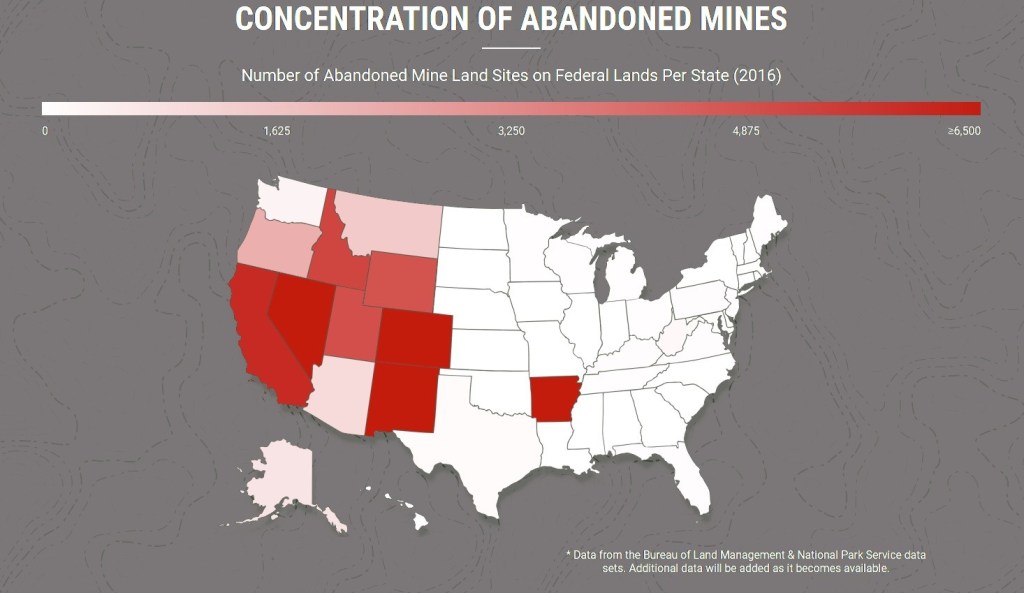
In the 19th Century mining activity in the Rocky Mountains caused considerable damage. These corporations do not care about the mess they leave behind, only profits. Some regulations are essential, which should be enforced with integrity, not bribes, and involve fines that are painful enough to motivate compliance. When I was writing The Curse of Dead Horse Canyon Trilogy my research made me aware of how bad that century-old situation was as well as oil exploration, both situations making it into the plot of the story.
I highly recommend Robin Wall Kimmerer’s “Braiding Sweetgrass” for more perspectives on that issue. You can see my review of this beautifully written book here.
Harming Vulnerable First Americans
Eliminating the Department of Education is another issue. While some research indicates the USA is not “dead last” but 8th out of 41 countries, in 2022, the U.S. ranked 16th in science, ninth in reading, and 34th in math. Not particularly stellar, to say the least.
Having had six children go through public schools, I’m well aware of the flaws in that system, too, e.g. using our children as test subjects (no pun intended) without our consent. Lunacy such as “New Math” and various other indulgences, like not teaching phonetics, and other “experiments” which deprive our youth of a decent education. This has gone on for decades, even predates the Department of Education, much less the “No child left behind” edict, which had its pros and cons as well.
The system, with or without the Department of Education, is deeply flawed. Indeed, they shot themselves in the foot when they started demanding all school districts incorporate the reigning political party’s “woke” agenda and various other idiotologies [not a typo] to which a vast majority of the population objected as proven by the 2024 election results.
Again, rather than throwing the Department of Education away like last year’s test scores, why not fix it? Our “throwaway” mentality should not relate to matters that affect human lives. Granted, sometimes fixing something, whether it’s your car or washing machine, is less cost-effective than buying a new one. But unless an agency is thoroughly corrupt to the core, you don’t delete it without closer examination regarding whether any part of it is worth salvaging.
One useful function of the Department of Education relates strongly to financial aid to poor districts. Its loss will be particularly hard on Native Americans. To quote from a recent email sent out by Native American College Fund president, Cheryl Crazy Bull:
We must raise our voice and let our representatives know that this bill cannot pass.
What you may not realize is that the Department of Education’s main role is financial. Dismantling it would disrupt programs that disburse federal student aid, negatively impacting all students that receive student loans and Pell grants. To qualify for a Pell grant, you must show need and the majority of College Fund and Tribal scholars demonstrate that financial need.
The Department of Education also provides federal funding for public schools and the ability to enforce civil rights protections for all students in education, including characteristics like disability, religion, and sex.
Native students are at the center of this attack and will experience tremendous hardships.”
If you don’t know how to contact your representatives, you can find that information here.
This very useful tool also includes your state officials, who often need prodding as well.
Getting rid of corruption is important. Saving taxpayers from enriching crooked politicians is essential. But the government is expected to provide some services. We just need to make our voices heard demanding that it be done in a wiser, more selective and sensitive manner.
In closing, as citizens, what we allow will continue. Whether its waste, fraud, and abuse or cutting things back so brutally and thoughtlessly that we never recover what good there was.
My method of writing is generally referred to as a “pantser,” i.e., I write by the seat of my pants. The other prevalent writing style that of a “plotter,” where the author determines the entire story, scene by scene, in an outline. I tried plotting, but my characters persistently got out of hand. They’d refuse to follow my plan and do their own thing. It didn’t take long to discover they had a better grip on the story than I did. Thus, I became a “pantser.” I populate my story idea with characters, then sit back to watch what they do as would a dutiful scribe.
I began work on this saga before connecting with my co-author, Pete Risingsun. I had a handle on the story’s government conspiracy angle, but lacked cultural knowledge of my main character, Cheyenne Charlie Littlewolf. I wrote what he told me to, but didn’t know whether it was feasible.
As a science fiction author, I wondered.
Was my imagination getting carried away?
I tend to obsess over accuracy and can get carried away with research. I started reading books on Native American cultures, but I needed to find a Cheyenne elder who could let me know if what I had written from Charlie’s point of view was accurate or too off-the-wall.
When Pete got involved he assured me that the various incidents I’d included were indeed realistic in the Cheyenne world. I smiled, relieved to learn Charlie was not leading me astray.
One incident that I wondered about is depicted in chapter six, “The Aspen,” of the first book, “The Curse of Dead Horse Canyon: Cheyenne Spirits.” It’s there that Charlie receives a message from the aspen tree that witnessed the wreck that killed his best friend. Besides numerous others, another one of my favorites is in the second book, “Return to Dead Horse Canyon: Grandfather Spirits,” where in chapter thirty-nine, “Trail Ride,” Charlie finds an ancient arrowhead that tells him and his brother, Winter Hawk, (cousin in western culture), that their prayer regarding the fate of the murderer had been heard.
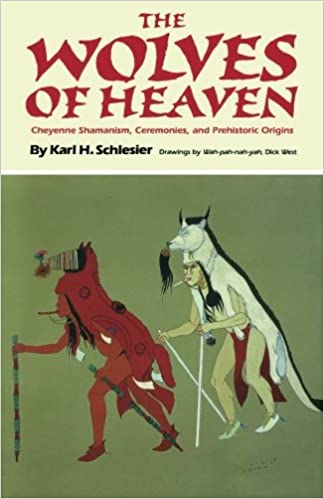
As work on the saga continued, more and more research came into play. The works of George Bird Grinnell as well as Peter John Powell were excellent sources, but had limitations. I find it ironic that some of the most detailed information on ancient Cheyenne (Tsistsistas) beliefs and ceremonies is conveyed by German anthropologist, Karl H. Schlesier. His book “The Wolves of Heaven” was priceless while writing this trilogy, especially his detailed description of the Massaum, the Earth Giving Ceremony, that plays a key role in the final volume. In a typical episode of serendipity, I found Schlesier’s book on Amazon, attracted by its subtitle, “Cheyenne Shamanism, Ceremonies, and Prehistoric Origins.”
Or was it a maiyun who brought it to my attention?
What is a maiyun?
Schlesier tells us they are powerful spirits that associate with human beings. There are also the hematasoomaeo, which he describes as “the immortal spiritual forms of plants, animals, and human beings. . . .The maiyun most responsible for physical life on earth belong either to the deep earth or to the sky places. In Tsistsistas ceremonies they are celebrated especially and represented through plant and animal forms.”
The lodge of the maiyun is the Sacred Mountain, i.e., Novavose. (You’ll meet plenty of them in “Revenge of Dead Horse Canyon: Sweet Medicine Spirits – Novavose.”)
Why have western religions denied the existence of such things? Claim that animals do not have souls, a belief with which any pet owner, farmer, or rancher will disagree? Slowly the world is awakening to the reality of other dimensions; recognizing the thin veil between life and death and the elusive nature of time.
Things ancient peoples took for granted.
Speaking of animals, a few months ago, my precious 18 year old feline fur baby, Ophelia, crossed over. I hoped that when she did, that she was reunited with her half-brother, Hamlet, who’d left this life four years before. Thus, I was drawn to the “Pets and the Afterlife” book series by Rob Gutro. He’s a medium who specializes in connecting with pets in the spirit world. These books contain dozens of stories of such experiences. The truth of what he envisions is validated by multitudes of grieving pet owners when he provides details of the encounter that he couldn’t possibly have known.
As I read Gutro’s books I couldn’t help but think of the maiyun–spirit helpers that indigenous people have relied on for millennia. What are “civilized” people missing by tuning out these messages and connections?
I am beyond grateful for my introduction to this marvelous world while writing these three tomes with Pete. My heart and mind lived there from July 2018 when this story was conceived until the final book was published in January 2025. My life is enriched beyond measure for the experience.
Two of my favorite quotes related to this lost wisdom were spoken by Tȟašúŋke Witkó (Crazy Horse), the Oglala Lakota Leader who said:
The red nation shall rise again and it shall be a blessing for a sick world; a world filled with broken promises, selfishness and separations; a world longing for light again. I see a time of seven generations when all the colors of mankind will gather under the sacred tree of life and the whole earth will become one circle again. . . In that day, there will be those among the Lakota who will carry knowledge and understanding of unity among all living things and the young white ones will come to those of my people and ask for this wisdom.
The Curse of Dead Horse Canyon Trilogy is a lengthy saga that is more than a juxtaposition of a corrupt government’s clash with Cheyenne spirituality. It’s an introduction to a world too many don’t yet see.
But as Crazy Horse declared, they will.
You can find the trilogy on Amazon and other online vendors.
As always, Navajo Wally Brown does a fantastic job in the following video summing up what it takes to be a great leader.
Sad but true, lack of leadership has brought the United States to where we are today. Caring for the people you lead is paramount. Who wants to follow someone who is exploiting their people for power and financial gain and sets a poor example of a moral individual?
Once again, Native Americans have shown that their culture is far superior to what has been the norm in Western culture for millennia.
Leadership starts in the home. Respect for authority is important, but must be earned and deserved. Just because someone has a title does not mean they’re worthy to be obeyed or followed. Do you have the courage to stand for truth?
Like Wally says in the video, leaders are not necessarily born. They are raised. Everyone has the capability with the right training and example. His story about the blind sheep is so apropos for today’s world.
What qualities do you think are essential for a leader? How many of those traits do you have? What can you teach to those around you, especially the youth who will inherit the mess the world is today?
Returning to true principles based on love is the only way.
November is Native American Heritage month! To kick it off, the organization, IllumiNative, has produced a short video highlighting Native American accomplishments.
Our world has so much to gain by recognizing and adopting Native American principles. Take a few moment to browse the IllumiNative website to see the many influences that have not received the publicity they deserve. Native influence is everywhere! Celebrate and share!
Today we recognize September 23, 2022, as Native American Day, the perfect time to honor Cheyenne Culture Hero, Sweet Medicine.
As with most tales preserved by oral tradition, there are different versions regarding Sweet Medicine’s origin. One version (from Cheyenne Memories by John Stands in Timber and Margot Liberty) tells of a young woman who lived with her parents. She had a dream where someone said, “Sweet Root will come to you, because you are clean, and a young woman.” She thought it was just a dream, but it repeated the next three nights. At this point she told her mother who said it was nothing and not to worry.
But as time passed, she began to feel as if she were expecting a baby, which her parents noticed as well. Yet this made no sense, since she never met anyone, other than the voice in the dreams.
When it was time to give birth, she left the village and went down by a creek where she built a small shelter and had a baby boy. Rather than take him home, however, she left him there, since she and her parents were ashamed.
Later that day an old woman was down by the creek collecting rye grass as bedding when she heard the baby crying. She found him and brought him home. Her husband was very happy and said “That’s our grandson. And his name shall be Sweet Medicine.”
The similarities to the virgin birth of Christ are hard to miss. Perhaps this shows a Christian influence creeping into later versions of the story. The Cheyenne’s high moral standards encouraged their women to be virtuous, so would embrace such a detail.
(If you’re a fan of The History Channel’s Ancient Aliens program, you may notice parallels to UFO abduction stories, many of which date back centuries. Native American connections with extraterrestrial visitors are well-documented, including Nancy Red Star’s book, Star Ancestors.)
The version of Sweet Medicine’s beginnings in George Bird Grinnell’s The Cheyenne Indians: Their History and Ways of Life (Volume II) is less dramatic. It states that Sweet Medicine was the second born child of a married woman, but nonetheless a very unusual child and individual.
Sweet Medicine was said to have performed various miracles, from conjuring up a buffalo calf when the tribe was hungry, to being able to elude pursuit by covering vast distances in record time, i.e., shades of Superman’s ability “to leap tall buildings in a single bound.”
Specific laws and ceremonies were among his most important contributions to Cheyenne culture. He organized the original four warrior societies, Swift Foxes, Elks, Red Shields, and Bowstrings. He instituted a sophisticated leadership structure that included ten chiefs from each of the four societies, plus four “old man chiefs,” one of whom carried the sacred medicine bundle he gave them. This brought stability to the Cheyenne that other tribes lacked.
“You chiefs are peacemakers. Though your son might be killed in front of your tepee, you should take a peace pipe and smoke. Then you would be called an honest chief. You chiefs own the land and the people. If your men, your soldier societies, should be scared and retreat, you are not to step back, but take a stand to protect your land and your people.“
He admonished chiefs to be examples of peace and courage. As stated in Cheyenne Memories, Sweet Medicine said, “Listen to me carefully, and truthfully follow up my instructions. You chiefs are peacemakers. Though your son might be killed in front of your tepee, you should take a peace pipe and smoke. Then you would be called an honest chief. You chiefs own the land and the people. If your men, your soldier societies, should be scared and retreat, you are not to step back, but take a stand to protect your land and your people.”
Generosity was another requirement imposed on chiefs. “When you meet someone, or he comes to your tepee asking for anything, give it to him. Never refuse. Go outside your tepee and sing your chief’s song, so all the people will know you have done something good.”
The four Sacred Arrows were another gift along with the sacred medicine bundle. Two arrows were for hunting and two for war, a detailed ceremony provided for renewing their power, which was lost should a Cheyenne murder a member of the tribe.
He taught the complex ceremony known as the Massaum, a.k.a. Animal or Crazy Dance, which bears some resemblance to an origin story among Plains Indians referred to as “The Great Race.” The Wolves of Heaven by Karl H. Schlesier is a comprehensive work focused on the Massaum. As an anthropologist, Schlesier places the ceremony’s origins, and thus Sweet Medicine, in the 500 – 300 BCE timeframe.
So where did Sweet Medicine gain his profound wisdom?
The legend states that Sweet Medicine and his wife disappeared for four years, which was spent deep inside the Sacred Mountain where they were taught by spiritual beings known as maiyun. (This is very similar to stories about other important spiritual leaders as expressed on Ancient Aliens, Season 18/Episode 20, “Secrets of Inner Earth.”)
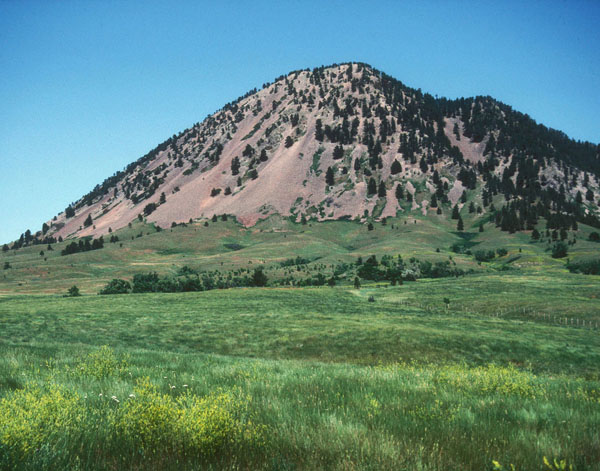
Thus, the tradition arose of fasting on the Sacred Mountain for four days to commune with the holy people. Bear Butte in South Dakota is the Cheyenne’s Sacred Mountain while other tribes have their own versions. There are numerous references to Devil’s Tower in Wyoming in these stories, another location infamous for UFO sightings, as immortalized in Steven Spielberg’s 1977 movie, Close Encounters of the Third Kind.
Cheyenne Sacred Mountain, a.k.a. Bear Butte, South Dakota
Before Sweet Medicine died at a very old, but undetermined age, he gave his final address, which included admonitions along with a prophesy:
“I have brought you many things, sent by the gods for your use. You live the way I have taught you and follow the laws. You must not forget them, for they have given you strength and the ability to support yourselves and your families.
“There is a time coming, though, when many things will change. Strangers called Earth Men will appear among you. Their skins are light-colored, and their ways are powerful. They clip their hair short and speak no Indian tongue. Follow nothing that these Earth Men do, but keep your own ways that I have taught you as long as you can.
“The buffalo will disappear, at last, and another animal will take its place, a slick animal with a long tail and split hoofs, whose flesh you will learn to eat. But first there will be another animal you must learn to use. It has a shaggy neck and tail almost touching the ground. Its hoofs are round. This animal will carry you on his back and help you in many ways. Those far hills that seem only a blue vision in the distance take many days to reach now; but with this animal you can get there in a short time, so fear him not. Remember what I have said.
“But at last you will not remember. Your ways will change. You will leave your religion for something new. You will lose respect for your leaders and start quarreling with one another. You will lose track of your relations and marry women from your own families. You will take after the Earth Men’s ways and forget good things by which you have lived and in the end become worse than crazy.
“I am sorry to say these things, but I have seen them, and you will find that they come true.”
So who exactly was Sweet Medicine?
A real person?
Or no more than another figure in the realm of folklore and mythology?
We may never know, but his prophesy’s accuracy is pretty hard to ignore.




















 The Curse of Dead Horse Canyon