
I believe that most artists, like myself, are basically insecure. Especially those of us who are perfectionists. We’re acutely aware of any flaws in our work and cringe at their discovery. Nonetheless, authors look forward to readers’ reviews, albeit with fingers crossed, that they’ll be good.
Imagine my horror when my latest release got an abysmal 2-star nasty review! Not only had I made a mistake that she gleefully pointed out, but said it was “long and boring.”
OMG!
Part of what she criticized actually was a mistake (and perfectionist that I am, immediately corrected), but clearly she didn’t have the same experience I had with how some Texans butcher English grammar.
It’s been said that a book doesn’t have true credibility until it has a few “bad” reviews. True as that may be, it’s not much consolation when it’s your book. Especially when it was only the second review posted, so it dragged the rating down significantly, as you can see above.

I immediately turned to people I know who’d read it as well as the previous two books and asked for their honest opinion. I really wanted to know if it was that bad, not fishing for unworthy praise. If it was truly that awful I was ready to unpublish it and do some serious editing. I was told that it was just fine, there was nothing wrong with it, the person simply didn’t “get it.”
Only slightly consoled, I decided to follow the advice of a fellow author’s blog which stated to check out the bad reviews given to some of the classics.
Such as this 1-star review of Hemingway’s “Farewell to Arms” that states, “This is, according to critics, one of Hemingway’s best books. If so, I really cannot fathom his greatness. Really boring book that feels neither exciting nor, for that matter, educational. Just dry…”
That helped.
Then I found this 3-star review for Charles Dickens’ classic, “A Tale of Two Cities:” It’s dense, wordy, and often confusing, making the story tough to follow and, at times, flat-out boring. The writing felt clunky, not lyrical, bogging down the epic scope with unclear details and slow pacing.
By then I was starting to see my reader friends were right. It’s all a matter of “getting” the story’s meaning. Having the mental and emotional depth to comprehend something that’s not the usual straight-line plot loaded with continual action is not every reader’s superpower.
Did being described as “boring” rank me with other great misunderstood authors?
Probably not, but it was a pleasant, albeit fleeting, thought. 😉
The reviewer admitted she’d “skipped” several parts and hated the ending. No doubt by skipping certain parts she missed the context leading up to the finale, detracting from its impact and meaning.
As I write this, I know of at least one reader who is already reading it for the second time. Her first read was a marathon race to whiz through it, just wanting to know what happened. Now she’s reading it to savor and absorb all that it contains.
The book has 569 pages. That is definitely long.
Why?
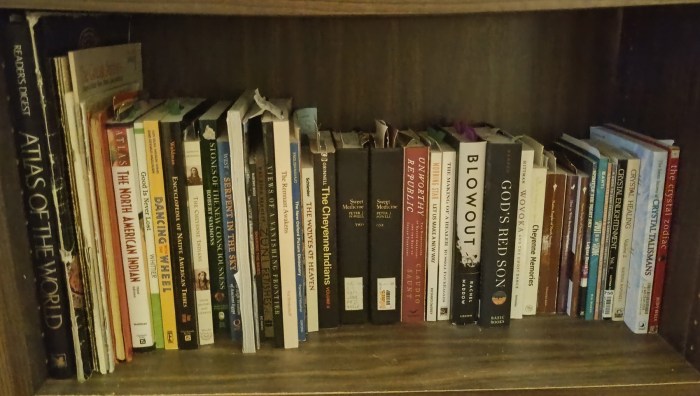
Let’s just say I have more than one shelf filled with books used researching this story along with my co-author, Pete Risingsun.
We read thousands of pages. More time was spent researching and crafting the story than writing it. Our idea of “perfection” was to present an accurate representation of Cheyenne culture, ancient and modern, as well as all they suffered at the hands of the U.S. Government. Their ceremonies have deep spiritual meaning, often beyond the comprehension of readers whose view of Native Americans hails from watching old TV shows like Gunsmoke depicting the “Old West” with its “cowboys and Indians.”
A 5-star review I found for Dickens’ “A Tale of Two Cities” helps explain this syndrome. This wise reviewer states, “I feel that this book is not viewed as being one of the top tier of Dickens works due to the fact that it is thrust upon grade 9 students as an introduction to literary classics and, being so, its impact and overall cultural power has become diluted due to the audience that initially received it. It is not in regards to the content of the work itself. The intellectual abilities of students of this educational level are not able to understand the historical era, appreciate the fluent descriptive nature of the writing nor to comprehend the literary nuances that the author presents.”
And there you have it.
Readers may consider a story “boring” when they can’t grasp its depth, context, and meaning.
Granted, many books lack all three and are the ones I’d be likely to give a 2-star review along with those riddled with typos, poor formatting, grammatical errors, plot holes, and so forth.
Reviews say as much about the reviewer as they do about the book. If they scare away readers like themselves that’s a good thing if it precludes more unfavorable reviews, right?

Forgive me for sounding defensive, but the fact the book earned both a Book Excellence Award and 5-stars from Readers’ Favorite since that horrific review helped restore my confidence. Hopefully, those awards also restore enough credibility for the story to highlight that bad review for what it is.
In the aftermath of that 2-star slam, truly the worst I’ve ever had, I cherish the Readers’ Favorite reviewer’s statement.
“This finale succeeds with a perfect 10 landing. Very, very highly recommended.”
It brought tears to my eyes. Thank you, thank you, thank you!
Needless to say, I’m beyond grateful that she “got it.”
 The Curse of Dead Horse Canyon
You are absolutely spot on!
LikeLike