Beautiful Prose, Beautiful Message

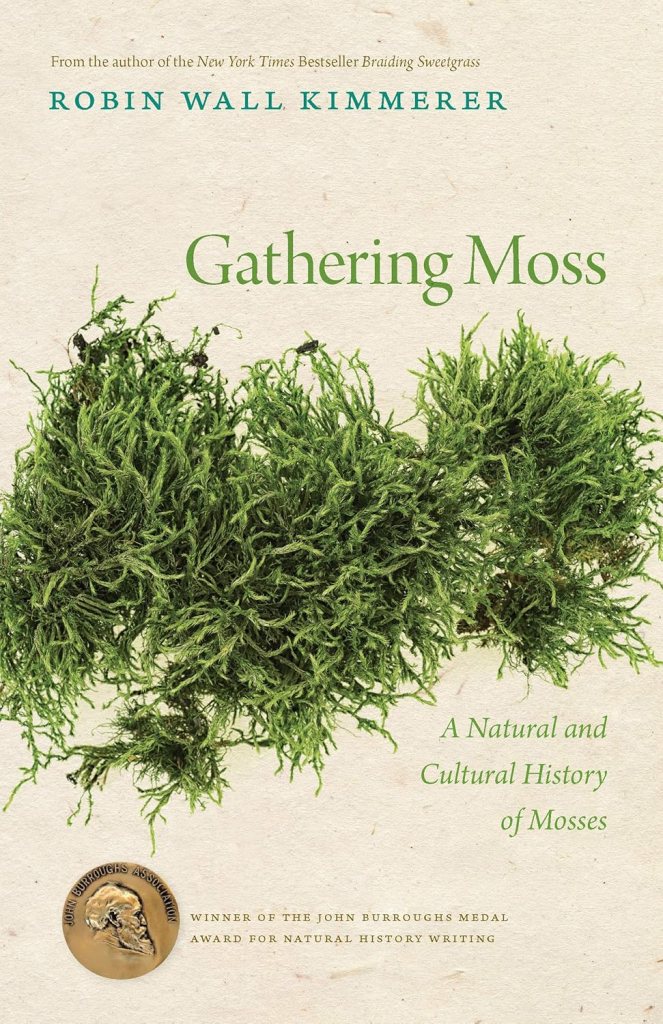
Cover of Robin Wall Kimmerer's book Gathering Moss

Review of Robin Wall Kimmerer’s “Gathering Moss: A Natural and Cultural History of Mosses”

This book has so many layers I hardly know where to start. First of all the prose is so beautifully poetic that aspiring writers of any genre should read it as a sterling example of that alone. Her use of analogies and metaphors add so much for the depth it reveals about this incredible author whose indigenous roots shine brightly in her books.

I never would have imagined that there could be that many varieties of mosses or that someone could devote their life and earn a PhD to their study. Our world is full of wonders, many of which are consistently overlooked. The beauty of mosses is clearly overlooked by the average person, myself included.

 I love nature of all varieties, and was fascinated as well as astounded by the botanical side of this book. Who has ever expected more beauty from a moss beyond its soft, velvety touch on tree trunks or an old stone wall? That some mosses you may find are as old as the place they occupy? That they are true home-bodies and don’t respond well to being moved? That they can live for centuries, yet are so sensitive and particular about where they grow?

How many people realize that moss has amazing absorption qualities such that it can hold 60X its weight in liquid? Or that prior to the availability of cloth much less Huggies that ancient woman used it for diapers or sanitary products? If you need a trivia question no one is likely to guess there’s one for you!

Robin’s love for nature is impossible to miss. As a Native American she has a connection to Mother Earth that most white people lack. A couple times when she mentioned a species evolving I had to smile. I guess you can’t get to PhD level without being indoctrinated to the white scientific view of the world to some degree. But surely in her heart she knows that each of these beautiful plants was created as were all the animals and humans.

Her experiences during her research were fascinating. Canoeing through rivers embraced by steep canyon walls, a research center accessible only by boat where she would spend summers with her daughters, a consulting job at some anonymous wealthy owner’s estate who was trying to coerce nature to his will, thinking money alone was enough.

As an integrated whole, this book is like a guided meditation. It’s about so much more than the science of bryophytes. The title has as many layers as the book itself. Like the cliche, “A rolling stone gathers no moss,” it beckons you to slow down and look closer at the world around you.

This book is a masterpiece. Think of it as a walk through the woods on a spring day, not to be rushed, expectations open, or you’ll miss its magic. It’s encouraging to see how popular her books are, that people are seeking a world that those obsessed with power and greed have tried so hard to hide.

You can pick up a copy on Amazon here.
Living in a Gift Economy with Reciprocity and Gratitude

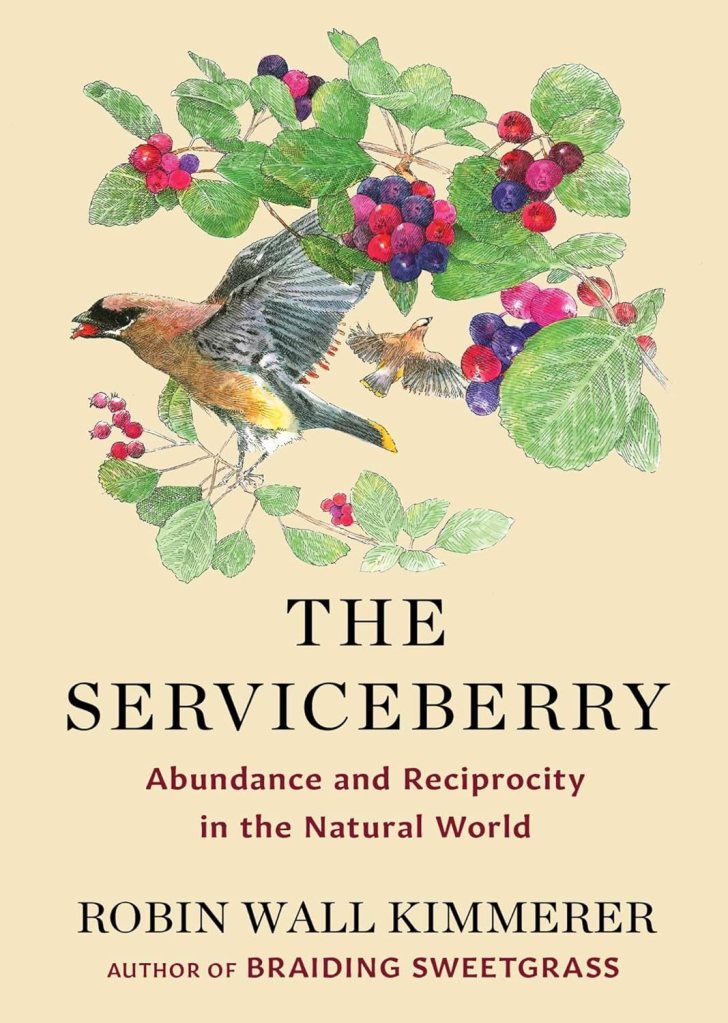
Book Cover of "The Serviceberry"

Review of “The Serviceberry: Abundance and Reciprocity in the Natural World” by Robin Wall Kimmerer

This beautiful little book gives you plenty to think about. The illustrations complement the text perfectly and help convey it’s sweet message. I expected it to be a bit longer, but it’s the expansion of an essay/article done previously.

I love the author’s insights based on her Native American heritage. There is so much wisdom there. The core message of the analogy to the serviceberry is reflected in the subtitle, “Abundance and Reciprocity in the Natural World.” Everything we have and need comes from the Earth as a gift. We should take only what we need. Greed and hoarding are not how nature operates. When do we attain the feeling of “enoughness?”

It’s message is also nicely expressed in Chief Seattle’s quote, “Take only memories, leave only footprints” from a speech he gave on honoring the environment.

Sharing builds friends and community. Giving back benefits both the donor and the recipient. She states, “Gratitude and reciprocity are the currency of a gift economy, and they  have the remarkable property of multiplying with every exchange, their energy concentrating as the pass form hand to hand, a truly renewable resource.”

She tells the story of a little wooden “Free Farm Stand” that was placed by the road where excess produce was left for people to take. The irony was that when winter approached and the stand was shut down, someone took the sign literally and actually took the stand itself! Fortunately, a young man in the area was working on his Eagle Scout Award and planned to build a new one as his project.

Many years ago I lived in a community that dated back to the 1800s where everyone knew each other. Probably more than half of them were related, progeny of the town’s founders. Our children played together, we shared our talents and our harvests. We bartered, eggs for fresh milk and various other exchanges.

This is fairly easy to do in a small community.  She mentions potlatches, which I was not familiar with, so I looked it up. The American Heritage Dictionary defines it as “A ceremonial feast among Indian tribes on the northwest Pacific coast to which the host distributes gifts requiring reciprocation.”

I have seen that on a smaller scale, where you would take a treat or dinner to someone and tell them to pay it forward to someone else as opposed to paying it back to the giver. To think this was a inherent part of Indigenous culture is thought provoking at the least.

These practices are more easily accomplished in small neighborhoods where everyone knows each other. It brings to mind something I read in Nancy Red Star’s book, “Star Ancestors,” about a great migration that occurred thousands of years ago. The people were advised not to stop and build cities, but of course some of them did.

If you look at cities today you can see the wisdom of that advice. In cities people lose touch with one another. Jean-Jacques Rousseau, clear back in the 18th Century, argued that humans were happier and more virtuous in a “state of nature.” Cities, civilization, and fancy social structures just made people fake, greedy, and miserable. He saw city life as the root of inequality and moral decay. He believed living close to nature, simple living, and smaller, self-sufficient communities — not the crowded, artificial world of cities, was the way to live. Centuries later, Henry David Thoreau echoed the same sentiment in Walden Pond.

Going deeper into that subject opens Pandora’s Box, so I’ll leave that for another day.

Indigenous cultures had a beautiful concept of community and taking care of one other. Small communities often operate in a similar manner. Each of us could start with our families by instilling the concept of giving, reciprocity, and gratitude, then expanding it to friends, neighbors, and relatives.

After all, it’s the family where such beliefs should begin.

You can get your copy on Amazon here.

Review of Robin Wall Kimmerer’s “Braiding Sweetgrass”

Robin Wall Kemmerer is uniquely qualified to pen this tome. Not only is she a member of the Potawatomi tribe, she also earned a PhD in botany. Her insights from both perspectives are priceless. These pages are filled with thoughts and wisdom entirely different from the white man’s view of life. Rather than being the superior being, Indigenous people see themselves as part of a greater whole.

Everything is alive in some way, whether vegetable, animal, or mineral. When Indigenous people speak of “all my relations” they are not just referring to other humans. The concept of land ownership was incomprehensible to them, making it easy to fall prey to it being virtually stolen. The Creator had given it to the people millennia before. It belonged to everyone.

She recounted the tragic story often told of Indigenous peoples being driven from their land to desolate places no one else wanted. Of children being taken from their parents and sent to government schools where their hair was cut off and mouths washed out with soap if caught speaking their native language. There are two ways to commit genocide–killing the people or eliminating their culture.

Fortunately, in spite of all the damage done and lives lost, their roots were so strong they endured, like a plant seemingly destroyed by a winter freeze.  Native American cultures nationwide are becoming revitalized. The contrast between their teachings and the ways of the white man speaks for itself. Their way is to honor the Earth; the white man’s way is to exploit it.

Like the senseless killing of six million bison strictly for their hides and horns, meat left to rot on the prairie.

Their legendary figure, the Windigo, represents this. Per the author, “The more a Windigo eats, the more ravenous it becomes. It shrieks with its craving, its mind a torture of unmet want. Consumed by consumption, it lays waste to humankind.”

When Indigenous people found a natural resource, whether plant, animal, or mineral, they took no more than half, allowing the remainder to multiply and bless them again. Everything was considered a gift from the Earth, whether food or means to build a shelter.

 Giving thanks for a gift is part of a civilized life and what they define as the Honorable Harvest.  

Have you ever considered that the food you eat gave up its life for you? Plastic-wrapped meat in the supermarket was once a living being. Vegetables as well. What about the trees that gave their lives for the paper products you use so thoughtlessly?

This book had a profound effect on me and how I see the world. It was both inspiring and heartbreaking. So much damage has been done to the Earth through greed and the Windigo mentality there are no easy answers.

Those who promote restoring the environment are often not honorable in their intent. Technologies that harness wind and solar power exploit the Earth in other ways, through the materials required to construct them. The “Great Reset” proposes tenets that may sound good, i.e. “you’ll own nothing but you’ll be happy,” but depriving people of their freedom and in some cases their lives, is likewise deeply flawed. Again it’s about putting power into the hands of a few. UN Agenda 21 explains how this massive societal change is to be accomplished and it’s horrifying to anyone who understands the implications.

Hard times are coming, as both Christian and Native American prophets have foretold for centuries. This book contains much of what must be (re)learned if we are to survive. I find it interesting that this book was first published in 2013, yet now is a best seller.

Clearly its time has come.

You can pick up a copy on Amazon, where it’s also available as an audiobook.

The Words That Come Before All Else

I am reading “Braiding Sweetgrass” by Robin Wall Kimmerer, a citizen of the Potawatomi tribe. The author is not only a Native American–in addition, she has a PhD in botany and is a decorated professor at SUNY. The book’s subtitle is “Indigenous Wisdom, Scientific Knowledge, and the Teachings of Plants.” Those nine words don’t even come close to describing the insightful treasures it contains.

In one section she compared the Pledge of Allegiance (noting how Native Americans tend to choke on the phrase “liberty and justice for all”) to the Thanksgiving Address, known as the “Words That Come Before All Else.” The author describes it as the “ancient order of protocol [that] sets gratitude as the highest priority. The gratitude is directed straight to the ones who share their gifts with the world.”

The origin is with the Onondaga, a member of the Haudenosaunee (Iroquois) Confederacy, whose constitution was a model for our own. It’s a shame we didn’t adopt their other values as well. Consider how it begins:

Today we have gathered and when we look upon the faces around us we see that the cycles of life continue. We have been given the duty to live in balance and harmony with each other and all living things. So now let us bring our minds together as one as we give greetings and thanks to each other as People. Now our minds are one.

Consider, if you will, how the USA might be a different country today if every session of Congress opened with that phrase. Would toxic partisanism be tearing this country to shreds? It continues:

We are thankful to our Mother the Earth, for she gives us everything that we need for life. She supports our feet as we walk about upon her. It gives us joy that she still continues to care for us, just as she has from the beginning of time. To our Mother, we send thanksgiving, love and respect. Now our minds are one.

Would we treat our planet with more respect if everyone began each day thanking the Earth? Would we drench our Earth Mother in pollution? Would we strip-mine her resources?

We give thanks to all of the waters of the world for quenching our thirst, for providing strength and nurturing life for all beings. We know its power in many forms–waterfalls and rain, mists and streams, rivers and oceans, snow and ice. We are grateful that the waters are still here and meeting their responsibility to the rest of Creation. Can we agree that water is important to our lives and bring our minds together as one to send greetings and thanks to the Water? Now our minds are one.

Native American prophecy declared a century or more ago that the day would come when people would have to buy water. The possibility seemed ludicrous. Yet here we are. Who would dare drink directly from even the remotest mountain stream?

The Thanksgiving Address continues to include all of nature: The Fish life in the water…the Food Plants…Medicine Herbs…the trees…animal life…the birds…the Four Winds…the Thunder Beings…our oldest Grandmother, the Moon…the enlightened teachers…the Creator.

I invite you to read this beautiful testament in its entirety at the end of this post.

Then consider that the people who created this literary work of love and respect were referred to as savages, simply because they fought to keep their ancestral lands. Thousands of women and children were massacred by the military. Treaties were broken by the U.S. Government as a matter of course, “the Indian problem” ultimately solved by forcing them to remote reservations on uninhabitable land. Their languages and customs were outlawed, their children stolen, and “re-educated” in boarding schools where their hair was cut off and their mouths washed with soap for speaking their own tongue. Even today the poorest counties in this supposed “great” country are found on reservations.

Where would we be today if the white man had assimilated their way of life, if our minds had become one? Modern peace chiefs have gone before Congress and the United Nations, warning them where the world is heading to no avail.

Meanwhile, indigenous prophecies relative to the fate of this nation are being fulfilled before our eyes. Their accuracy is startling.

How different it could have been if our minds had been one.