How much do you know about Native Americans?

“Leaving,” Painting by John Stanley, 1920

QUIZ

Most people know little to nothing about the First Americans. If you cannot answer at least three of the following questions maybe it’s time you learned more.

1. How many Indigenous tribes are there in the United States?

A. 15 – 30

B. 30 – 50

C. 50 – 75

D. Over 100

2. Native Americans have their own religion.

(True/False)

3. How many unique Native American languages are there?

A. 4 – 6

B. 7 – 10

C. 20 – 50

D. 50 – 100

4. How many people are enrolled members of recognized tribes in the United States?

A. 100,000 – 250,000

B. 250,000 – 500,000

C. 1,000,000 – 3,000,000

D. 4,000,000 – 5,000,000

5. Which tribe has the most enrolled members?

A. Cherokee

B. Navajo

C. Apache

D. Cheyenne

6. How many places have names that originated with a Native American tribe, chief, or word?

A. 10 – 25

B. 35 – 50

C. Over 100

D. Over 1000

7. Which of the following references do Native Americans prefer the least?

A. American Indians

B. First Nation People

C. Indigenous People

D. Native Americans

——————————————————————————————————————————-

ANSWER KEY

1. ANSWER: D

There are literally hundreds of Native American tribes in the USA! How many can you name? Some of the ones that are most familiar include the Apache, Algonquin, Blackfoot, Cherokee, Cheyenne, Chickasaw, Comanche, Cree, Crow, Iroquois, Mohecan, Navajo, Paiute, Seminole, Seneca, Shoshone, and Sioux.

2. ANSWER: Neither or Both, depending on how you look at it.

Native North Americans consider spirituality a way of life, not a specific religion. In many of their languages, a word does not exist for “religion.” Their spiritual beliefs incorporate all of life, whether animal, vegetable or mineral–even the Earth herself. It includes their treatment of the land, gathering of food, crafting of objects, etc. Rituals, sacred lands, sacred objects, ancestral remains, and all of life are one.

Ceremonies include prayer, fasting, and the sweat lodge, among others. Morality, kindness, generosity, honor, and bravery are all important principles.

The “Lakota (Sioux) Instructions for Living” passed down from White Buffalo Calf Woman states:

Friend do it this way–that is, whatever you do in life, do the very best you can with both your heart and mind.

And if you do it that way, the Power of The Universe will come to your assistance, if your heart and mind are in Unity.

When one sits in the Hoop Of The People, one must be responsible because All of Creation is related. And the hurt of one is the hurt of all. And the honor of one is the honor of all. And whatever we do affects everything in the universe.

If you do it that way–that is if you truly join your heart and mind as One–whatever you ask for, that’s the Way It’s Going To Be.

3. ANSWER: C

There are 32 different language “families” as well as several more considered “isolates.” Language families, which are spoken by many tribes, include: Algonquian, Athapascan, Caddoan, Chimakuan, Chinookian, Chumashan, Eskimaleut, Iroquoian, Kiowa-Tanoan, Kalapuyan, Kusan, Maidu, Miwok-Costanoan, Muskogean, Palaihnihan, Pomo, Sahaptian, Salinan, Salishan, Shastan, Siouan, Timucuan, Tunican, Uto-Aztecan, Wakashan, Washoe, Wintun, Yanan, Yokutsan, Yukian, Yuman, Yakonan.

4. ANSWER: D

In 2000 there were over four million American Indian and Alaska Natives.

5. ANSWER: A

In 2000 there were 729,533 Cherokee; 298,197 Navajo; 96,833 Apaches; and 18,204 Cheyenne

6. ANSWER: D

Here are a few examples, the list far more lengthy than you can imagine.

Native WordTribeMeaning
AlaskaAleutmainland
AlabamaMuskogean“I clear the thicket” or to camp
ChinookChinookTribal Name
ConnecticutMohegan“the long river”
DakotaTribal name“allies” or people also known as Sioux
ErieIroquoian“long tail” in reference to wild cat
KentuckyWyandot“land of tomorrow”
ManhattanTribal name“island mountain”
MassachusettsTribal name“at the range of hills”
MinnesotaSioux“reflection of sky on water”
MississippiAlgonquin“big river”
MontaukAlgonquin“at the fort”
NiagaraIroquois“thunder of waters resounding with a great noise”
OhioIroquoisbeautiful
OklahomaMuskogean“red people”
PontiacOttawaOttawa chief
SeattleDuwamishChief Seatl
TacomaAlgonquin“mountain” or “gods”
TahoeWashoe“big water”
WinnebagoTribal namefrom Algonquian “people of the dirty waters”

7. ANSWER: A

Preferences vary from tribe to tribe, but most dislike being called “Indians.”

ANSWERS SOURCE FOR QUESTIONS 1 – 6: “Atlas of the North American Indian” by Carl Waldman
Research Notes & Bibliography

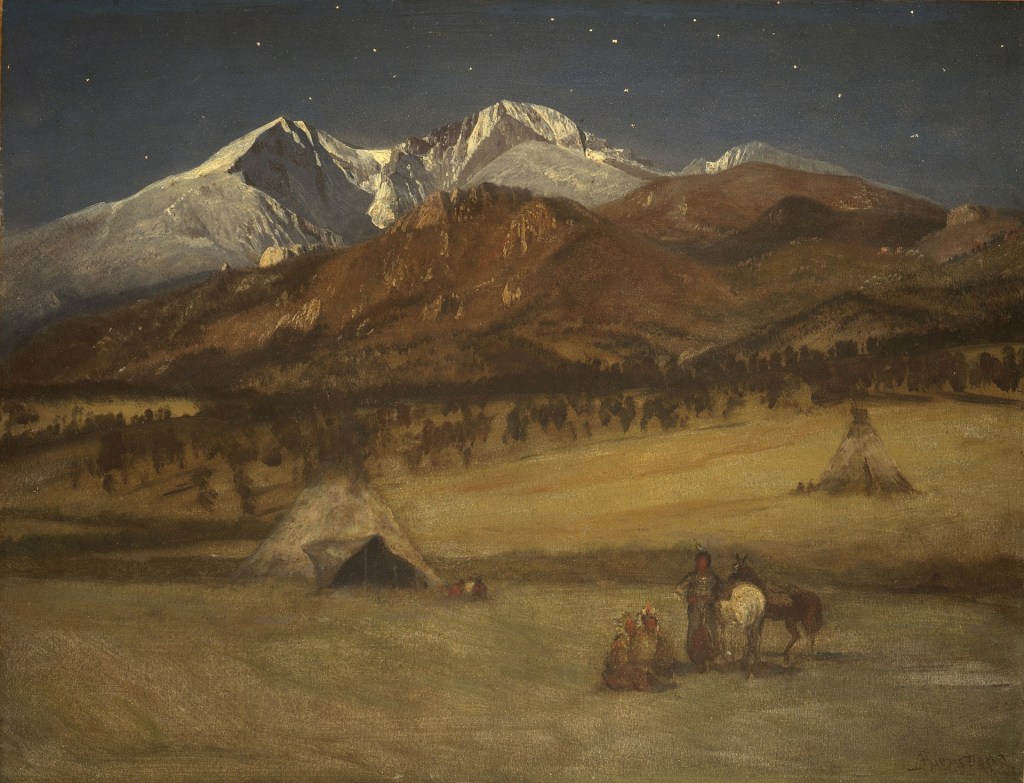
“Village” by Albert Bierstadt c. 1920

The list of websites I accessed researching “The Curse of Dead Horse Canyon: Cheyenne Spirits” is far too long to list. It included such subjects as where to report water contamination issues in Colorado, seasonal wild flowers, fracking risks, and drilling for oil. But by far, the most extensive research related to Native American history.

Quite frankly, I hadn’t given it much thought before. My experience with Native Americans had been limited, but positive. I was aware that reservations harbored numerous issues, but hadn’t considered why. The indoctrination I’d received in public schools as a child had never addressed their side of the story. I didn’t think of it as right or wrong, simply historical fact.

I grew up in the glory days of westerns and tales of cowboys and Indians. I never thought of the latter as bad, only different. Of course in history class they were portrayed as uneducated savages. Medicine men were somewhere on par with witches and sorcerers.

Then a few years ago I read a book that sensitized me to the harsh realities associated with colonization. It at least made me think. Then, as I was writing this book, Charlie Littlewolf came on the scene. That’s how it works in my novels. I get an idea and start writing, then the characters show up. I immediately knew there was a lot to learn about who he was and where

Want to know what really happened? Read this first.

he came from, both genetically and geographically.

So I started reading. I ordered several books, most of which I read cover to cover. The quotes at the beginning of each chapter mostly come from “Great Speeches of Native Americans.” That book literally made me cry as the reality of how Indigenous Americans were treated began to register.

It was nothing short of shameful how many treaties were broken, largely because they weren’t ratified by Congress. The U.S. side of the agreement, which often promised food and other supplies, was never fulfilled, but what the Indigenous people brought to the table was long gone. One Native American noted how he couldn’t understand how there were so many “chiefs,” none of whom were authorized to sign such an agreement on behalf of the government.

A beautiful glimpse of Native American spirituality.

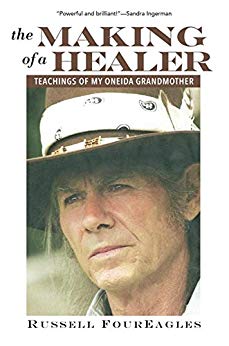
The first book I read on spirit medicine was “The Making of a Healer: Teachings of my Oneida Grandmother” by Russell FourEagles. It was one of the amazingly beautiful books I’ve ever read. For the first time I realized the spiritual nature of Native American beliefs. I knew they believed in a “Great Spirit” but had no idea how that related to how they honored the Earth. If you happened to see the movie “Avatar” a few years back, then you got a taste of their view of life as well as the brutality of colonization, whether on this planet or a distant one.

By the time I’d finished writing the first version of the book I wanted a Native American to read it and tell me if anything was incorrect or culturally insensitive. That goal ultimately led me to my co-author, Pete Risingsun, a Northern Cheyenne who’s well-versed in his culture. He pointed out the many things I had wrong and not only helped me correct it but brought it to life.

Which begs the question, was all my reading prior to finding Pete a waste of time?

Hardly.

Without that background I don’t think we could have communicated as well as we did.

The heartbreaking story of the Northern Cheyenne’s journey.

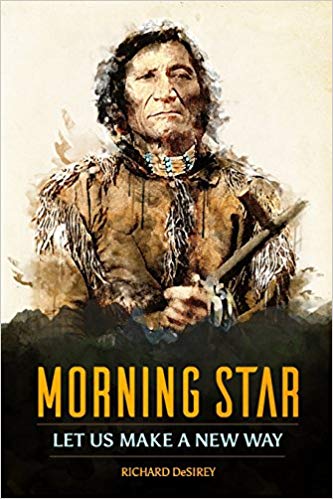
Knowing the history was essential to us being on the same page. The first thing Pete did was send me the book “Morning Star: Let Us Make a New Way” by Richard DeSirey, which told the story of the Northern Cheyenne. Northern Cheyenne traditions, rituals, and ceremonies are very specific and often differ from those associated with the Southern Cheyenne. His knowledge was worth his weight in gold.

Nonetheless, for anyone who wants to learn more about Native Americans, here are the books that I acquired and read to a greater or lesser degree before Pete came onboard.

Those with asterisks (*) are those I dub essential reads, plus the DVD course “Native Peoples of North America” from The Great Courses if you really want to know the part of American history you weren’t told in school.

BIBLIOGRAPHY

Bennett, Hal Zina: Zuni Fetishes: Using Native American Objects for Meditation, Reflection, and Insight. ISBN 0-06-250069-4

Blaisdell, Bob, Editor; Great Speeches by Native Americans; Dover Thrift Editions; 2000. ISBN 978-0-486-41122-4*

Brinkerhoff, Val W.; The Remnant Awakens; Digital Legend Press; 2016. ISBN 978-1-7295451-9-5

DeSirey, Richard D.; Morning Star: Let Us Make A New Way; 2017; ISBN 978-1-976355-4-7*

FourEagles, Russell: The Making of a Healer: Teachings of my Oneida Grandmother; Copyright 2014, Quest Books. ISBN 978-0-8356-0927-2*

Lake-Thom, Bobby; Spirits of the Earth: A Guide to Native American Nature Symbols, Stories, and Ceremonies. ISBN 0-452-27650-0

Maryboy, Nancy C. and Begay, David; Sharing the Skies: Navajo Astronomy; Rio Nuevo Publishers, Tucson, Arizona; 2010. ISBN 978-1-933855-40-0

Mose, Don Jr.: The Legend of the Navajo Hero Twins: Illustrated by Charles Yanito: Copyright 2013, San Juan School District, Blanding, Utah. ISBN 1-931489-59-9

Parnwell, E.C.; Translated by Marvin Yellowhair; The New Oxford Picture Dictionary English/Navajo; Oxford University Press; 1989. ISBN 0-19-434362-6

Sun Bear and Wabun; The Medicine Wheel Earth Astrology; Simon & Schuster; 1980. ISBN 978-0-671-76420-3*

Sun Bear, Wabun Wind, and Crysalis Mulligan; Dancing with the Wheel; Simon & Schuster; 1991. ISBN 978-0-671-76732-7

Waldman, Carl; Atlas of The North American Indian 3rd Edition; Checkmark Books; 2009. ISBN 978-0-8160-6859-3

Waldman, Carl; Encyclopedia of Native American Tribes 3rd Edition; Checkmark Books; 2006. ISBN 0-8160-6274-9

Native Peoples of North America; The Great Courses No. 8131 (c) The Teaching Company; presented by Daniel M. Cobb.*

Websites

https://www.powwows.com/top-10-places-authentic-native-culture-lives/*